

Top 9 Business WiFi and Wireless Connectivity Companies in 2026
Compare 9 Business Wi-Fi and wireless connectivity companies in 2026, with a focus on reliability, security, scalability, support, and multi-location business needs.
A network administrator monitoring wireless uptime and coverage across multiple business locations
A dropped connection at a retail checkout or a clinic’s front desk isn’t a minor annoyance. It’s lost revenue, a frustrated customer, and sometimes a lost patient record nobody can pull up. Reliable wireless connectivity is essential for keeping businesses connected across devices, locations, and customer-facing operations. Unreliable connectivity costs small and mid-sized businesses somewhere between $137 and $427 per minute in downtime, and businesses with 20 to 100 employees can face $8,000 to $25,000 in losses per hour when the network goes dark, according to downtime-cost research aggregated by The Network Installers in 2025. Add it up over a year, and the average small business loses roughly $7,800 to internet outages alone.
That math is changing how businesses shop for WiFi. A few years ago, the pitch was all about speed. Now it’s about whether the network stays up, stays secure, and keeps working the same way across every location a company operates. For a single coffee shop, that’s a minor concern. For a business running five, ten, or twenty sites, it’s the difference between a smooth Tuesday and a week of angry calls.
Below are nine companies building business wireless connectivity in 2026, ranked with multi-location reliability, security, and vendor accountability in mind, not just raw megabits.
What to Look For When Choosing a Business WiFi Solution
Related walkthrough
How to Use Claude AI with Blender MCP – Part 2 (Full Tutorial 2026)

Speed used to be the whole conversation. It isn’t anymore. The FCC’s National Broadband Map, updated in May 2025, shows that 110 million homes and small businesses, about 95% of them, now have access to fixed service at 100/20 Mbps or faster, with nearly 7 million more locations gaining access to gigabit-tier service since June 2024. Baseline speed is close to solved for most of the country. What separates a good provider from a mediocre one in 2026 comes down to a handful of other things.
Uptime and reliability commitments matter more than the number printed on a spec sheet. Ask what an SLA actually guarantees, and what happens when it’s missed. Security standards matter just as much. CISA’s guidance on securing enterprise wireless networks calls out WPA3 encryption and proper segmentation between guest, staff, and point-of-sale traffic as baseline requirements, not nice-to-haves. That guidance exists because attackers know small businesses are a soft target: only 47% of SMBs with fewer than 50 employees have any cybersecurity plan in place, and 43% of all 2025 cyberattacks targeted small businesses specifically, per CrowdStrike’s 2025 data.
Multi-site scalability is another filter worth applying. A network that works beautifully in one store but requires a custom build every time a business opens a second or third location isn’t scaling; it’s multiplying headaches. Related to that is the question of support: is there one point of contact, or will an outage mean three separate calls to an ISP, a hardware vendor, and an IT contractor while each one blames the others? Finally, decide whether hardware alone is enough or whether bundled services (voice, data, and wireless together) make more sense for the way the business actually operates.
Businesses working through this kind of infrastructure decision often find it overlaps with evaluating managed service providers for growing operations, since the same reliability and accountability questions apply to both.
1. TailWind Voice & Data

TailWind Voice & Data homepage
TailWind Voice & Data takes a different approach than most names on this list. Instead of selling hardware or a single-site internet plan, it operates on a “Carrier-as-a-Service” model that bundles wireless access, voice, and data management under one contract and one point of contact. For a retail chain, restaurant group, financial office, dental practice, or manufacturing operation running multiple locations, that structure removes a specific and common pain point: the vendor blame game that happens when a site goes down and nobody can say for sure whether the ISP, the router, or the phone system is at fault.
That single-vendor structure is also what makes TailWind’s best business WiFi solutions worth a look for operators juggling more than one address. Access-point design stays consistent across every site, reducing dead zones and slow point-of-sale performance that crop up when each location’s network was set up by a different installer at a different time. For a business owner who has ever spent an hour on hold trying to figure out which vendor to call during an outage, that consolidation alone can be worth the switch.
2. Cisco Meraki

Cisco Meraki homepage
Cisco Meraki holds the largest share of the enterprise WLAN market, an estimated 38.9% as of IDC’s Q1 2026 report, and it’s easy to see why. The cloud-managed dashboard gives IT teams visibility into dozens or hundreds of access points from a single screen, which is a serious advantage for businesses that already employ in-house network staff. Enterprise WLAN spending hit $10.5 billion in 2025, up 11.4% year over year, and Meraki has captured a large chunk of that growth. It’s a strong fit for larger organizations with the technical bench to run it. Smaller operators without a dedicated IT person may find the platform has more capability than they need.
3. HPE Aruba Networking
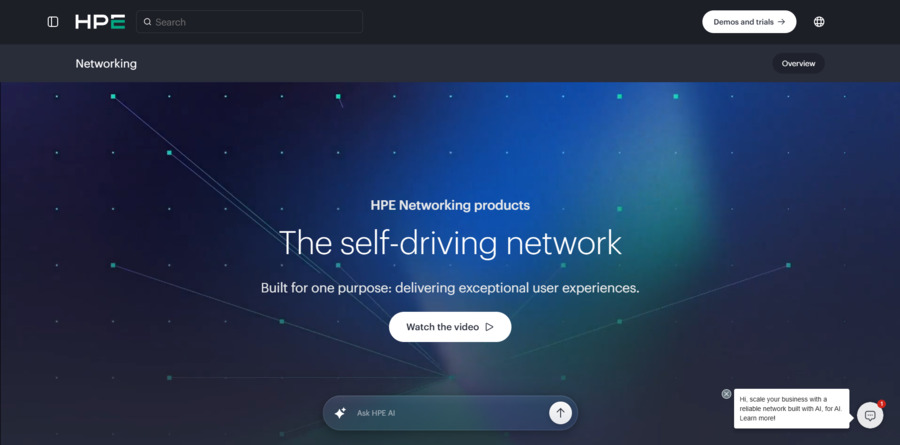
HPE Aruba Networking homepage
HPE Aruba Networking, part of Hewlett Packard Enterprise, is built for organizations that already have real network infrastructure in place. Its mobile access solutions are geared toward large campuses, hospital systems, and enterprises with existing wired backbones that need wireless layered on top. It’s a capable platform, but it tends to make the most sense for companies with the budget and staff to plan a proper deployment rather than businesses looking for something to plug in and walk away from.
4. Comcast Business

Comcast Business homepage
Comcast Business leans on its fiber-backed network and markets 99.99% reliability, along with an optional multi-network failover add-on designed to keep point-of-sale systems and cloud applications running if the primary connection drops. That failover option is worth a close look for retail and hospitality businesses that can’t afford a card reader going dark during a lunch rush. Comcast’s footprint is strongest in markets it already serves for residential and cable service, so availability can vary more than with some nationwide fiber providers.
5. AT&T Business
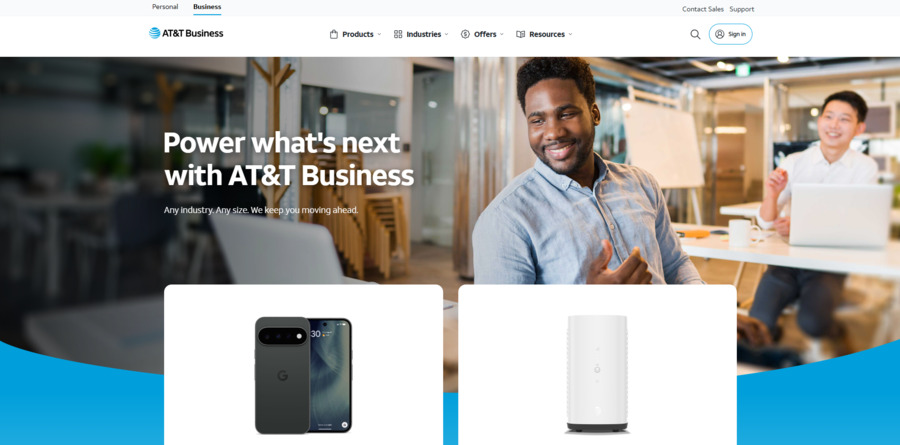
AT&T Business homepage
AT&T Business Fiber topped the J.D. Power 2025 U.S. Business Internet Satisfaction Study among large and medium enterprises, and its multi-gigabit fiber speeds are a genuine draw for data-heavy operations. Businesses that need raw bandwidth for large file transfers, cloud backups, or video-heavy applications tend to rate the service highly. Fiber availability still depends heavily on the building’s location, so confirm coverage before counting on it as a primary connection.
6. Verizon Business

Verizon Business homepage
Verizon Business offers both fiber and 5G fixed wireless access, making it a solid option for companies that want cellular failover alongside a wired connection. That combination matters most for businesses in areas where a single outage type, say a cut fiber line during construction, could otherwise take the whole location offline. Verizon’s 5G fixed wireless has expanded significantly over the past two years, reaching locations that traditional fiber buildouts haven’t reached yet.
7. Ubiquiti
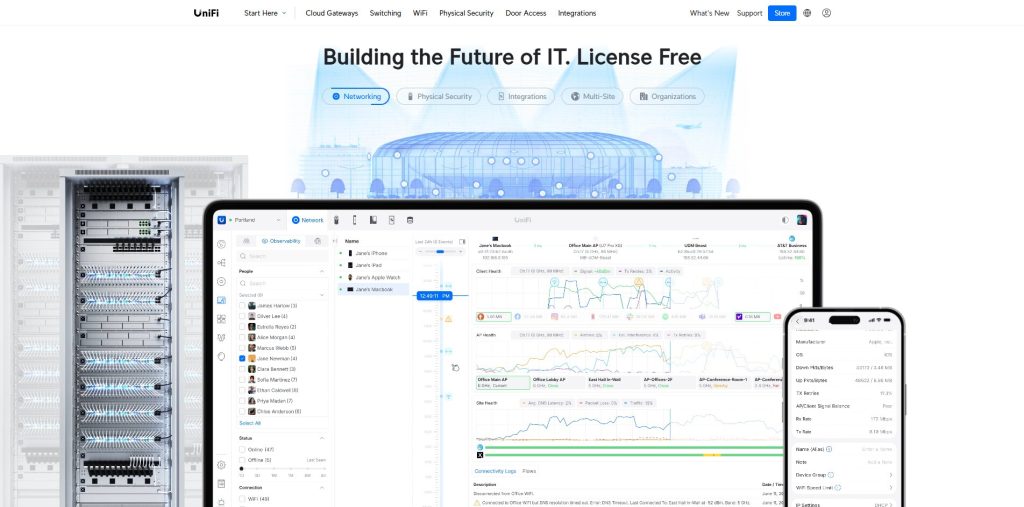
Ubiquiti homepage
Ubiquiti built a loyal following among cost-conscious small businesses through its UniFi hardware ecosystem. The gear is affordable relative to enterprise platforms, and the interface is approachable enough for a moderately technical owner to configure without outside help. The tradeoff is support: UniFi is fundamentally a self-managed system, so a business that wants a managed experience, or that lacks the time to handle firmware updates and troubleshooting internally, will need to budget for outside help or accept more hands-on maintenance than a fully managed alternative requires.
8. Cradlepoint
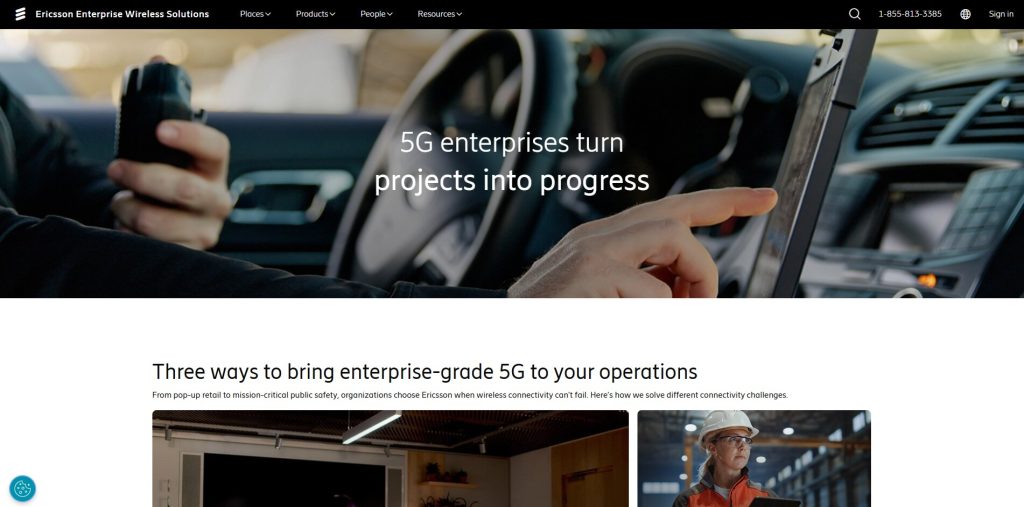
Cradlepoint homepage
Cradlepoint, owned by Ericsson, has built its reputation on 5G fixed wireless access and failover connectivity. It’s a common choice as a backup WAN link for retail chains and field operations that need a connection to keep working even if the primary line goes down, and increasingly it shows up as a primary connection option in areas where wired infrastructure is limited. For businesses whose whole operating model depends on staying connected in the field, not just at a fixed address, Cradlepoint’s cellular-first approach is worth evaluating.
9. RUCKUS Networks
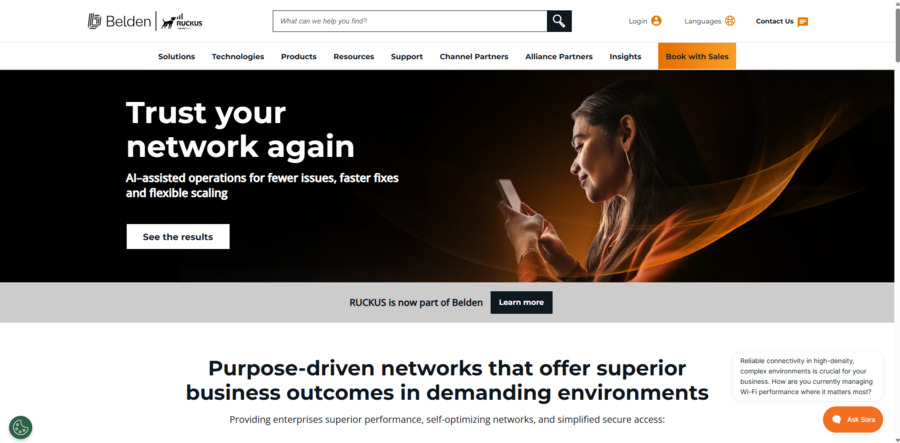
RUCKUS Networks homepage
RUCKUS Networks, now owned by CommScope, built its name in high-density environments like stadiums, convention centers, and university campuses where thousands of devices need to connect at once without the network choking. That specialty makes it less relevant for a typical multi-location retail or restaurant business, but for a single large-footprint location, a warehouse, an event venue, or a big-box store, RUCKUS’s hardware is purpose-built for exactly that kind of crowd.
Choosing the Right Fit
Key criteria to compare before committing to a business WiFi provider
There isn’t one right answer, and any list that claims otherwise oversimplifies. A single location with an in-house IT team and the budget to invest in infrastructure might be better served by a platform like Meraki or Aruba, where the depth of control outweighs the setup effort. A business running one office and comfortable handling its own hardware might prefer Ubiquiti’s lower price point. Neither choice is wrong for the right business.
But for the growing number of companies operating across multiple locations, the calculation shifts. With SMB downtime running into hundreds of dollars a minute and cyberattacks increasingly aimed at small businesses, reliability and vendor accountability start to outweigh raw specs. That’s the gap bundled providers like TailWind Voice & Data are built to close: one contract, one point of contact, and a standardized setup across every site instead of three vendors pointing fingers when something breaks.
Before signing anything, it’s worth revisiting the fundamentals of keeping IT infrastructure secure as teams scale, since a WiFi decision rarely stands alone. It touches security policy, vendor management, and how a business plans to grow. Get that part right, and the network stops being something the business worries about and starts being something it can simply rely on.
Article rating
Was this article useful?
0.0 out of 5 from 0 ratings