

What is whaling phishing and why executives are targeted
Whaling phishing targets executives with fake, urgent emails to trigger fraudulent transfers. Here is how it works and how to stop it.
Whaling fishing refers to sending targeted emails claiming to be a trusted executive or partner within the organization to trick a senior leader into giving approvals to wire transfer, sharing credentials, or disclosing confidential data. It is different from mass phishing emails. Cybercriminals research thoroughly and send highly personalized emails to catch one specific “big fish”, usually a CEO, CFO or head of the department who has financial or data authority.
How does a whaling phishing attack actually work?
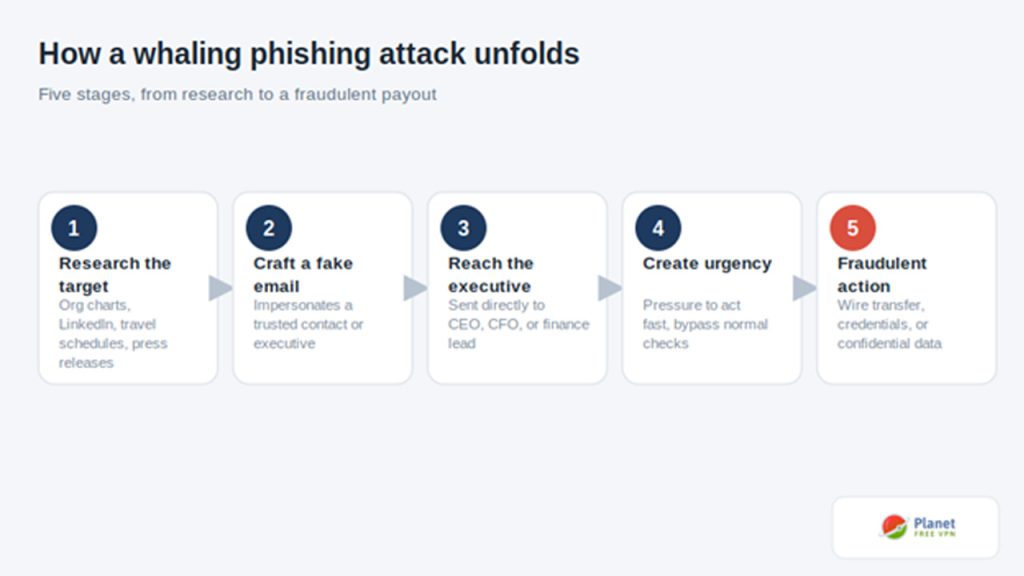
A whaling attack starts with reconnaissance. Attackers find whatever information is available on public forums, such as social media, LinkedIn profiles, press releases, earnings calls, or even out-of-office replies to study a company’s workflow, vendor relationships, and travel schedules to use to their advantage. This type of information gathering is commonly associated with social engineering cyber threats, where attackers exploit publicly available information and human behavior to make their attacks appear more convincing. Then, they draft an email that closely mimics a real contact, often a board member, auditor, or the CEO, and send it to a specific executive or someone involved in the finance chain. The message is usually drafted to create a sense of urgency, such as a pending acquisition, a confidential legal matter, or an unusual but time-sensitive payment. The email looks highly relevant and includes real details, making it difficult to detect at first glance and allowing it to bypass initial skepticism.
Why are executives and senior leaders specifically targeted?
Executives sit at the intersection of authority and access. A CFO can approve a wire transfer without a second signature; a CEO’s request is rarely questioned by staff. Senior leaders also generate a large public footprint — conference talks, interviews, social posts that gives attackers material to sound convincing. Their inboxes are often filled with sensitive information, details, contracts, and payroll access which makes even a single successful hacking attempt far more valuable for attackers than access to a junior employee’s account. This asymmetry between potential payout and effort is exactly why whaling attacks, though fewer in number than ordinary phishing, tend to cause disproportionately large financial losses.
What are the warning signs of a whaling email?
Related walkthrough
SuiteCRM Email to Anything Free Scan | Extract Data from Unstructured Emails

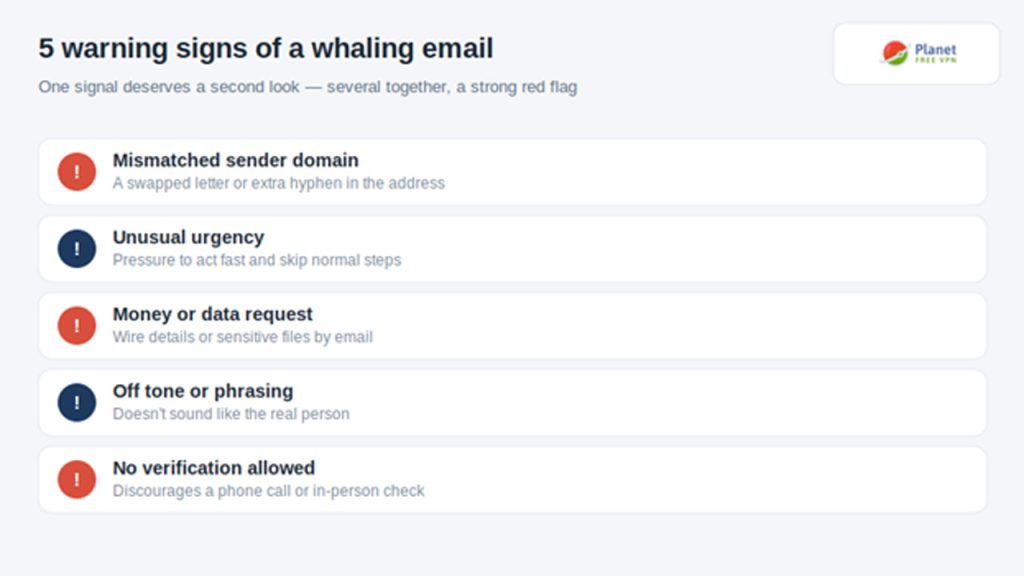
Whaling emails are polished, but they still share recognizable patterns:
- A sender address that looks almost right — a swapped letter, an extra hyphen, or a different domain extension.
- Unusual urgency paired with a request to bypass normal approval steps (“handle this quietly and quickly”).
- A request involving money, wire details, or sensitive files that wouldn’t normally arrive by email.
- Slightly off tone or phrasing compared to how the impersonated person usually writes.
- Pressure to avoid verifying the request by phone or in person.
Any one of these alone isn’t proof of an attack, but the combination — especially urgency plus a financial or data request — is a strong signal to pause and verify.
Whaling vs Spear Phishing vs CEO Fraud
Spear phishing is also a personalized attack, but it is aimed at any individual regardless of their position within the organization. For instance, it can target both a payable clerk and a manager without thinking about which could benefit him more. Whaling, on the other hand, is a subset of spear phishing and specifically targets senior executives or other high-ranking “whales” because the authority and data they hold is much more valuable than junior staff. CEO fraud, which is also known as business email compromise, closely resembles whaling, but it focuses on the outcome rather than the target. An attacker identifies himself as a CEO (or another senior figure) to trick someone else into transferring funds. In short, whaling describes who is targeted; CEO fraud describes what the attacker impersonates to get the payoff.
What steps can businesses take to prevent whaling attacks?
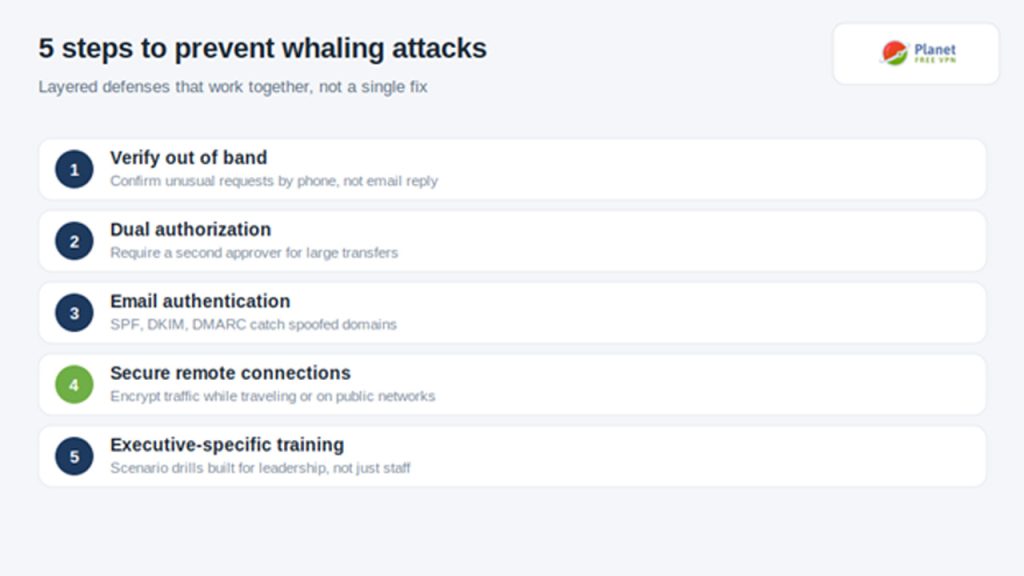
No single control stops whaling attacks — they succeed by exploiting trust and urgency, so defenses need to work together through a zero trust security approach that verifies sensitive actions instead of automatically trusting requests:
- Verify unusual requests out of band. Any request involving payments, credentials, or sensitive files should be confirmed through a phone call or in-person check, not by replying to the same email thread.
- Enforce dual authorization for financial transfers. Requiring a second approver for wire transfers above a set threshold removes the single point of failure a whaling email relies on.
- Use email authentication and anomaly detection. SPF, DKIM, and DMARC records, combined with tools that flag look-alike domains, catch many spoofed sender addresses before they reach an inbox.
- Secure remote and travel connections. Executives working from hotels, airports, or conferences are easier to target when their traffic is exposed on unsecured networks; a VPN like Planet VPN can encrypt that connection so credentials and internal correspondence aren’t as easy to intercept while traveling.
- Run executive-specific security training. Generic phishing awareness training rarely covers the personalized pretexts used in whaling; leadership teams benefit from tabletop exercises built around realistic scenarios.
What mistakes make companies more vulnerable to whaling?
The most common mistake is assuming seniority equals security awareness — executives are often exempted from the phishing simulations and training that lower-level staff receive, even though they’re the primary target. A second mistake is having no formal verification step for large or unusual financial requests, which leaves a single email as the only barrier. Those companies that disclose their internal details to the public, such as full org charts, travel, itineraries and vendor details give attackers an opportunity to get their hands on raw material for planning a more convincing and personalized pretext. At last, several businesses see whaling as a technical issue that they believe can be solved with spam filters alone. However, it is far from reality. Whaling is fundamentally a process and verification gap.
Quick summary: best practices to stop whaling phishing
- Treat any executive request involving money or data as unverified until confirmed by phone or in person.
- Require dual approval for wire transfers and other high-value financial actions.
- Deploy email authentication (SPF/DKIM/DMARC) and look-alike domain monitoring.
- Include executives in regular, scenario-based phishing training — not just general staff.
- Limit how much organizational and travel detail is shared publicly.
Frequently Asked Questions
Q1. What is whaling phishing in simple terms?
Whaling phishing is a scam email crafted to impersonate a trusted figure and sent to a senior executive, aiming to trick them into approving a payment or sharing sensitive information.
Q2. Who is most likely to be targeted by a whaling attack?
CEOs, CFOs, and other executives with financial approval authority or access to confidential data are the most common targets, since they can act on a request without additional sign-off.
Q3. How can I tell if an email is a whaling attempt?
Look for a mismatched sender domain, urgent language pushing you to skip normal verification, and requests involving money or sensitive files that wouldn’t usually arrive by email.
Q4. Is whaling the same as business email compromise?
They overlap but aren’t identical: whaling describes targeting a high-value individual, while business email compromise (or CEO fraud) describes impersonating an executive to deceive someone else into acting.
Q4. Can email filters alone stop whaling attacks?
No. Filters catch some spoofed domains and known malicious links, but whaling relies on social engineering and personalized pretexts that often pass technical filters, so verification steps and training are still necessary.
Q5. What should an executive do if they suspect a whaling email?
Don’t reply to or forward the email. Report it to IT or security immediately and verify the original request through a separate, known contact method before taking any action.
Article rating
Was this article useful?
0.0 out of 5 from 0 ratings