
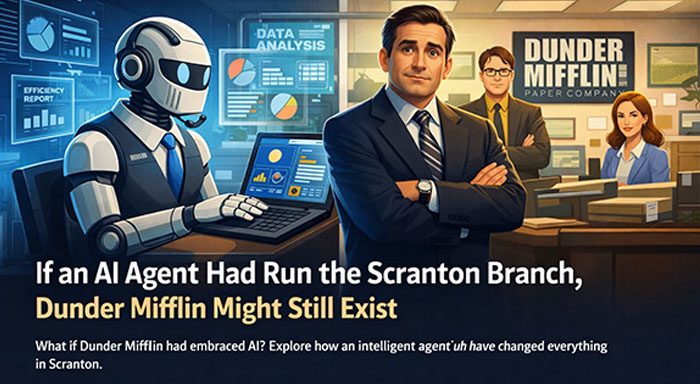
If an AI Agent Had Run the Scranton Branch, Dunder Mifflin Might Still Exist
What if an AI agent ran Dunder Mifflin? Discover how AI workflow automation could improve efficiency, sales, and decision-making in business operations.
Michael Scott throws a pizza party to celebrate a quarterly sales goal that was already going to be met without one. He schedules a full-staff diversity training day and spends most of it making things worse. He drives into a lake because a GPS told him to turn, and he turned. For eleven seasons, these moments read as comedy. Viewed through a different lens, though, they read as a case study in what happens when the person running an operation lacks access to real-time data, acts on instinct over evidence, and treats morale as a substitute for management. Companies exploring AI agent development, including those working with platforms like Easyflow to automate decision workflows, often start by asking a version of this question: where exactly does human judgment break down, and what would a well-designed agent do differently? The answer, at least in Scranton, is: quite a lot.
Dunder Mifflin’s Scranton branch was, by most measures, a mid-sized regional paper distributor running on relationships, goodwill, and the sales instincts of a handful of people who were better at their jobs than their manager deserved. An AI-focused workflow platform wouldn’t have replaced those relationships. What it would have done is take every decision Michael made by feel and run it against something resembling actual data, consistently, without needing a documentary crew to catch the results. That shift from gut-feel management to data-backed decisions is exactly what AI-powered CRM systems are built to support in real business operations.
What an AI Agent Would Have Caught First
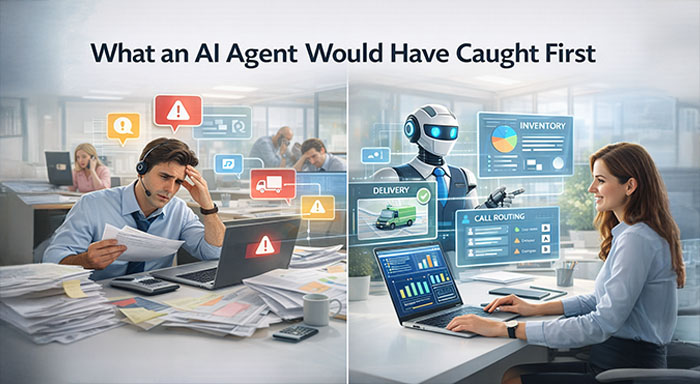
Start with inventory. Scranton routinely ran customer service calls that could have been resolved faster with better stock visibility, delivery tracking, and automated order confirmations. Michael handled client escalations personally, which was occasionally charming and regularly catastrophic. An AI agent managing the branch’s operational layer would have intercepted most of those calls before they reached a manager at all, routing them based on issue type, account history, and resolution likelihood.
Scheduling is a quieter example but a sharper one. The Scranton branch lost hours every week to meetings that had no agenda, ran long, and produced nothing actionable. An AI agent doesn’t call a meeting to process its own feelings about a merger announcement. It surfaces the relevant information, flags the decision that needs to be made, and waits. Workers spend roughly 28% of their time on tasks that automated agents could handle without any loss of quality. In a branch of 20 people, that’s nearly 5 full-time employees’ worth of recaptured hours every week.
The sales side is more interesting. Dwight Schrute’s numbers were consistently the best in the branch, and he operated almost entirely on instinct, relationship memory, and an obsessive understanding of his accounts. An AI agent working alongside someone like Dwight doesn’t replace that instinct. What it does is feed it: flagging which accounts are showing churn signals before the account holder notices, identifying which product lines are underleveraged in a given territory, surfacing upsell timing based on purchase history and seasonal pattern. This is precisely the trajectory covered in the evolution of CRM from manual processes to AI-driven systems where human instinct and machine pattern recognition work together rather than against each other. Dwight with an agent is probably 15% more effective. Michael, with one, might have been manageable.
A few things agents handle well in real branch-style operations and would have handled well in Scranton:
- Monitoring account health across a large customer list and flagging at-risk accounts before renewal conversations become urgent.
- Automating follow-up sequences after sales calls, so nothing falls through the gap between a promising conversation and a closed deal.
- Summarizing performance data across teams without requiring a manager to pull it manually every Monday morning.
- Routing inbound service requests based on complexity and account value, so senior staff spend time on problems that actually need them.
None of those are glamorous. All of them represent hours per week that currently disappear.
What It Still Couldn’t Have Fixed
Related walkthrough
Adobe Launches AI-Powered Agent Orchestrator

There’s a limit to this thought experiment, and it’s worth naming honestly. An AI agent running Dunder Mifflin Scranton would have improved operational performance. It would not have fixed the company’s underlying business problem, which was that physical paper distribution was a contracting market being disrupted from multiple directions at once. No amount of scheduling efficiency changes the trajectory of a shrinking category.
Companies exploring AI agent development sometimes miss this. The technology is genuinely good at optimizing within a defined operating model. Routing, scheduling, prioritization, follow-up, early warning on account health — these are things agents handle well, and firms building these systems have gotten quite precise about where automation adds real value versus where it creates the illusion of progress while the larger problem goes unaddressed. Easyflow’s approach, for instance, focuses on mapping the actual failure points in an existing workflow before designing the agent around them, which turns out to matter more than most buyers expect going in.
According to Gartner, 61% of enterprise AI agent deployments had measurably improved operational efficiency, but fewer than a third had contributed to a strategic shift in how the business competed. The technology optimizes. Strategy still requires humans.
The decisions that would have actually saved Dunder Mifflin were not operational ones. There were questions about whether to pivot toward digital document management earlier, how to position against warehouse clubs undercutting on commodity paper, and whether the branch network made economic sense at its existing scale. An AI agent surfaces the data that makes those questions answerable. It doesn’t make the call.
The highest-performing deployments shared one characteristic: the agent was designed around the specific failure modes of the existing process, not around a generic model of what AI is supposed to do. Scranton’s failure modes were well-documented. Eleven seasons worth of documentation, in fact.
What this means practically for any business considering an AI agent development partner is that the design conversation matters as much as the technology. An agent built around how a branch actually fails, rather than how a pitch deck assumes it works, is a different product. The same principle applies to custom CRM development — systems built around real workflow failures consistently outperform those built around assumed ones. Firms like Easyflow that start with the failure map tend to produce something that holds up after the rollout. The ones that skip that step tend to produce something that works beautifully in a demo.
Final Word
Michael Scott was not the core problem at the Scranton branch. He was a symptom of a company that ran on personality and relationship capital in a market quietly running out of road. An AI agent managing his operational responsibilities would have made the branch more efficient, the sales team better supported, and the clients less likely to call in angry. Whether Dunder Mifflin survives beyond that is a different question, and one that no agent can answer on its own. The decisions that matter most still require someone willing to make them.