
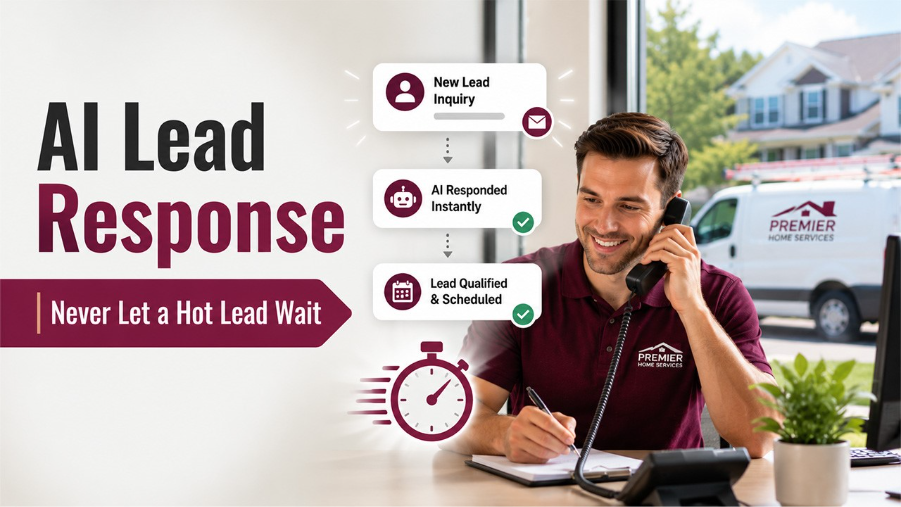
Automating the Inevitable: How to Win More Jobs with AI-Driven Lead Response
A slow response after an inquiry practically means you've lost the customer. See what miracles AI-driven lead response can do.
There’s a strange kind of denial running through most home service businesses right now. Owners will spend thousands on ads, boost their Google profile, run a slick referral program — and then let a lead sit in an inbox for six hours before anyone calls back. Not laziness. Just a system that forgot to care about the response.
The research on response times is pretty eye-opening. Get to a web lead within five minutes, and you’re 21 times more likely to turn them into a real opportunity. Wait half an hour, and you might as well be calling a different number. Most businesses never see this data, so they keep treating a two-hour callback as “pretty quick.”
The five-minute window
Someone’s got a leaky roof or a pipe burst, and they fill out a quote request online. What actually happens? They’re usually comparing three or four companies at once, tabs open, half-distracted. Whoever calls back first often wins the job — not because their pricing is better, but because they’re simply the one who showed up while the homeowner was still paying attention.
The catch is that “showing up in five minutes” is basically impossible for a human team to do consistently. People eat lunch. They’re mid-job with grease on their hands. They sleep. Leads, on the other hand, don’t care what time it is — plenty come in at 9 p.m. on a Sunday, right when nobody’s watching the phone.
An AI-driven response system like Workflow Pros doesn’t get tired or distracted; it sends that first text or email within seconds, confirms the details, and — this part matters — starts pre-qualifying the lead before a human even opens the conversation.
Automation ≠ robotic
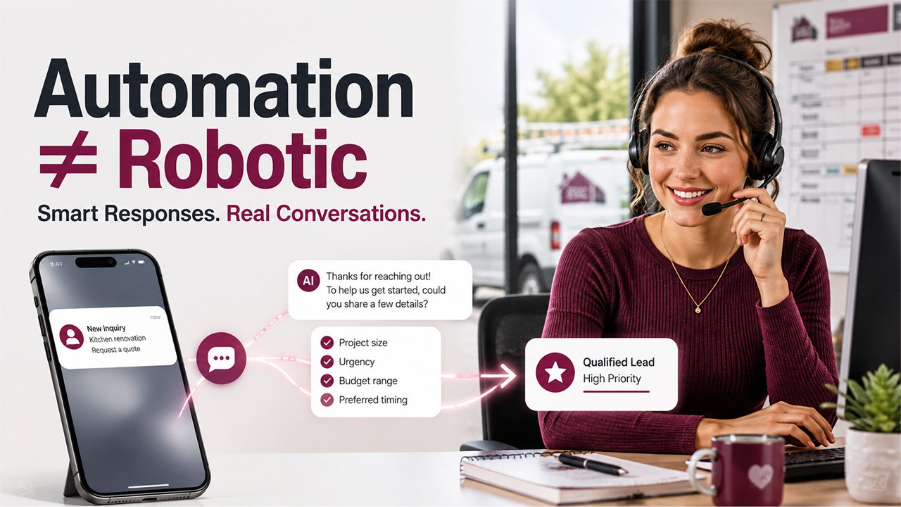
Nobody wants to sound like a call center script. But the businesses doing this well aren’t sending generic “Thanks for reaching out!” auto-replies. They’re using conversational AI that asks the right follow-up questions — square footage, urgency, budget range, preferred timing — and routes the answers straight into a system a dispatcher can actually act on.
That routing piece is where a lot of shops quietly upgrade their operations. Some run this through Workflow Pros, which ties the automated first-touch response to the pipeline itself, so a lead doesn’t just get a fast reply — it lands in the right stage, tagged and prioritized, before a technician ever picks up the phone. That’s the difference between “we responded fast” and “we responded fast and knew exactly what to do next.” A lot of automation setups nail the first half and completely drop the second.
And honestly, the data backs up why that second half matters so much. Research from Lead Connect found that 78% of customers end up buying from whichever company responds to them first — not the cheapest one, not the most reviewed one. First. That single stat should reshape how a service business thinks about its intake process.
The parts people usually get wrong
Related walkthrough
GuestPostMailer Dashboard Overview | AI-Powered Guest Posting & CRM Automation Tool

A few patterns show up again and again when businesses try to bolt AI onto their lead flow without rethinking the process underneath it:
Treating automation as a replacement instead of a relay
The AI isn’t there to sell the job. It’s there to start the conversation and pass it to a real person without dropping anything. Big jobs like HVAC or kitchen remodels still need a real conversation before anyone’s signing anything.
No follow-up sequence after the initial outreach
One text isn’t enough. Velocify’s data says it all: if you stop after one call, you’re leaving almost half your converted leads on the table. Keep dialing. By attempt number six, you’ve reached 95% of them.
Skipping the qualification layer entirely
Fast response without qualification just means the sales team wastes time on tire-kickers faster than before. Speed without filtering is just noise, delivered promptly.
There’s also a subtler mistake worth naming: businesses assume automation is only about speed. But honestly, the bigger win is consistency. A sales rep might respond in three minutes if they’re on top of their game, or three hours if they’re buried in emails or just having a rough morning. Machines don’t have mood swings. They’re consistent every time. And over months, that reliability drives a better close rate — even though that same rep might beat the AI on a specific lead now and then.
What this looks like in your workflow
Picture a mid-sized landscaping company running seasonal campaigns. Spring hits, and lead volume triples almost overnight — mulch installs, irrigation repairs, the works. Without automation, that spike usually means leads sitting untouched for hours because the two people who normally handle intake are now also running crews.
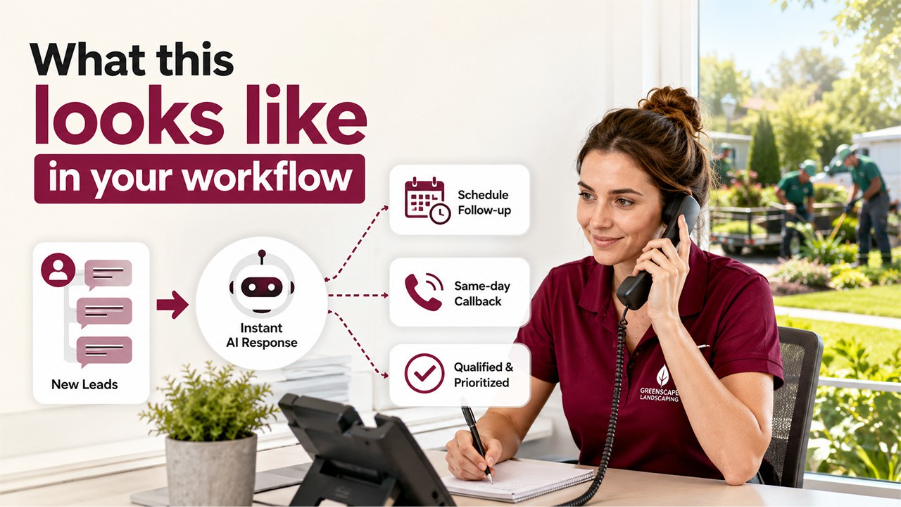
With an automated response layer in place, every lead gets an instant acknowledgment, a couple of clarifying questions, and — depending on the answers — either a same-day callback flag or a scheduled follow-up slot. The office staff isn’t drowning; they’re working a pre-sorted list instead of a raw firehose. Companies that get serious about inbound lead response speed and structure often see conversion lifts in the 25–40% range, sometimes higher. But it’s not a guarantee. It depends a lot on your industry, where your leads are coming from, and how badly you were dropping the ball before.
It’s not magic. It’s just removing the gap between “someone wants this service” and “someone from the company is talking to them about it.”
Before you implement – a practical consideration
You can have the best automation in the world, but if you treat it like a set-it-and-forget-it appliance, you’re wasting your money. The scripts need occasional tweaking. The qualifying questions need to evolve as the business changes what it sells. And somebody, at some point, still needs to pick up the phone and actually build rapport — AI gets the door open, but it doesn’t walk through it.
If you look at who’s actually winning the most jobs these days, it’s not the companies throwing the most money at Google Ads. It’s the ones who, over the last year or two, came to terms with a hard truth: the five-minute response window is real, it’s unforgiving, and you cannot win that race with human effort alone. You need a system. Automate the response. Keep the relationship human. That combination is what actually moves the needle — everything else is just decoration on top of it.