
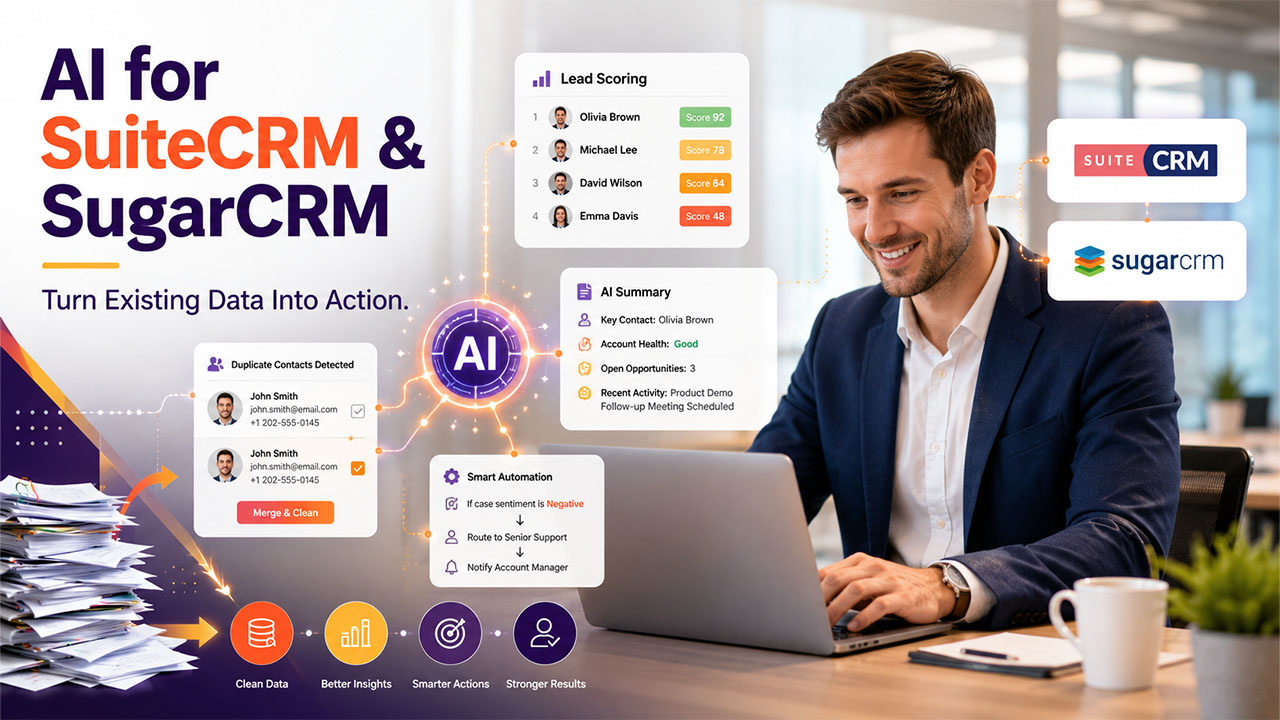
How AI Is Changing CRM: Practical Use Cases for SuiteCRM and SugarCRM Teams
Explore the practical use cases of integrating AI in CRM, from data cleanup and lead scoring to automation and CRM summaries.
Most teams that run SuiteCRM or SugarCRM has already have moved a large amount of data, which they don’t know what to do with. Most of the data, such as contacts, deals, cases, and email history, just lies in the system, which is technically stored, but is mostly unused. All this unused data can act as the ideal starting point for AI in CRM, and is one of the more honest one, compared to the version usually hears about. The opportunity is not some futuristic assistant. It is finally doing something useful with the data you already have.
The main problem is that most of the AI-and-CRM conversation is either vague or so technical that it will never reach the admins and developers who are actually running these platforms. Here is a practical version of where AI genuinely helps a CRM teams, where it does not, and what does it take to implement it without creating a mess.
Start with the boring win: data quality
Before any clever prediction, there is a problem every CRM team knows intimately. The data is mostly messy, contains duplicate accounts, half-empty contacts records, leads to enter multiple ways, and companies spell differently in the same database. No such feature works well, and no amount of AI can fix the foundation that is maintained by no one.
This is where AI earns its keep first, and least glamorously. Modern models are good at exactly the tedious cleanup that humans avoid: spotting probable duplicates that do not match exactly, flagging records that look incomplete, standardizing inconsistent entries, and suggesting merges. Improving CRM data quality is not the exciting use case anyone puts on a slide, but it is the one that makes every other use case possible. Teams that skip it and jump straight to prediction end up with confident predictions built on garbage.
If you do nothing else with AI in CRM this year, point it at your data hygiene. The return is immediate and it compounds.
Where AI actually helps day to day

Once the data is in reasonable shape, a handful of use cases consistently pay off for SuiteCRM and SugarCRM teams.
Lead scoring is the obvious one. Instead of a static rules-based score that somebody set up two years ago and never revisited, AI lead scoring looks at which leads actually converted historically and ranks new ones on that pattern. It is not magic, and it needs enough history to learn from, but for teams with a real sales volume it beats a hand-built formula that nobody trusts anymore.
Summarization is quietly one of the most useful. A rep opening an account with three years of history does not read three years of history. An AI summary of the relationship, the open issues, and the last few interactions turns a ten-minute archaeology dig into a fifteen-second read. This is the kind of small, constant time saving that adds up across a whole team.
Then there is CRM automation itself, which AI makes smarter rather than just faster. Traditional automation fires on rigid rules: if field X changes, do Y. AI-assisted automation can handle the fuzzier cases, routing a case based on what it is actually about rather than a keyword match, drafting a first-pass reply for a rep to edit, or flagging a deal that has gone quiet when the pattern suggests it is going cold. The rules-based automation you already have does not go away. AI just extends it into the judgment calls that rules could never capture.
Where AI does not help (yet)
Related walkthrough
SuiteCRM LiveChat Integration for automatic lead Generation u0026 Data Sync via Email to lead

It is worth being honest about the limits, because overselling this is how teams end up disappointed.
AI is bad at anything where being confidently wrong is expensive and unmonitored. It will happily generate a plausible summary that is subtly incorrect, or score a lead with total confidence based on a pattern that no longer holds. Anything customer-facing and unsupervised is risky. The reliable pattern is AI proposes, a human disposes, at least until you have enough track record to trust a given task.
It also does not fix process problems. If your sales team does not update the AI in CRM, the technology trained on their non-updates learns nothing useful. The technology amplifies whatever discipline you already have. It does not manufacture discipline you lack.
What it actually takes to implement
Here is the part that gets skipped. Adding AI to a SuiteCRM or SugarCRM environment is not a plugin you switch on and forget. It is an integration project with real decisions: where the data lives, what leaves your environment and what does not, how predictions get surfaced in the interface your team already uses, and who checks that the outputs stay accurate over time.
For a lot of teams, this is the point where it makes sense to bring in help rather than learn every lesson the expensive way. Whether that is an in-house developer who owns it or external AI consulting services that have done the integration before, the value is having someone who has already made the mistakes, on data governance, on model selection, on the unglamorous plumbing between the model and the AI in CRM. The build itself is rarely the hard part. Knowing what to build, and what to leave alone, is.
However you resource it, treat the first project as narrow. Pick one use case, data cleanup or lead scoring is a good start, prove it works on your actual data, and expand from there. The teams that try to AI-enable their whole CRM at once tend to produce a lot of activity and very little that anyone trusts enough to rely on.
The realistic takeaway
Integration of AI in CRM is considered genuinely useful. The integration wins are practical and often boring, in which cleaner data, smarter scoring, faster context, and automation, are handled the messy cases. None of it requires replacing SuiteCRM or SugarCRM. It requires using AI to get more out of the CRM you already run.
Start with the data. Add one use case that pays for itself. The platform should keep a human in the loop always, until the track record earns the trust. Doing this will stop AI from being a buzzword in the CRM, and will start being the thing which quietly makes the whole system work better.