

What Is Autonomous CRM? Features, Benefits, Examples & Use Cases
Learn what Autonomous CRM is, how it works, its key features, benefits, examples, and why AI-powered CRM is transforming customer relationships.
Most CRM systems were built around the idea of keeping all your customer information in one place, making it accessible, and helping your team stay organized. That part worked, but many other things fell apart. One of the biggest gaps is having data but not actually using it well. Insights remain unused, high-intent leads got lost in a crowded pipeline, and opportunities to reach out at exactly the right moment passed because nobody caught the signal in time. It’s not because the system didn’t have data; rather, it just couldn’t do anything with it on its own.
That’s where Autonomous CRM comes into the picture. It does more than just store information; it acts on it. This distinction matters especially to those businesses that have tons of customer data but struggle to use it well.
What Is Autonomous CRM?
Autonomous CRM refers to customer relationship management software that uses artificial intelligence, machine learning, and intelligent automation to handle tasks, make decisions, and take action without waiting for a human to tell it what to do.
That’s the key shift. Traditional CRM is reactive. You have to enter data, extract insights, and then decide what to do next. Whereas autonomous CRM is proactive. It monitors customer behavior, processes incoming data in real time, identifies what needs to happen, and then acts on it or, at minimum, surfaces a clear recommendation, so your team can act fast.
This evolution has gone through many stages to reach where it is now. At first, CRM started as a digital base to store customer records, moved into pipeline management, and then it got layered with AI-powered insights. Autonomous CRM marks the next step in that progression where the system doesn’t just inform; it initiates it.
Core Components of Autonomous CRM
Autonomous CRM consists of components that work in harmony to make the system intelligent and self-directing. The core elements include:
- Artificial Intelligence and Machine Learning: It is the foundational layer. AI processes large volumes of customer data, recognizes patterns, and uses that data to train itself over time. Using Machine learning, the system improves its predictions and recommendations.
- Natural Language Processing (NLP): Using NLP, the CRM understands and interprets human language in emails, chat conversations, support tickets, and voice interactions. Additionally, this allows the system to recognize intent, not just read words.
- Intelligent Automation: It is called the execution layer. Once the system identifies what needs to happen, such as a follow-up email, a lead assignment, or a contract renewal reminder, automation is triggered, and it handles the actual delivery without needing any manual input.
- Real-Time Data Processing: Instead of waiting for nightly syncs or weekly reports, autonomous CRM works on live data. When a customer performs any action, it triggers immediate responses. This means nothing important will fall through the timing gap.
- Predictive Analytics: To forecast accurate outcomes, the system uses historical data and behavioral signals. It can predict which leads are most likely to convert, which customers might abandon your brand, or which deals are likely to stall.
How Does Autonomous CRM Work?

Let’s see how autonomous CRM operates in practice:
- Data Collection and Unification: The system extracts data from every source where customers are active, such as website visits, email opens, purchase history, support interactions, and social engagements. It stores all data in a specific customer profile
- AI Analysis and Pattern Recognition: After pulling data from multiple sources, the AI engine processes that data in real-time. It identifies behavioral patterns, engagement signals, and spots any unusual or suspicious activity.
- Decision-Making and Prioritization: After analyzing everything thoroughly, the system now determines the best course of action and the perfect time to execute it. For instance, when there is a high-intent lead, the system might flag it for immediate sales or outreach. It can also identify when a long-term start showing early signs of disengagement, which helps businesses take appropriate measures.
- Automated Execution: The system automatically executes routine tasks such as sending a follow-up, making changes to a customer record, routing a support ticket, or triggering a re-engagement sequence. It need not wait for human input.
- Learning and Refinement: Every interaction is new data for the system. The system keeps learning from every outcome or interaction to make more accurate predictions and continuously refine its models.
- Human Oversight and Escalation: The system does not replace humans. It escalates those decisions that need judgment, context, or sensitivity to a human, along with full context already attached. The person who steps in is already informed about the situation, so he doesn’t have to start from scratch.
Key Features of Autonomous CRM
Let’s explore the essential autonomous CRM features that are designed to automate decisions, streamline workflows, and enhance customer engagement.
- AI-powered Lead Scoring: Autonomous CRM knows that not all leads deserve equal attention. It automatically classifies leads based on behavior, demographics, and engagement history. This way, your sales teams always know where to shift their focus first. Businesses already using AI call agents for initial screening report significantly less time wasted on low-intent leads.
- Automated Customer Segmentation: The system groups customers dynamically based on real-time data rather than static lists. As behavior changes, segmentation updates automatically, keeping targeting accurate without manual intervention.
- Conversational AI and Chatbots: Autonomous CRM can engage customers directly through AI-driven chat by answering questions, qualifying leads, booking meetings, and resolving common support issues around the clock, without a human agent on standby.
- Predictive Sales Forecasting: The system doesn’t rely on gut feel or pipeline reports compiled manually. It generates forecasts that are supported by data. This helps sales leaders get a clearer and more reliable view of what’s likely to close and when.
- Automated Workflow and Task Management: Routine processes such as follow-up scheduling, deal stage progression, internal notifications, and renewal triggers run automatically based on predefined rules and AI recommendations. Less human intervention means fewer chances of errors.
- Sentiment Analysis: By analyzing the language and tone in customer communications, the system gauges how a customer is feeling about an interaction or a product. That signal can trigger proactive outreach before a problem escalates.
- Omnichannel Engagement: Autonomous CRM tracks and responds across every channel, such as email, SMS, social, live chat, and phone, with consistent context. The customer never has to repeat themselves, regardless of where they reach out.
Read also: CRM Phone Integration: A Complete 2026 Guide
Benefits of Autonomous CRM for Businesses
Related walkthrough
Agentic AI Explained Simply | The Future of Autonomous AI Agents


These capabilities translate into measurable business outcomes that improve efficiency, customer experience, and overall growth.
Save Time by Automating Repetitive Tasks: Some tasks, such as entering data, scheduling tasks, and setting up follow-up reminders, consume hours that could be used on actual selling or relationship management. Autonomous CRM handles these tasks automatically, freeing human agents for more important things.
Turn Customer Data into Actionable Insights: Most businesses have data, but they don’t know what to do with it. With an autonomous CRM, you can turn that data into action by surfacing the right insight when you need it most.
Improve Customer Response Times: Speed matters in customer relationships. A lead that doesn’t hear back within hours is already less likely to convert. An at-risk customer who doesn’t get a timely outreach is already closer to leaving. Autonomous CRM acts in real time, so the window doesn’t close.
Scale Operations Without Increasing Headcount: The volume of customer interactions grows with the business. With traditional CRM, you have to hire more people to manage it. However, with an autonomous CRM, the system scales itself with the data without needing additional headcount.
Reduce Human Errors and Missed Opportunities: Manual processes fall short. People forget, input wrong details, or overlook things when they are overworked or handle several things at once. However, when you apply automation to the right tasks, there are fewer mistakes in the customer experience.
Scale Operations Without Increasing Headcount: The volume of customer interactions grows with the business. With traditional CRM, you have to hire more people to manage it. However, with an autonomous CRM, the system scales itself with the data without needing additional headcount.
Reduce Human Errors and Missed Opportunities: Manual processes fall short. People forget, input wrong details, or overlook things when they are overworked or handle several things at once. However, when you apply automation to the right tasks, there are fewer mistakes in the customer experience.
Top Autonomous CRM Platform Examples
Let’s compare different autonomous CRM platforms, each approaching it a little differently depending on the industry and use case they serve best:
| Platform | Best For | Autonomous CRM Capability |
|---|---|---|
| Salesforce Einstein | Enterprise sales and service teams | AI-driven lead scoring, automated workflows, predictive forecasting, and next-best-action recommendations |
| HubSpot CRM | SMBs and marketing-led growth | Automated contact management, AI email suggestions, smart sequencing, and behavioral segmentation |
| Klaviyo | E-commerce and direct-to-consumer brands | Autonomous customer segmentation, predictive analytics, and behavior-triggered campaign automation |
| Zoho CRM (Zia AI) | Mid-size businesses across industries | AI assistant Zia handles anomaly detection, sentiment analysis, and automated task suggestions |
| Microsoft Dynamics 365 | Enterprise-level operations | Copilot-powered automation across sales, service, and marketing with deep Microsoft ecosystem integration |
| Neexa AI | Conversational sales automation | Autonomous lead engagement and qualification through AI chat, operating 24/7 without human agents |
| Freshsales (Freddy AI) | Fast-growing sales teams | AI-powered contact scoring, deal insights, automated follow-ups, and pipeline health monitoring |
Real-World Applications of Autonomous CRM
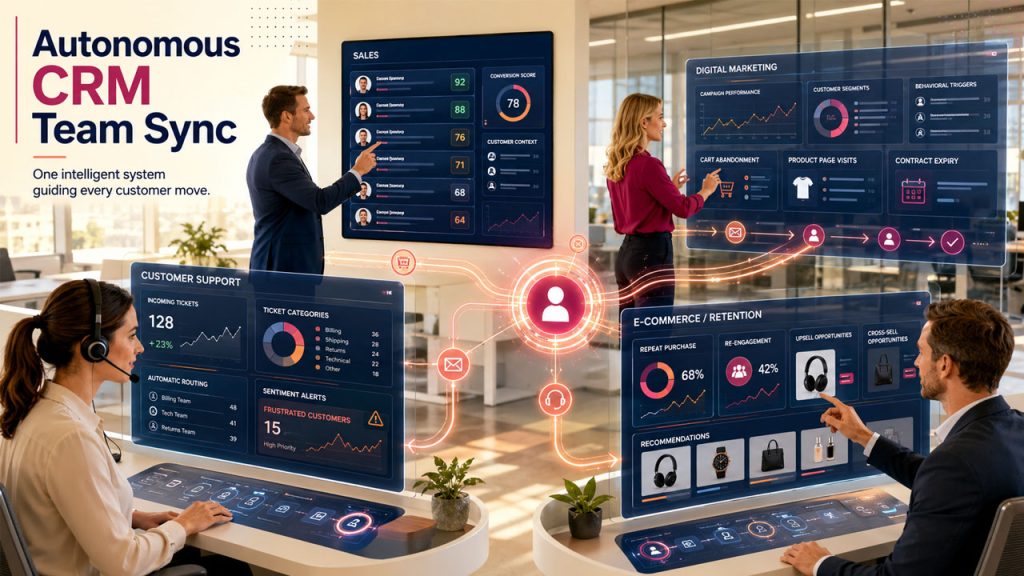
An autonomous CRM delivers value across multiple teams and business functions:
Sales Teams: Reps do not have to work through a vague list of leads; instead, they get a ranked view of who’s most likely to convert with full context already attached. This makes the first conversation more meaningful and impactful.
Digital Marketing Teams: CRM in digital marketing helps run marketing campaigns in a smarter way. Customer segments update in real time, so messaging stays relevant. Automated workflows trigger personalized communications based on behavior such as cart abandonment, product page visit, or contract expiry approaching without anyone manually building the sequence each time. Businesses that have integrated CRM and email marketing into a unified workflow consistently see stronger conversion rates and more relevant communication at every stage.
Customer Support Teams: The system automatically categorizes and routes incoming tickets to the right agent. AI handles common queries directly. Additionally, when a customer is frustrated, sentimental signals alert human agents before it turns into a complaint.
E-commerce Businesses use it to reduce churn and increase repeat purchases. The system identifies customers who haven’t engaged in a while and triggers re-engagement campaigns automatically. It also surfaces upsell and cross-sell opportunities based on purchase history and browsing behavior.
B2B Companies: They use autonomous CRM to manage long and complex sales cycles more effectively. The system tracks every touchpoint across a long buying journey, flags deals that are going quiet, and ensures nothing gets lost across a multi-person buying committee.
Conclusion
CRM has one goal: to help businesses build better customer relationships. For a long time, it helped organizations by storing information, managing pipelines, and tracking history. However, a few things remained unaddressed, such as action, follow-through, and right timing. Autonomous CRM closes that gap. It handles the volume, the routine, and the real-time, so that your team can handle conversations, judgment calls, and the relationships that actually move the needle.
It’s not about removing people from the process. It’s about making sure the process actually works at scale, in real time, without things falling through the cracks. For businesses that want to grow without just adding headcounts, that’s not a small thing. That’s the whole point.
FAQs About Autonomous CRM
Q. What is an autonomous CRM?
It’s a CRM system that uses AI and automation to take action on customer data independently, without requiring constant manual input.
Q. How is autonomous CRM different from traditional CRM?
Traditional CRM stores and organizes data for humans to act on; autonomous CRM analyzes that data and acts on it automatically.
Q. Is autonomous CRM suitable for small businesses?
Yes. Many platforms offer scalable autonomous CRM features that work for businesses of any size, not just enterprise-level organizations.
Q. Does autonomous CRM replace sales or support teams?
No. It handles repetitive and data-heavy tasks so that sales and support teams can focus on higher-value, relationship-driven work.
Q. What kind of data does autonomous CRM use?
It pulls from email, social media, purchase history, website behavior, support interactions, and more to consolidate everything into unified customer profiles.