





Explore how the Board Reporting Tool helps governance teams measure oversight, improve stakeholder reporting, and track decisions effectively.
Governance teams do a significant amount of oversight work that rarely appears in standard reports. They prepare board materials, coordinate committee workflows, track decisions, support risk oversight, and maintain records that may later matter to auditors, regulators, investors, or the board itself. Yet much of this work remains hard to see. A board may receive a polished meeting pack, but not see how many actions were closed after the last meeting. A CEO may rely on committee output, but not see whether the governance team improved decision timelines or reduced reporting gaps.
That visibility gap is becoming harder to ignore. As board expectations rise, governance leaders need a clearer way to show what oversight work entails, where the board focuses its attention, and how decisions move from discussion to action.
A Board Reporting Tool helps governance teams transform this hidden oversight activity into measurable insights by connecting board decisions, committee workflows, risk discussions, and action tracking into a structured reporting view for stakeholders.
Why Governance Teams Need to Demonstrate Their Value
That’s an important task for governance because stakeholders increasingly expect board work to be measurable, traceable, and connected to risk oversight.
- CEOs want cleaner board cycles and faster decision support.
- Audit committees want evidence that key risks were discussed, assigned, and followed up.
- Regulators and investors expect governance processes to support accountability, not operate as informal administration.
This pressure reflects broader board trends. PwC’s Annual Corporate Directors Survey shows continued director focus on governance priorities, risk, and board effectiveness. Deloitte’s Board Practices Quarterly also reflects growing demand for clearer oversight practices and practical board benchmarks. For governance professionals, the challenge is practical: their work is essential, but it is often noticed only when something fails. Better reporting for governance teams makes the function’s contribution visible before it becomes a problem.
As organizations strengthen oversight processes, many are adopting governance, risk, and compliance (GRC) platforms to bring risk tracking, compliance activities, controls monitoring, and reporting workflows into a more structured framework. These platforms help governance teams create better visibility into organizational risks and support more evidence-based decision-making.
What Stakeholders Actually Want to See
Stakeholders want evidence that governance activity supports oversight, decision quality, and follow-through. A report showing that the governance team managed six committee meetings says little on its own. Stakeholders usually want to know whether board attention matched the organization’s risk profile and whether decisions produced action.
The most useful reporting usually covers:
| Reporting area | What it shows |
| Risk coverage | Whether material risks appeared on board or committee agendas |
| Decision follow-through | Whether approved actions were completed on time |
| Attendance and engagement | Whether directors are participating consistently |
| Committee workload | Whether oversight work is balanced across committees |
This is where governance metrics reporting becomes more useful than basic activity tracking. It gives stakeholders a reliable view of how oversight is functioning.
A Board Reporting Tool supports this approach by bringing governance metrics into a single reporting framework, allowing stakeholders to understand whether board attention, risk oversight, and decision execution are aligned with organizational priorities.
How a Reporting Tool Closes the Gap
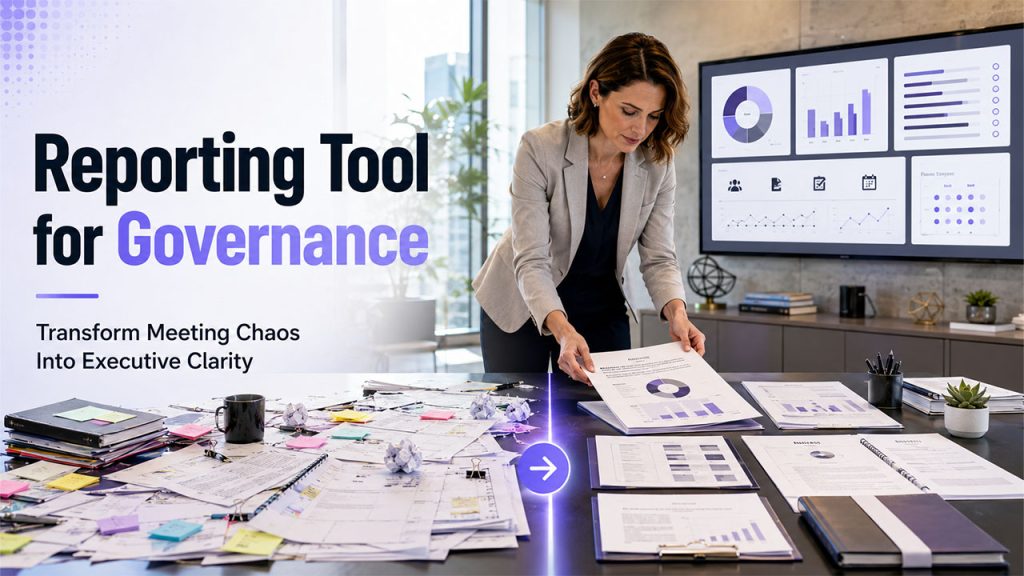
A reporting tool closes the gap by turning governance activity into structured, stakeholder-ready information. Governance leaders are using a board reporting tool to turn day-to-day oversight activity into stakeholder-ready reports, quantifying risk coverage, decision velocity, and committee workload without manual rebuilds.
Nowadays, governance data often starts in fragmented formats. Agenda items sit in one place, minutes in another, action items in a spreadsheet, and committee materials in separate folders. When a stakeholder asks for a clear view of board activity, the governance team may need to rebuild the story manually. Building a reliable reporting environment requires connected enterprise data platforms that help organizations unify information from multiple systems and create consistent reporting structures.
A structured reporting layer connects agenda categories, meeting records, approvals, action items, document usage, and committee calendars into a consistent reporting model. The output may be a dashboard for the CEO, a quarterly summary for the audit committee, or an annual governance narrative for the board.
A governance reporting tool is most useful when it answers practical questions: Which risks received attention? Which decisions are still open? Which committees carry the heaviest workload? Which actions are overdue?
Benefits for Governance Leaders
The main benefit of a Board Reporting Tool for governance leaders is credibility. Instead of describing the volume and impact of oversight work, teams can present evidence-based insights that demonstrate how governance supports decision-making and accountability. They can show the value of their work with evidence rather than description. With structured reporting, corporate secretaries and governance teams can have more productive conversations with the CEO. Instead of saying that the board cycle has become heavier, they can show the increase in agenda items, late papers, committee actions, or approval timelines.
Audit committees also benefit. A clear report on risk coverage, action closure, and escalation history can help the committee understand whether oversight processes are working as intended. For regulated organizations, reporting can support better interactions with supervisors, auditors, or internal assurance teams. The governance team may not need to disclose every operational detail, but it should be able to show that key matters were scheduled, reviewed, decided, and followed up.
Structured board reporting software can also support budgeting conversations by showing where manual work is concentrated and where reporting gaps create operational risk.
Metrics Worth Reporting

The most useful governance metrics connect board activity to oversight quality. Attendance can show whether directors are present for key decisions. Decision cycle time can reveal whether approvals are delayed by incomplete materials or repeated deferrals. Action item closure rates show whether board decisions are being implemented.
A practical board KPI reporting model may include:
| Metric | Practical use |
| Attendance by board and committee | Identifies engagement or scheduling issues |
| Decision cycle time | Shows where approvals slow down |
| Risk coverage | Tests whether oversight matches the risk register |
| Action item closure rate | Shows follow-through after meetings |
| Paper timeliness | Highlights process discipline |
| Committee workload | Helps rebalance governance burden |
Reporting Cadence and Delivery
Reporting cadence should match the audience and decision cycle. A board chair may need a short dashboard before each meeting. The CEO may prefer a quarterly summary focused on decision timelines and open actions. An audit committee may need deeper reporting on risk coverage, compliance matters, and unresolved control issues. The full board may only need an annual governance effectiveness summary.
Format matters as well. A dashboard works for recurring indicators. A slide deck supports committee discussion. A short narrative is often better for explaining complex trends, such as why decision cycle time increased after a restructuring or regulatory change. The point is not to produce more reports. The point is to deliver the right evidence at the right level of detail.
Key Considerations Before Adoption
Before adopting a reporting tool, governance teams should define what good reporting needs to prove.
Before selecting a Board Reporting Tool, governance teams should evaluate how the solution handles data accuracy, security controls, stakeholder-specific reporting needs, and integration with existing governance processes.
- Data quality is the first issue. If agenda categories, action owners, meeting outcomes, and committee records are inconsistent, reporting will reflect those weaknesses.
- Security is equally important. Governance reports may contain sensitive information about board performance, executive decisions, cybersecurity, litigation, or regulatory matters. Access controls should match the sensitivity of the underlying records.
- Stakeholder-specific views also matter. A committee chair may need detailed action tracking, while the full board may need trend-level reporting. A regulator may need evidence of process, not internal commentary.
- Governance teams should also avoid vanity metrics. Counting meetings, papers, or agenda items can be useful, but only when the numbers explain something meaningful about attention, accountability, risk coverage, or decision follow-through.
Conclusion
The value of governance has to be made visible to all stakeholders and employees. Corporate secretaries, general counsel, and governance teams already support risk oversight, decision discipline, committee coordination, and board accountability, but their contributions often disappear within meeting cycles and administrative records. A Board Reporting Tool gives governance leaders a credible, repeatable way to show how the board spends its attention, measure oversight effectiveness, and demonstrate value to CEOs, committees, regulators, and investors. It can also make conversations with CEOs, audit committees, regulators, and investors more evidence-based.
As stakeholder expectations rise, governance reporting will become less about administrative summaries and more about oversight intelligence.
Respond to this article with emojis