

Best GRC Platforms for Tech Teams: Automated Controls, Continuous Monitoring & Audit Readiness
Discover the best GRC platforms for tech teams in 2026 and compare the leading cloud-native IRM tools for automated controls.
Spreadsheets buckle under modern pressure. Cyber threats multiply hourly, regulators roll out mandates quarterly, and boards expect crisp answers before the next earnings call. Yet many organisations still run risk programs on legacy GRC suites or, worse, a patchwork of shared drives.
Cloud-native Integrated Risk Management (IRM) platforms are built for a SaaS world. They sit alongside the rest of your stack, update automatically, and pull in real-time data. That removes upgrade cycles, infrastructure overhead, and the silo walls that slow risk teams down.
In this guide, we break down the best GRC platforms for tech teams in 2026, focusing on cloud-native tools that enable automated controls, continuous monitoring, and audit readiness. Each one meets three non-negotiables:
- True cloud delivery: multi-tenant SaaS or containerised, with no on-prem starter kit
- Multi-domain coverage out of the box, so you avoid stitching point tools together
- Proven traction: analyst leadership, strong funding, or a sizeable customer base
You will see how each platform stacks up, where it shines, and where it still needs work. We kept the prose tight and the jargon light, more coffee chat than pitch deck.
Here’s what we’ll cover:
- A quick look under the hood at our evaluation framework
- Six bite-sized reviews in ranked order, including strengths, watch-outs, and ideal fit
- A side-by-side matrix for rapid comparison
- The trends shaping IRM software through 2026 and beyond
- A buyer checklist plus fast answers to common RFP questions
By the end, you will know which names deserve a demo request, and which can stay off your shortlist. Let’s dive in and leave legacy risk management in the past.
How We Evaluated the Best GRC Platforms for Tech Teams
Related walkthrough
Stellar OST to PST Converter Review 2026 | Online vs Desktop – Real Test

Choosing the right IRM platform is part science, part street smarts. We started with the science.
First, we reviewed the latest analyst research and lab tests from Risk Publishing. Its 2026 comparison of enterprise risk tools highlights what buyers want now: cloud agility, broad domain coverage, and machine-driven efficiency.
Next, we screened more than a dozen vendors against three hard gates:
- True SaaS or containerised cloud delivery
- Multiple risk modules out of the box
- Proof of traction, including analyst leadership, strong funding, or a sizeable customer base
Six vendors cleared every gate.
From there, we scored each finalist across eight criteria mapped to real-world workflows:
- Cloud architecture (15%): Can the system scale instantly without hardware chores?
- Risk coverage (20%): Does it unite cyber, vendor, operational, compliance, audit, and more in one model?
- Regulatory and framework support (15%): Are ISO 31000, NIST CSF, and DORA mapped and maintained?
- Automation and AI (15%): How much busywork disappears through continuous control monitoring or generative AI copilots?
- Integration and extensibility (10%): Will it connect natively to ServiceNow, Jira, SAP, cloud logs, and future tools?
- Reporting and analytics (10%): Can it turn raw data into board-ready insights quickly?
- Usability (10%): Will risk owners, not just GRC power users, feel at home in the interface?
- Customer feedback and market presence (10%): Do practitioners endorse the product, and is the vendor still investing?
Each criterion received a one-to-ten score. We applied the weights above, calculated composite totals, and ranked the platforms. Where scores tied, peer reviews and implementation stories broke the deadlock.
The result is a defensible ranking shaped by what risk leaders need in 2026: rapid deployment, integrated insight, and evidence the vendor will keep innovating. That’s the yardstick we’ll use in the reviews ahead.
1. Vanta: automated risk & compliance for cloud-first teams
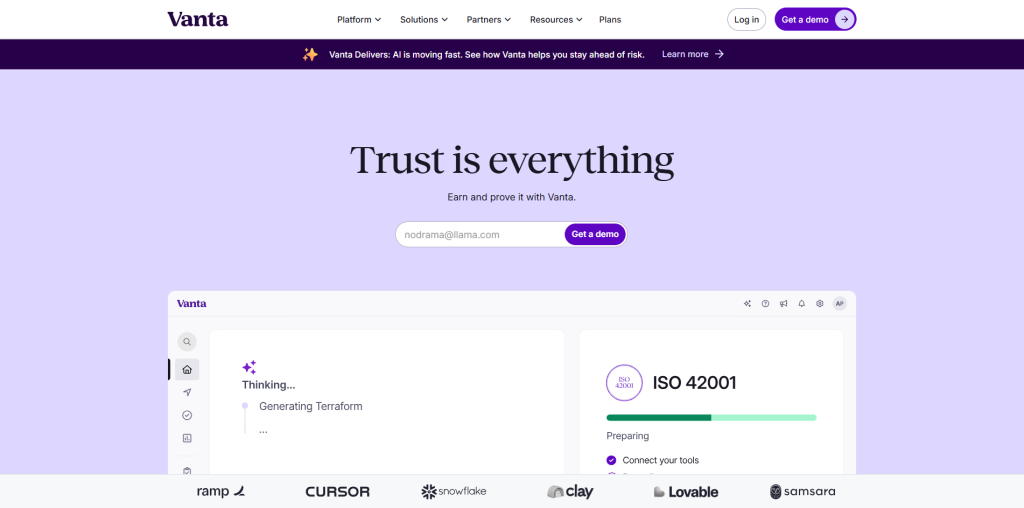
Vanta was built for cloud-first teams that want risk and compliance to run with the rest of their SaaS stack, not behind it. Vanta’s automated compliance solution connects to AWS, GitHub, Okta, and dozens of other tools, then runs continuous tests to show your controls are working in practice.
On the IRM side, Vanta gives you a pre-populated threat library, a straightforward risk register, and workflow rules that push remediation work into Jira or Asana.
Strengths: fast setup, tight integrations, and automated evidence collection that can cut audit time by up to 82 percent.
There is also clear momentum behind the roadmap. A $150 million Series D in 2025 pushed Vanta’s valuation beyond $4 billion and grew the customer community.
Watch-outs: Vanta prioritises speed and automation over breadth. If you need deep operational modelling or Monte Carlo simulations, those capabilities tend to live in heavier suites further down this list.
Ideal fit: lean security or compliance teams that want automated, always-on visibility across cloud stacks without hiring an army of GRC admins.
2. LogicGate Risk Cloud: no-code power without the bloat
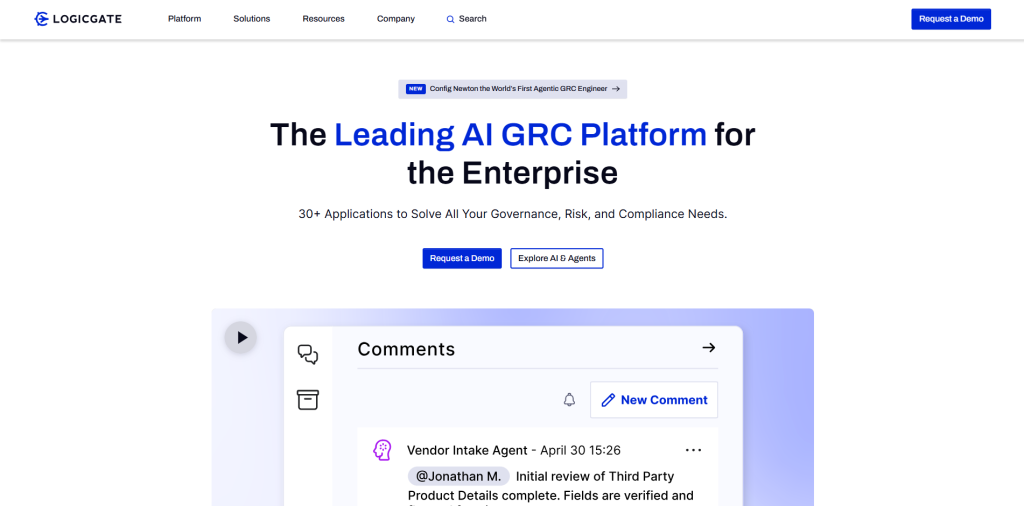
LogicGate Risk Cloud is built for a reality most risk leaders know well: every team runs risk a little differently, and “one-size-fits-all” workflows rarely fit anyone. Its differentiator is the visual, no-code builder. You can drag, drop, and connect steps to match your process, whether that’s a three-stage vendor assessment with reminders and legal approval, or an ESG scorecard you want to add next quarter. No code, no IT ticket.
That flexibility does not come at the expense of coverage. LogicGate offers more than 30 ready-made applications spanning enterprise risk, cyber, third-party, resilience, ESG, and emerging AI risk, all sharing one data core. That matters in practice because a vulnerability captured in the cyber module can update the enterprise view immediately, instead of living in a separate spreadsheet.
Dashboards refresh in real time for different audiences. Executives get heat maps, control owners see tasks, and analysts see trend lines, all from the same dataset. LogicGate also offers a generative AI assistant, and early adopters report saving hours on board reports because the system suggests narratives based on live metrics.
Strengths: highly configurable workflows, broad app coverage on a shared data core, and real-time reporting that supports both operators and leadership.
Watch-outs: the same flexibility that makes Risk Cloud powerful can overwhelm teams without clear process definitions. Most customers do best when they start with one or two modules, then expand once the cadence is established.
Ideal fit: mid-market and enterprise organisations that know their methodology, want tailored workflows, and do not want developers involved just to change a form.
3. ServiceNow integrated risk management: when IT workflows meet enterprise risk
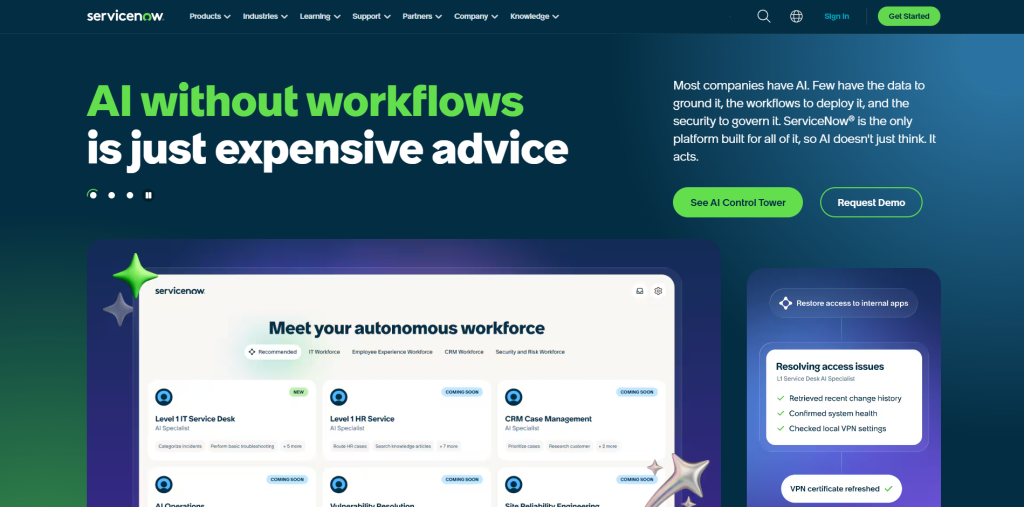
If your organisation already runs incidents, change control, or HR requests on ServiceNow, its IRM suite can feel like an extension of what you already have, not a separate system to maintain. The practical benefit is data continuity. Risk signals can flow from the same tables that power IT service management, security operations, vendor management, and more.
That shared foundation shows up quickly in day-to-day work. A critical vulnerability logged by SecOps can appear on the risk register instantly, complete with an owner, current status, and a remediation deadline. No exports, no duplicate records, no spreadsheet reconciliation.
ServiceNow’s real advantage is workflow muscle. Risk assessments, exception approvals, and control attestations can run on the same engine that routes routine service requests. You can design multi-step processes, set SLA timers, and nudge lagging owners automatically. Auditors benefit from the audit trail, and operators benefit because remediation tasks land in the queues teams already use, which helps issues close faster.
Strengths: a unified data model across risk and operational systems, powerful workflow automation, and strong traceability for audit.
Watch-outs: the platform’s breadth comes with real implementation effort. You need clear process maps and at least one admin who understands the Now Platform.
Ideal fit: large enterprises already rooted in ServiceNow that want real-time risk visibility without adding another standalone application.
4. Riskonnect: all-in-one risk suite with industry DNA
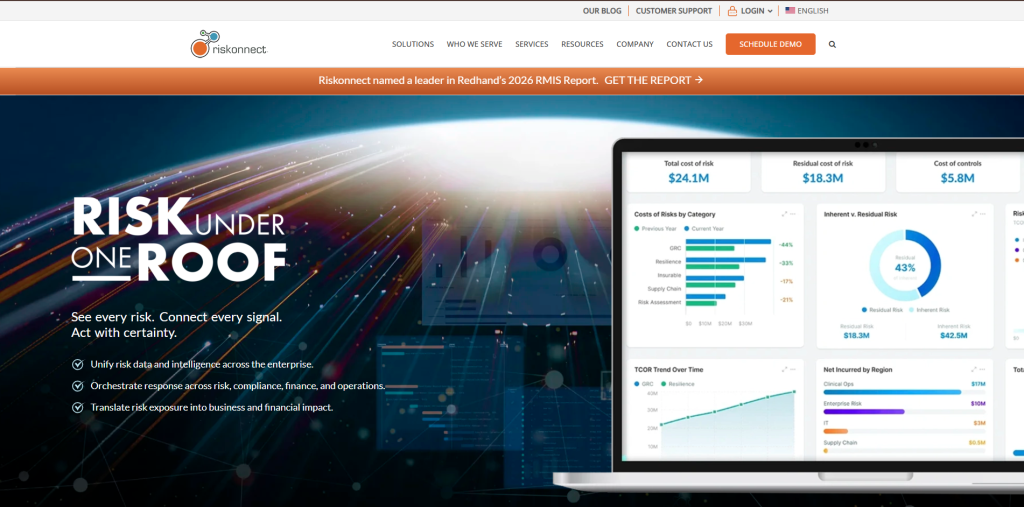
Riskonnect takes a wide-angle view of IRM. It combines enterprise risk and compliance with incident reporting, insurance claims, safety analytics, vendor oversight, business continuity, and ESG, all feeding a single data lake. In practice, that means events in the real world do not stay trapped in one module. A factory-floor accident can flow into operational risk scores and update executive KPIs within minutes.
That breadth is the product of time. Riskonnect spent a decade absorbing niche solutions and wiring them into one SaaS platform, and it shows in how “ready” the platform feels for regulated environments. Healthcare teams can pull OSHA forms from the library. Insurers can use pre-mapped solvency controls. Banks can start with DORA impact tolerances already laid out. Less reinvention, more execution.
Reporting stays action-oriented. Dashboards surface red heat tiles, link directly to underlying incidents, and let teams launch remediation tasks in a click. Users report that monthly board prep drops from days to hours because the narrative is already connected across incidents, controls, and risk.
Strengths: broad, end-to-end coverage on a shared data lake, strong fit for regulated industries, and dashboards designed to drive action instead of just status updates.
Watch-outs: the platform can feel complex if you switch on too many modules at once. The best deployments phase it, starting with a core risk register and adding the next two modules that address the biggest pain.
Ideal fit: large, heavily regulated enterprises that want to retire a patchwork of incident, audit, and continuity tools and run risk from one cloud console.
5. OneTrust: privacy roots, platform ambition
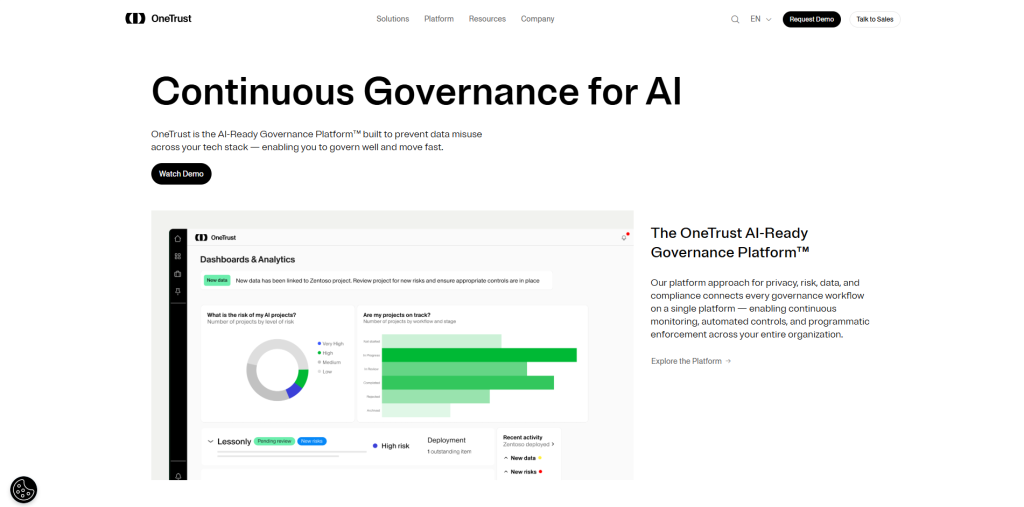
OneTrust started by tackling cookie banners and GDPR workflows. That privacy foundation now anchors a broader Trust Intelligence Platform that spans data governance, third-party risk, security controls, ethics hotlines, and ESG disclosures.
The value is in how those domains connect. Modern risk rarely stays in one lane, and OneTrust is designed to let signals travel. A data-mapping scan that finds personal information sitting on an unprotected server is both a privacy exposure and a cyber risk. In OneTrust, those alerts can flow into the risk register, link to the relevant controls, and trigger remediation work without copy-paste handoffs.
The product is also intentionally modular. You can turn on the tiles you need, such as Vendor Risk, IT and Security Risk, or ESG, and expand navigation as your program grows. Budget owners should note the trade-off here. Costs rise as you add tiles, but the à-la-carte model makes it easier to prove value in one area before you scale.
Automation covers a lot of the routine work. Vendor questionnaires chase suppliers, policy attestations ping employees on schedule, and AI classifiers tag new data sets so control owners can see where fresh exposure may be emerging. The risk module itself still trails some rivals in deep analytics, but the integration convenience is a big reason teams stick with it.
Strengths: strong cross-domain connections from privacy and data governance into risk workflows, modular adoption, and automation for recurring tasks.
Watch-outs: total cost can increase as you add tiles, and organisations looking for deeper risk analytics may find the module lighter than more specialised IRM suites.
Ideal fit: organisations where privacy or third-party risk dominates the agenda, and leadership wants one cloud platform to manage trust end-to-end, from cookie consent to board-level heat maps.
6. Optro: audit-native UX that pulls risk into the spotlight

Optro started as a SOX compliance helper, and it still shows an auditor’s bias for clarity. The dashboards are straightforward, with a plain-English view of controls, open issues, and linked risks. That simplicity helps with adoption. Peer reviews cite high user-adoption scores, in large part because non-specialists can see what needs to happen next.
The “connected risk” model is where Optro earns its place in an IRM shortlist. When an auditor flags a control failure, the system raises the residual risk score, sends a remediation task to the owner, and tracks progress through to closure. That closed loop reduces swivel-chair handoffs and keeps the three lines of defense aligned in the same workflow.
Setup is typically light. Many organisations start with SOX or internal audit, then activate the enterprise risk module. Because both run on the same SaaS core, data moves between them without additional integration projects or middleware licences.
Strengths: an interface designed for auditors and business stakeholders, plus a tight linkage between controls, issues, and risk that supports follow-through.
Watch-outs: Optro is not built for deep operational calculators or asset-level quantitative engines. It focuses on governance, controls, and assurance, not modelling hurricane scenarios or running supply-chain Monte Carlo analyses. Large multinationals often pair it with a heavier analytics layer.
Ideal fit: public or pre-IPO companies under SOX that want a friendly interface, and want audit findings to update risk registers automatically instead of months later in a spreadsheet.
Conclusion
The six platforms above each solve a real problem, but none of them solve every problem. Vanta gets cloud-first teams to audit-ready fastest. LogicGate gives you the freedom to model your own process without code. ServiceNow turns risk into a first-class workflow inside the systems your IT teams already live in. Riskonnect consolidates incidents, claims, continuity, and ESG so leadership stops chasing siloed dashboards. OneTrust extends a privacy foundation into broader trust workflows. Optro turns audit findings into living risk register updates instead of forgotten spreadsheets.
The harder question is which problem you actually need solved first. Most teams overshoot by buying breadth they cannot operationalise, then quietly fall back to spreadsheets six months later. A better starting point is to name the one workflow that currently steals the most cycles, whether that is questionnaire chasing, board reporting, vendor reviews, or post-incident follow-up, and pick the platform that owns that lane today. You can always layer adjacent modules later, and most of these tools are explicitly designed for that kind of phased adoption.
Treat your shortlist demos like a job interview, not a feature parade. Bring real data, real workflows, and real edge cases. Ask the vendor to walk through a vendor onboarding, a control failure, and a board-ready report using your actual operating model, not a sandbox. The platform that handles that small slice cleanly is almost always the one that will scale with you. The rest is just slideware. These six tools represent the best GRC platforms for tech teams looking to move beyond spreadsheets and legacy risk systems.