
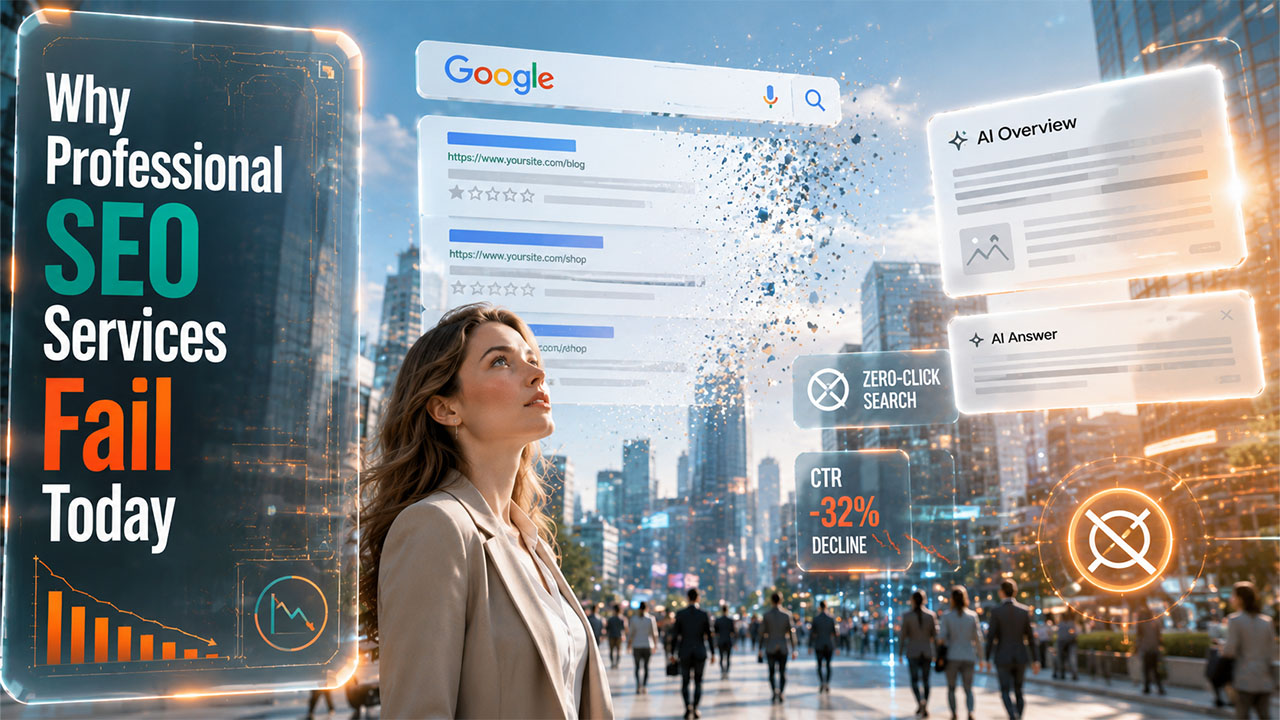
Professional SEO Services Are Being Asked to Solve a Problem They Weren’t Built For
Discover why professional SEO services alone can no longer guarantee rankings, traffic, or growth in an era shaped by AI overviews and zero-click searches.
Professional SEO services are facing a crisis that has been building for years. Clients arrive with expectations shaped by outdated promises, and agencies are left managing the fallout of a discipline that was never designed to do what businesses now demand of it. The result is wasted budgets, broken relationships, and campaigns that fail before they start.
The Gap Between What Clients Want and What SEO Delivers
The most common friction point is the timeline. Clients want top-three rankings in 90 days. Agencies deliver 20-30% organic traffic growth over 12 months. Those are not the same thing, and no amount of client education fully closes that gap once expectations are set.
HubSpot’s 2023 State of Marketing data found that 68% of clients expect measurable results within 3 months. SEO simply does not work that way. Domain authority builds gradually. Technical improvements take time to get indexed. Content earns search engines’ trust over months, not weeks.
| Client Expectation | SEO Reality | Realistic Timeline |
| #1 Google ranking | Top 10 position | 12+ months |
| 500% traffic increase | 20-50% organic growth | 6-9 months |
| Immediate sales lift | Gradual conversion improvement | 9-12 months |
Three patterns repeat constantly. E-commerce clients push for instant top rankings on high-volume keywords; agencies instead build traffic through long-tail terms and intent matching. Local businesses want leads next month; agencies spend that time optimizing Google Business Profiles. Enterprise clients want domain authority to jump fast; off-page SEO yields incremental gains, not dramatic ones.
SEO Was Built for a Different Internet
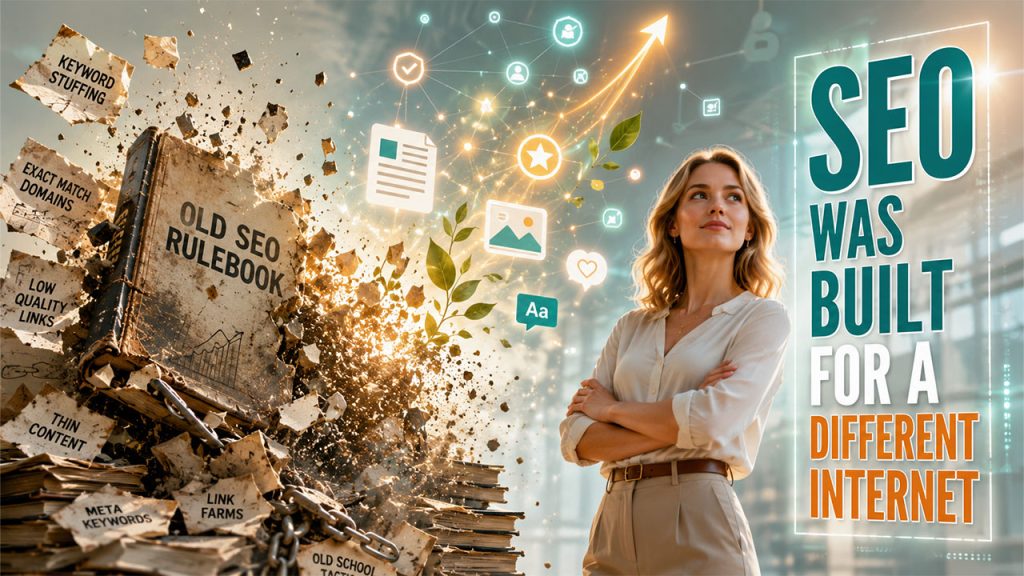
Search engine optimization started as technical work for early search engines. Google’s 1998 PageRank algorithm ranked pages based on link authority. That was a solvable problem. Build links, earn authority, rank higher. The logic was clear.
The search environment has changed since then in ways that traditional SEO was never designed to address. Key algorithm shifts reshaped what ranking actually means:
- 1998: PageRank launch, rewarding link quantity and quality
- 2011: Panda update penalized thin content and keyword stuffing
- 2018: Medic update introduced E-A-T (expertise, authoritativeness, trustworthiness) as a ranking factor
- 2024: Helpful Content systems now prioritize genuine utility over optimization tactics
Each update moved the goalposts. What worked in 2015 can get a site penalized today. Agencies operating on outdated playbooks are selling strategies that may actively harm the clients who pay for them.
What Professional SEO Services Cannot Fix?
Organic traffic dropped more than 50 percent for mid-tier content sites following the 2023 Helpful Content Update. SparkToro’s research found that 65 percent of Google searches now end without a click. Users get their answer from a featured snippet, an AI overview, or a knowledge panel and never visit the site that provided the information.
Google’s Search Generative Experience appears above organic results for more than 30 percent of queries. Semrush data shows a 29% drop in click-through rate from position 1 due to AI-generated summaries appearing above it. Ranking first no longer means what it used to mean.
The three main disruptions reshaping organic search are AI overviews pulling answers from indexed content without generating visits, Perplexity and ChatGPT Search capturing conversational queries, and shopping and local results pushing organic listings below the visible fold on many commercial searches.
An agency can optimize for E-A-T principles, improve core web vitals, and build a strong internal linking structure. None of that fixes zero-click behavior. That is a structural shift in how search works, not a technical problem SEO can solve.
Why Businesses Keep Hiring SEO Agencies Anyway
Related walkthrough
Free SEO Tool: DA/PA Checker Chrome Extension

The appeal is understandable. Professional affordable SEO services offer specialized expertise. The promise of passive, compounding organic traffic is genuinely attractive compared to paid channels that stop the moment the budget runs out.
The problem is that some agencies exploit this appeal with pricing that implies certainty no one can guarantee. Black-hat providers charging $500 per month rely on spammy link building and doorway pages, often resulting in manual penalties. Grey-hat operations at $2,000 per month buy low-quality backlinks to temporarily boost authority, which fades after the next core update. White-hat SEO, done properly, costs $5,000 or more per month with realistic timelines of 12 to 18 months.
The mismatch between what clients hear in sales calls and what SEO can actually deliver sets up campaigns for failure before work begins.
How Scope Creep Compounds the Problem
Unclear contracts turn keyword research projects into full-site rebuilds. One documented case study shows an e-commerce client who spent $87,000 with an agency that delivered 2 percent traffic growth, far short of the promised 300 percent. The agency had expanded from core SEO work into conversion rate optimization ($18,000) and paid search management ($24,000), spreading effort thin across channels that were not focused.
Warning signs that a campaign is heading this direction:
- Vague KPIs such as “more traffic” with no defined targets
- Success metrics that shift mid-campaign without client agreement
- No fixed timeline on deliverables like link building or technical fixes
- Unlimited revision cycles that extend projects indefinitely
Once scope creep takes hold, it dilutes the agency’s focus on what it was actually hired to do. Clients end up with partial results across multiple channels rather than meaningful progress in any one of them.
What Actually Works Alongside SEO
The answer is not to abandon search engine optimization. It is to stop treating it as the only lever worth pulling. Companies like NetReputation have been public about this, positioning reputation management and search visibility as connected but distinct disciplines that require different tools.
A hybrid strategy combining email, YouTube, and community building drove 187 percent lead growth over 12 months for one e-commerce client. That number is not just from SEO. It came from owning multiple audience touchpoints that are not dependent on Google’s algorithmic decisions.
| Channel | Estimated ROI | Control Level |
| Email marketing | 42:1 | Full |
| YouTube | 15:1 | High |
| 12:1 | Medium | |
| Community platforms | 20:1 | Full |
| Paid social | 8:1 | Full |
Email: The Channel Businesses Actually Control
Email marketing delivers full audience control, which SEO, by definition, cannot. Build a list through lead magnets tied to genuine value, not generic downloads. Segment based on buyer intent. Track open rates and clicks with precision.
The reason email consistently outperforms SEO on ROI is that a purchased list or earned subscriber base does not disappear after a core algorithm update. That asset belongs to the business.
YouTube as a Search Engine
YouTube is the second-largest search engine in the world. It runs on a discovery algorithm that rewards consistency and relevance, not domain authority built over the years. Tutorials, explainers, and case studies attract compounding organic views without relying on Google’s indexing decisions.
Evergreen video content also addresses the zero-click problem differently. A viewer who watches a 10-minute tutorial and then visits the site is a warmer lead than someone who skims a featured snippet and bounces.
Community Platforms and Direct Relationships
Private groups, forums, and niche community platforms build audience trust that neither Google rankings nor social media followers can replicate. Members become referral sources. Engagement is direct and measurable. There is no algorithm that decides whether content is seen.
The three main advantages of community-based channels are full control over distribution, direct feedback loops for content and product decisions, and referral-driven growth that compounds without paid amplification.
What Needs to Change in How SEO Is Sold
The core issue is not that professional SEO services are worthless. It is that they are routinely sold as solutions to problems they cannot solve on their own.
Realistic contracts define deliverables with specific KPIs: target keyword positions, organic traffic benchmarks, core web vitals scores, and conversion rate baselines. They set timelines based on competitive analysis, not optimism. They include clear language about what algorithm changes mean for the work.
Agencies that build trust with clients are the ones who clearly and early say that SEO is one channel in a broader strategy, not a substitute for a full digital marketing operation. That conversation is harder to have in a sales call. It is much easier to have than the one that happens 12 months later when a client wants to know where their $87,000 went.
Conclusion
SEO has earned its place in any serious digital marketing strategy. However, it works best when businesses have a clear picture of what their goal is, understand what it can deliver, how long it takes, and what it cannot fix on its own. The agencies that are worth working with are the ones that tell you that upfront, even when it costs them the sale. Stop chasing rankings as an end goal. Build systems across multiple channels, own your audience, and treat search as one part of a larger engine, not the whole thing.