
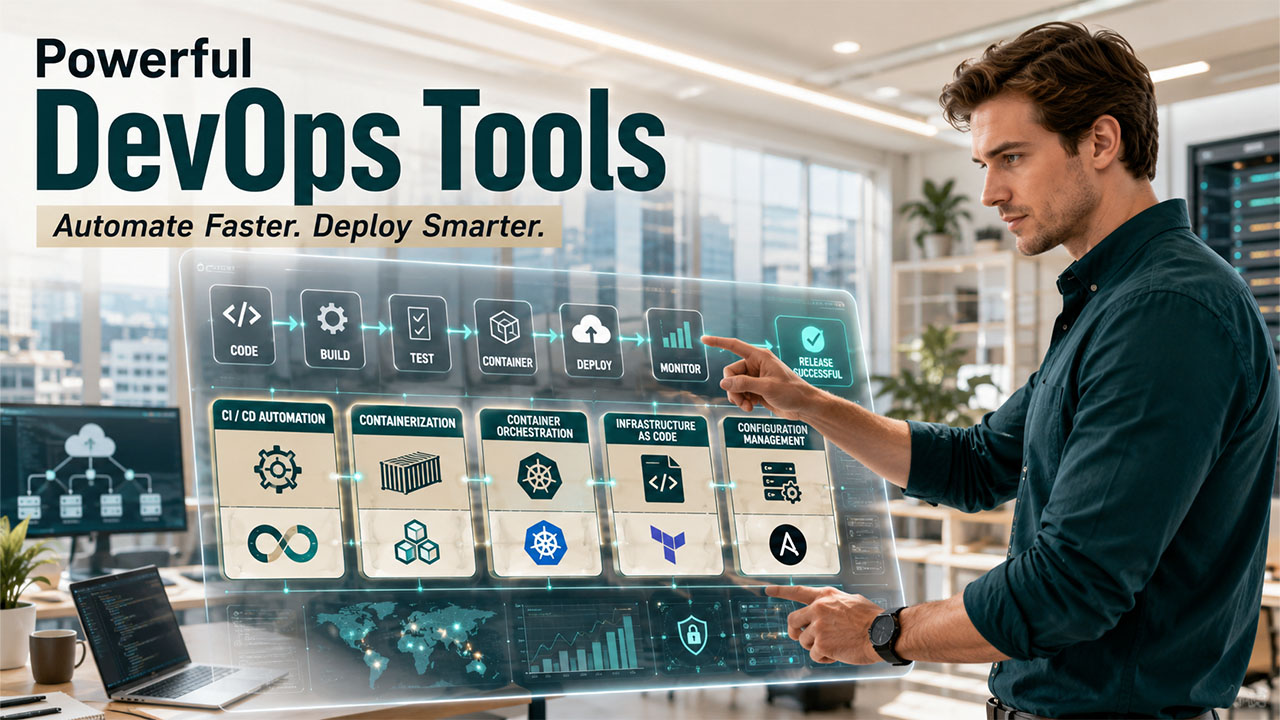
Top 5 DevOps Tools to Streamlining Modern Software Development in 2026
Explore the top 5 DevOps tools that can help streamline software development and discover their features, best practices, and challenges.
In this guide, we will explore the best DevOps tools that help in streamlining software development in modern organizations, along with understanding their benefits, limitations, and most popular solutions.
In the current modern software development landscape, organizations need to deliver high-quality applications quickly, while also maintaining stability and security. The growing demand for efficient software development has made DevOps one of the most crucial methodologies in modern IT. DevOps promotes collaboration, automation, and continuous improvement throughout the complete lifecycle of software development.
For every successful DevOps strategy, there are DevOps tools that help in automating repetitive tasks, improving collaboration, monitoring applications, and managing infrastructure. These tools also ensure a smooth delivery of the software. Be it a startup, enterprise, or an individual developer, choosing the right DevOps tools can help significantly in improving the overall productivity, along with reducing deployment errors, and accelerating time-to-market.
What are DevOps Tools?
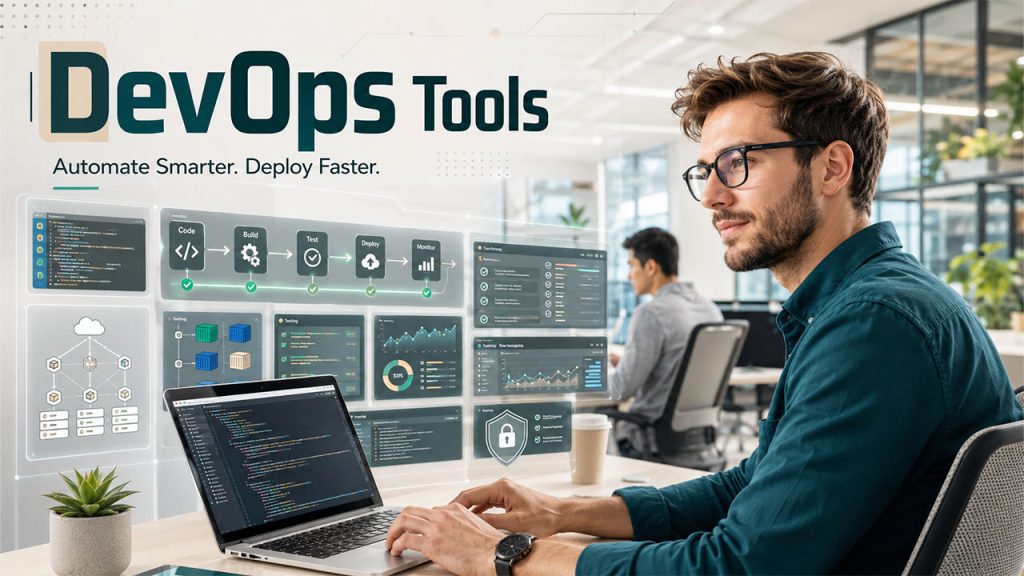
DevOps tools are software applications which help software developers automate and manage different stages of the software development lifecycle (SDLC). These tools support key processes, such as planning, coding, building, testing, deployment, monitoring, security, and infrastructure management. The tools help development and operations teams to work efficiently together by reducing manual tasks, along with improving collaboration, and ensuring consistent software delivery.
DevOps tools support multiple stages of the software development pipeline, which include source code management, continuous integration and continuous deployment (CI/CD), configuration management, containerization, orchestration, infrastructure as code (IaC), monitoring, logging, and security.
In the current cloud-native and agile development landscape, DevOps tools have become more essential for organizations, as they help teams deliver high-quality applications faster, while also responding to changing customer requirements and maintaining reliable, secure, and scalable systems.
Why are DevOps Tools Important?
The DevOps tools offer numerous benefits to organizations, especially in building, testing, deploying, and managing software more efficiently. These tools also help in automating repetitive tasks, along with improving collaboration between development and operations teams.
Some of the key importance of DevOps tools are as follows:
- Faster Software Delivery: One of the major advantages of DevOps tools is their ability to accelerate the software development lifecycle. Code integration, testing, and deployment automation help teams to quickly and more frequently release new features, bug fixes, and updates.
- Improves Collaboration: DevOps tools also help create a shared environment in which developers, operations engineers, quality assurance teams, and security professionals can collaborate more effectively.
- Increased Automation: Organizations can automate various repetitive tasks, such as code building, testing, infrastructure provisioning, configuration management, and deployments using the tools.
- Higher Software Quality: The automated testing and continuous integration features of DevOps tools help in standardizing the deployment process across development, testing, and production.
Categories of DevOps Tools

The categories of DevOps tools serve a key purpose, from planning and coding to deployment, monitoring, and security. Selecting the right combination of tools can help the organization in building a reliable application, along with improving collaboration and delivering software more efficiently.
Version Control Tools
The vision control systems help the developers in tracking code changes, along with efficient collaboration and maintaining a modification history.
Popular Tools
- Git
- GitHub
- GitLab
- Bitbucket
Continuous Integration and Continuous Deployment (CI/CD)
The CI/CD tools help in automating the process of building, testing, and deploying applications.
Popular Tools
- Jenkins
- GitHub Actions
- GitLab CI/CD
- CircleCI
Configuration Management Tools
The configuration management tools help ensure that the server and infrastructure remain consistent across development, testing, and production environments.
Popular Tools
- Ansible
- Puppet
- Chef
- SaltStack
Containerization Tools
The container package applications, along with their dependencies, ensure consistent behavior across various environments.
Popular Tools
- Docker
- Podman
- LXC
Container Orchestration Tools
These tools can manage hundreds or thousands of containers, along with automating deployment, scaling, networking, and recovery.
Popular Tools
- Kubernetes
- OpenShift
- Amazon ECS
Infrastructure as Code
The IaC tools allow teams to easily define infrastructure using configuration files, rather than manual steps.
Popular Tools
- Terraform
- AWS CloudFormation
- Pulumi
Monitoring and Logging Tools
Monitoring is the most essential stage for maintaining application health and identifying issues.
Popular Tools
- Prometheus
- Grafana
- Datadog
- New Relic
Security Tools
Modern DevOps tools incorporate security throughout the software development lifecycle, using DevSecOps practice.
Popular Tools
- SonarQube
- Snyk
- Trivy
- Aqua Security
Top 5 DevOps Tools in 2026
Related walkthrough
How to Use Claude AI with Blender MCP (Full Setup Tutorial 2026)

The modern DevOps ecosystem evolved significantly with new technologies and automation capabilities. In this evolution, a few tools remained the preferred choice for organizations, especially due to their reliability, scalability, and strong community support.
Some of the most popular DevOps tools in 2026 are as follows:
1. Jenkins
Jenkins is among the most used open-source automation servers for implementing Continuous Integration and Continuous Deployment (CI/CD). The platform automates repetitive tasks, such as code building, testing, and deployment, allowing development teams to deliver software quickly and reliably.
Key Features:
- Automated build and deployment pipelines
- Extensive plugin ecosystem
- Pipeline as Code support
- Integration with Git, Docker, Kubernetes, and cloud platforms
2. Docker
Docker is among the most popular containerization platforms, which is used in DevOps. The platform allows developers to package applications, along with their dependencies, into a lightweight and portable container, which can run consistently across different environments. The platform also helps in simplifying application deployment and speeding up software delivery.
Key Features
- Lightweight and portable containers
- Consistent application environments
- Fast application deployment
- Efficient resource utilization
3. Kubernetes
Kubernetes is considered the industry-leading container orchestration platform, which is designed to automate the deployment, scaling, and management of containerized applications. The platform offers advanced capabilities, such as automatic scaling, load balancing, self-healing, rolling updates, and service discovery.
Key Features:
- Automated container deployment
- Auto-scaling based on workload
- Self-healing capabilities
- Load balancing and service discovery
4. Terraform
Terraform is considered the leading Infrastructure as Code (IaC) tool, which helps teams in enabling the provision and management of infrastructure using configuration files, instead of manual processes. The platform allows infrastructure to be version-controlled just like application code, ensuring consistent deployment, repeatability, and easy to maintain.
Key Features:
- Multi-cloud infrastructure management
- Infrastructure as Code (IaC)
- Automated resource provisioning
- Reusable modules
5. Ansible
Ansible is an open-source automation tool, which is most commonly used for configuration management, application deployment, infrastructure provisioning, and IT process automation. It is an agentless platform, which communicates with remote systems over SSH without requiring additional software.
Key Features:
- Agentless architecture
- Easy-to-read YAML playbooks
- Automated server configuration
- Application deployment automation
Choosing the Right DevOps Tools
Selecting the right DevOps tools mainly depends on various key factors, such as:
- Team Size
A small team may benefit from an integrated platform, while a large organization may require specialized enterprise solutions.
- Cloud Environment
Users need to ensure that the DevOps tools are compatible with their preferred cloud provider.
- Integration Support
Developers should prefer tools that can be seamlessly integrated with the existing technology stack to reduce any operational complexity.
- Scalability
The DevOps platform should support the future growth of the organization without requiring major architectural changes.
Common Challenges
While DevOps tools offer significant benefits such as faster software delivery, improved collaboration, and increased automation, the real challenges arise while implementing and managing them. The organization faces severe technical, operational, and cultural obstacles while adopting a DevOps tool.
Some of the key challenges while using DevOps tools are as follows:
- Selecting the Right Toolset: Selecting the right DevOps toolset is among the biggest challenges. Selecting the right tool that aligns with the organizational requirements, technology stack, and long-term goals can be difficult.
- Integration Complexity: Organizations generally use multiple DevOps tools to support different stages of the software development lifecycle. The organization needs to ensure these tools work seamlessly together, especially while integrating legacy systems with modern cloud-native technologies.
- Security and Compliance Challenges: Misconfigured pipelines, insecure container images, exposed credentials, and inadequate access controls can lead to severe security risks. Organizations should also address common DevSecOps bottlenecks to ensure security does not slow down software delivery while maintaining compliance throughout the CI/CD pipeline.
Conclusion
DevOps tools have become an essential part of modern software development, as they help organizations automate processes, improve collaboration, enhance security, and deliver applications. From version control and Ci/CD automation and containerization, DevOps tools play a crucial role in creating an efficient software delivery pipeline. As technologies continue to grow rapidly, DevOps tools play a crucial role in enabling faster innovation, along with supporting cloud-native development.
FAQs Of DevOps tools
What is the importance of DevOps tools in modern organizations?
In a modern organization, DevOps tools help in automating repetitive tasks, reducing manual errors, and improving software quality.
Can DevOps tools improve software development?
Yes, DevOps tools can help improve software development by automating processes such as code integration, testing, deployment, and infrastructure management.
What are the best CI/CD tools in DevOps?
In DevOps, the best CI/CD tools are Jenkins, GitHub Actions, GitLab CI/CD, and CircleCI. These help in automatically building, testing, and deploying applications.
Can DevOps tools improve security?
Yes, the DevOps tools can improve security by integrating security checks into the software development lifecycle.