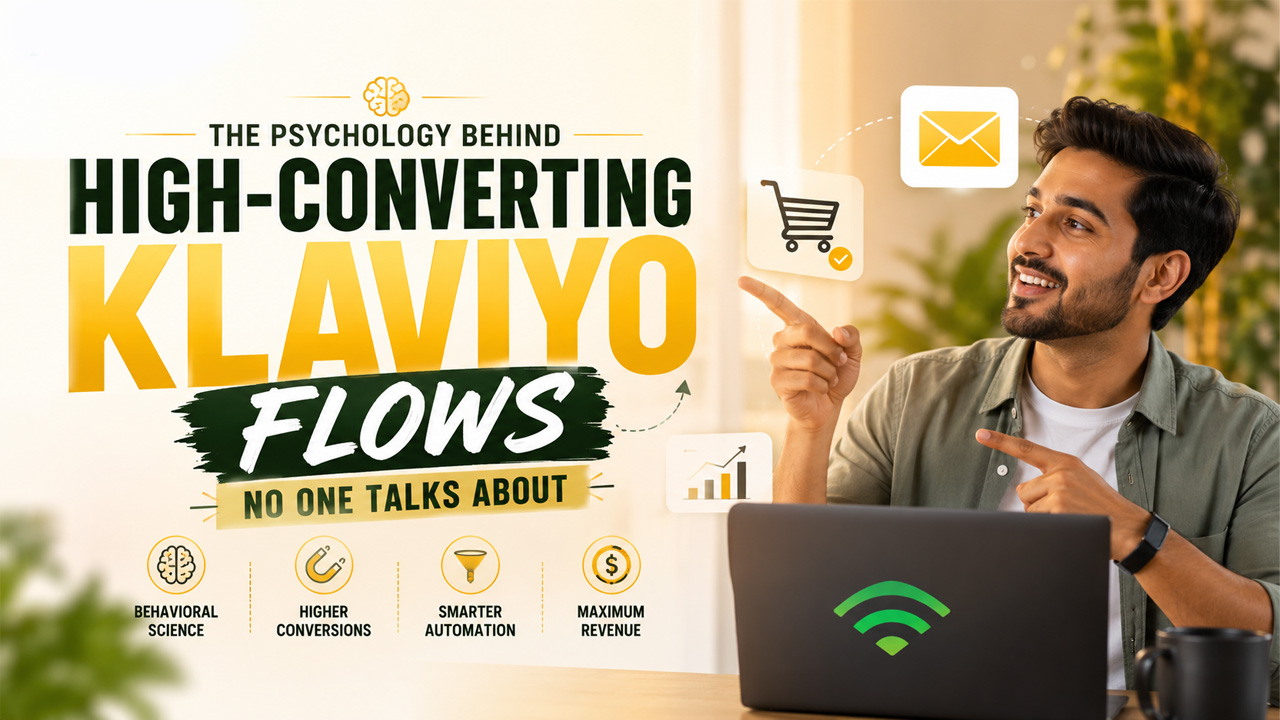
The Psychology Behind High-Converting Klaviyo Flows No One Talks About
Discover how to leverage behavioral science in your email marketing. Learn how a top klaviyo Flows marketing agency uses the Zeigarnik effect and loss aversion to drive sales.
Email is not a math problem. It is a human one.
The brands that win do not just automate better. They understand what makes a person pause, remember, hesitate, return, and buy.
Most teams build flows like traffic lights. Green, yellow, red. Send, wait, send again. Then they wonder why the customer feels nothing.
That is where a Klaviyo email marketing agency changes the game.
It does not just wire up templates. It also builds flows around human behavior, social identity, FOMO, and the little emotional touchpoints that boost revenue.
Let’s cut to the chase and uncover some hard-hitting truths about high-converting Klaviyo flows.
Why do psychological triggers outperform standard automation?
True conversion doesn’t come from tactics alone. It comes from understanding behavior.
- Urgency creates movement.
- Scarcity sharpens desire.
- Social proof builds confidence.
- Personalization makes it feel it’s meant for you.
Together, they don’t just drive clicks, they build emotional connection.
And that’s the difference.
- Logical loyalty is fragile. It says, “I bought because it was cheap.”
- Emotional loyalty is different. It says, “I bought because this brand feels like mine.”
That second kind is what turns customers into repeat buyers and then into advocates. They do not just purchase. They remember, return, and recommend.
Psychological triggers outperform standard automation because people rarely buy from logic alone. They buy from timing, trust, identity, and unfinished emotional business.
The revenue gap is real. Automated emails often drive over 16x higher revenue per recipient than batch-and-blast campaigns. That is not because automation is magical.
It is because automation can be made personal, timely, and psychologically sharp.
| Psychological trigger | What it creates | What it drives |
| Urgency | “I should act now” | Faster conversion |
| Scarcity | “I might lose this” | Higher response |
| Social proof | “People like me chose this” | Lower resistance |
| Personalization | “This fits me” | Stronger trust |
How does the Zeigarnik effect power abandoned cart flows?
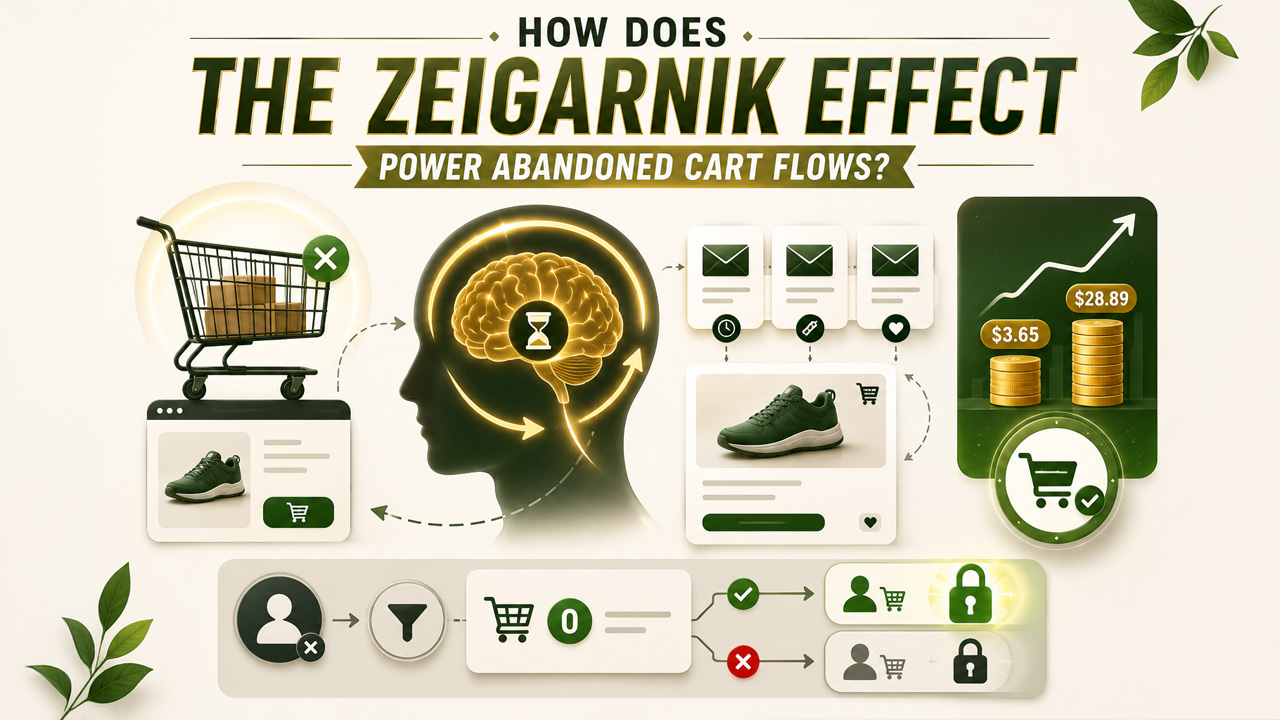
The Zeigarnik effect makes unfinished tasks harder to forget, which is why abandoned cart emails work by framing the cart as an open loop that the brain wants to close.
People remember incomplete things. That is the whole trick.
The Zeigarnik effect says the mind keeps unfinished tasks alive more vividly than completed ones. An abandoned cart is not just a missed sale. It is an open tab in the customer’s head.
That is why great abandoned cart flows do not nag. They nudge the brain toward closure.
- Instead of “You forgot this,” the email should feel like a continuation.
- It should whisper, “You were close.”
The financial stakes are not small. The average abandoned cart flow may generate $3.65 per recipient, while the top 10% can generate $28.89 per recipient.
Same trigger. Different architecture.
The best flows create cognitive closure without becoming annoying. They remind the customer what they left behind, show the exact item, and make the next step feel easy.
But the psychology only works if the logic is clean. You do not want to chase someone who has already checked out and bought.
That is why a strict filter matters: Placed Order zero times since starting this flow.
Without that, the flow becomes a comedy of errors. With it, the loop stays open only for the people who still need it.
Open loops sell. Closed mistakes do not.
How does social identity theory transform welcome flows?
Related walkthrough
How to Create AI UGC Ads Using Google Flow Agent | Complete Beginner Guide

Welcome flows succeed when they create belonging. The goal is to move a subscriber from casual interest to “this brand is for people like me.”
The moment after signup is fragile and powerful. The customer has raised a hand. Now they are asking, quietly, whether they made the right choice.
That is where welcome flows do real work. Not by pushing faster, but by building identity.
A strong welcome series does three things.
- It removes doubt.
- It builds confidence.
- It shows the brand is a place the subscriber can belong.
You do not want to sound like a salesperson. You want to sound like an introduction.
That means clarifying who the product is for. It means using testimonials, guarantees, and proof points that reduce second-guessing. And it means telling the founder story well enough that the brand feels human, not assembled in a lab.
The right welcome flow says:
- “Here is who we are.”
- “Here is who we help.”
- “And here is why people like you stay.”
That social signal matters because people buy into groups before they buy into products. A brand that feels like a community gets remembered. A brand that feels like a billboard gets skipped.
| Psychological job | Purpose | |
| Email 1 | Recognition | “You’re in the right place” |
| Email 2 | Proof | Testimonials, guarantees, outcomes |
| Email 3 | Identity | Founder story, values, community |
| Email 4 | Momentum | First purchase or next step |
What role does loss aversion play in win-back campaigns?
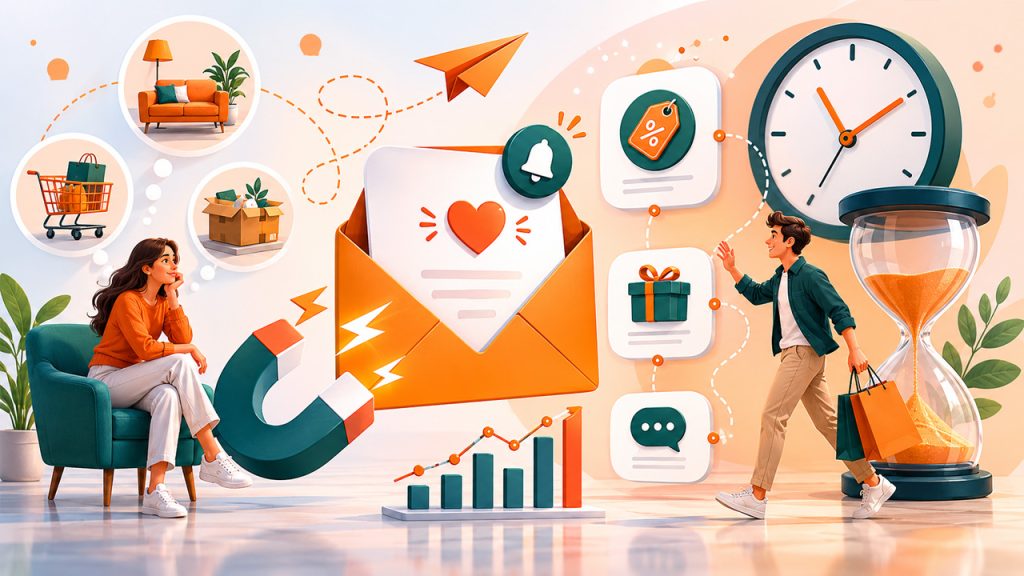
Win-back flows leverage loss aversion to remind customers what they are missing before it’s too late. The timing must match the product cycle, or the message becomes noise.
Loss aversion is simple. People hate losing more than they enjoy winning.
That is why win-back flows can work so well.
They do not need to create a new desire.
They only need to remind the customer what they are drifting away from.
But timing is everything.
A furniture buyer and a consumable replenishment customer do not move on the same clock. One purchases slowly. The other forgets quickly.
That is where predictive analytics matters. A good Klaviyo marketing agency knows when to apply pressure and when to stay quiet.
A classic win-back sequence moves like this:
- First, the emotional “Miss you” message.
- Then, a scarcity-based coupon.
- Then, a “what happened?” feedback request.
Each step is carefully. Each one gives the customer a way back in.
If that fails, the flow should enter sunset mode. Not every contact deserves eternal pursuit. Some deserve a final confirmation, then a respectful exit.
That protects deliverability. It also protects the brand from sounding desperate.
A good win-back flow does not beg. It reminds.
What separates behavioral flows from generic automations?
The difference is not the tool. It is the psychology behind the logic, the timing behind the send, and the emotional job each email is designed to do.
Generic automation sends because it can. Behavioral automation sends because it should.
One talks at the customer. The other moves with them.
That distinction sounds small until you see what it changes. Open rates become less random. Clicks become more intentional. Revenue per recipient starts climbing because the flow feels like a response, not an interruption.
The brain is already involved in every conversion. The only question is whether your flow is speaking its language.
Wrapping up
That brings us to the business end of this article, where it’s fair to say that high-converting Klaviyo flows are not built on luck.
They are built on how people think, remember, hesitate, and decide.
The brands that win in ecommerce email marketing in 2026 will not be the ones with the most templates. They will be the ones with the sharpest behavioral logic.
Book a free Behavioral Flow Audit with our Klaviyo marketing agency and see where your current setup is leaving revenue behind.
The ball is in your yard now. It’s time to make every effort count.