
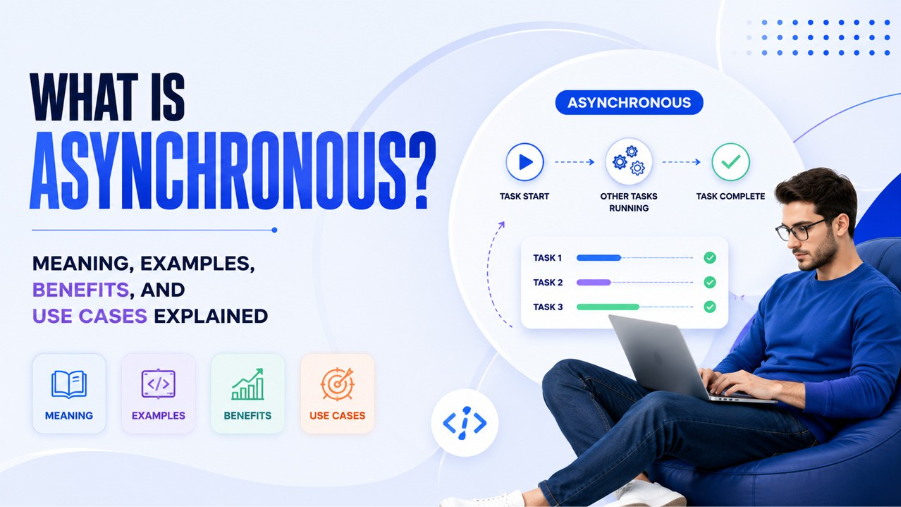
What is Asynchronous? Meaning, Examples, Benefits, and Use Cases Explained
Learn what asynchronous programming is, how it works, its benefits, common examples, and why it is essential for building fast and responsive modern applications.
This blog explains what asynchronous really means, both in everyday terms and in programming, where tasks run independently instead of waiting in strict order. We looked at how it works through callbacks, promises, async/await, and the event loop, and compared it to synchronous programming to highlight key differences in speed and complexity.
We also covered common examples like API calls and real-time messaging, core concepts every developer should know, and the genuine benefits and challenges that come with using them. Finally, we touched on how languages like JavaScript, Python, and Go implemented it differently, and where it shows up in real-world systems like streaming platforms and e-commerce checkout.
As a person who has been around code for some time, there is one particular word that you have heard way too many times whenever you were coding with APIs or performing file I/O operations, which is asynchronous. At first, this concept may seem straightforward, but when you try to implement it, you realize how challenging it really is.
In layman’s terms, the meaning of “asynchronous” is quite simple and refers to the idea that things do not have to be performed sequentially; they could be executed independently without being affected by each other. The power of asynchronous is immense in terms of programming because it gives us an opportunity to perform multiple actions at once in an application without making it hang while processing some lengthy operations.
In this blog post, we will learn the meaning of asynchronous, analyze it using examples, talk about its advantages, and mention use cases.
What is Asynchronous?
In simple terms, asynchronous means tasks don’t have to happen one after another in a strict sequence, a concept that builds on basic coding concepts like control structures and program flow. Instead, a task can start, run in the background, and let other things happen while it’s still working, rather than blocking everything else until it finishes.
Imagine yourself placing an order in a restaurant. You do not have to wait to stand at the counter while waiting for the order to be completed. You can just sit somewhere and wait for the notification regarding the completion of your order. This is what we refer to as asynchronous behaviour, where things happen without having to wait for all of them to finish first.
In the case of programming, when we need to fetch something from the server, read some file, or wait for some user input, instead of waiting there until we have done that, we continue doing other things asynchronously.
How Does Asynchronous Programming Work?
At the very essence of asynchronous programming lies the idea of allowing tasks to run independently of each other, without having the entire program wait for the completion of one task before executing another. While performing a certain asynchronous task, such as a request over a network connection or reading from a file, the program does not simply idle around until that task is done. Instead, it proceeds to perform some other code execution, and when that asynchronous task eventually completes, it is informed about that, and the results are appropriately taken care of.
This can be implemented in several ways, including the use of callbacks, promises, or async/await syntax, among others, according to the programming language being used. Mostly, all of this works through the concept of an event loop that continuously monitors whether there are any unfinished tasks and takes care of those when they are completed without stopping the execution of the main thread.
Synchronous vs Asynchronous Programming
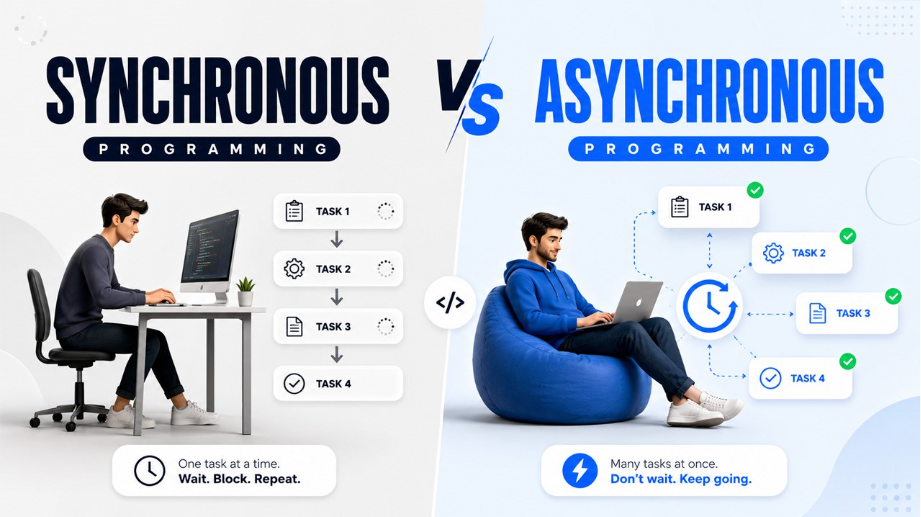
The key differences between the two come down to how tasks are handled:
- Execution order: Synchronous tasks run one after another, in strict order; asynchronous tasks can run independently without waiting for each other.
- Blocking behaviour: Synchronous code blocks the program until a task finishes; asynchronous code lets other tasks run while waiting.
- Performance: Synchronous programming can feel slow with time-consuming tasks; asynchronous programming keeps things responsive and efficient.
- Complexity: Synchronous code is simpler to read and predict; asynchronous code can be trickier to reason about and debug.
- Use case fit: Synchronous works well for simple, quick operations; asynchronous is better suited for tasks like API calls, file handling, or anything that takes noticeable time.
Common Examples of Asynchronous Code Execution
The following is a list of common cases of asynchronous code execution, which usually happen without the knowledge of the programmer.
- API requests: Requesting information from a remote server without blocking the application’s further execution until getting a response
- File access: Reading from or writing to files without affecting the further execution of an application.
- Database requests: Making queries that take some time to return results without affecting other operations of an application.
- User actions: Handling user interaction events such as clicks, scrolling, and input while allowing other code blocks to execute.
- Timers and delays: Scheduling code execution using methods such as setTimeout and setInterval.
- Web sockets and event handling: Processing live data such as messages or notifications.
Core Concepts of Asynchronous Programming
In order to get acquainted with asynchronous programming, it is necessary to learn a number of key concepts, which appear in practically all languages and frameworks:
Benefits of Asynchronous Programming
Related walkthrough
Mastering API Integration: HTTP Methods Explained with OpenAI Examples

Asynchronous programming brings some real advantages, especially for applications that depend on speed and responsiveness.
Here’s what makes it worth using:
- Improved performance: Tasks run in the background instead of blocking the entire program, making applications feel faster overall.
- Better user experience: Interfaces stay responsive even while waiting on slower operations like API calls or file loads.
- Efficient resource use: The system can handle other tasks instead of sitting idle while waiting for one operation to finish.
- Scalability: Applications can handle multiple requests or operations at once, which is especially useful for servers and APIs with heavy traffic.
- Smoother handling of I/O operations: Tasks like network requests, file reads, and database calls run more efficiently without freezing the rest of the app.
Asynchronous Programming in Popular Languages
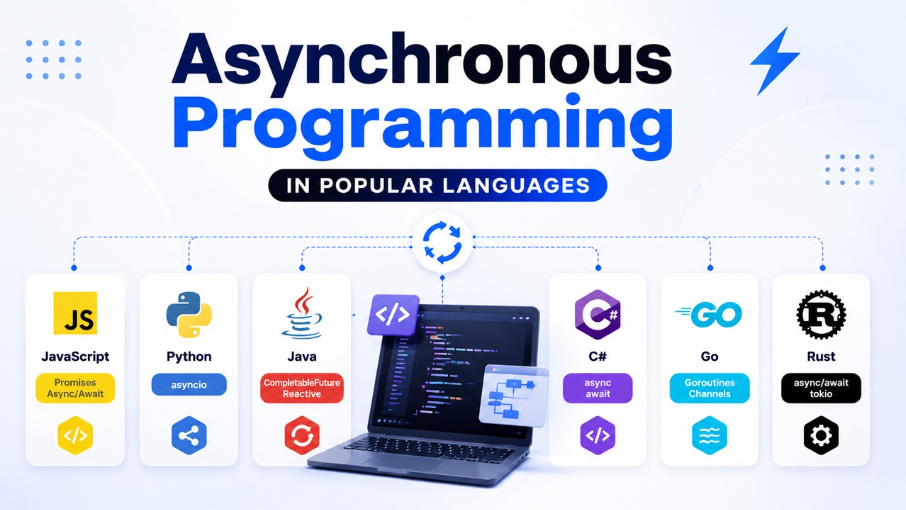
All modern programming languages provide their own means of asynchronous programming, even though the implementation details might be quite different. JavaScript uses promises and async/await features with the asyncio library, which are commonly used when dealing with I/O-bound operations, such as web request processing.
Java employs CompletableFuture classes and reactive programming frameworks instead, whereas C# enables programmers to write asynchronous code as naturally as synchronous code with async and await modifiers. Go language doesn’t use async/await syntax at all; instead, it relies on goroutines and channels. In Rust, one can use async/await syntax along with the tokio library.
Use of Asynchronous Programming in the Real World
Asynchronous programming is not just a theory that is discussed in books; it is the force behind the operation of many technologies that people interact with on a day-to-day basis. It is used in web applications to load data, images, or any content on demand, without requiring users to wait for a page to refresh. Chatting and messaging applications make use of asynchronous programming to ensure that message exchanges take place instantly and don’t slow down other functions of the application.
Streaming applications use asynchronous programming to buffer audio and video while the user is using the platform. E-commerce sites need to perform many tasks, such as checking inventory, making payments, and confirming orders, without slowing down the transaction process. Asynchronous programming can help in this regard. Similarly, asynchronous programming helps in managing multiple requests from an API or microservice at the same time. Even IoT applications make use of asynchronous operations by processing sensor data and responding to events.
Challenges of Asynchronous Programming
While asynchronous programming offers a lot of benefits, it isn’t without its difficulties. Here are some common challenges developers run into:
- Harder to read and debug: Asynchronous code can be trickier to follow compared to straightforward synchronous code, especially with nested callbacks.
- Callback complexity: Relying too heavily on callbacks can lead to deeply nested, hard-to-maintain code, often referred to as “callback hell”.
- Error handling: Catching and managing errors in asynchronous code requires extra care, since failures don’t always surface immediately.
- Race conditions: When multiple asynchronous tasks affect shared data, the order of execution can sometimes cause unexpected results.
- Testing difficulties: Writing tests for asynchronous code can be more complex, since timing and execution order aren’t always predictable.
Conclusion
By now, asynchronous programming should seem much less daunting than it did at first. A seemingly straightforward concept, whereby tasks can execute on their own rather than needing to wait for each other to complete, has turned out to be one of the foundational aspects of highly responsive modern software.
We have talked about what asynchronous programming is all about, compared it to synchronous programming, provided examples, concepts, advantages, and difficulties that it involves, analyzed the ways it works in various programming languages, and discussed the practical implementations of asynchronous programming in real-world applications.
At the end of the day, asynchronous programming does not depend on how well you remember the syntax but on the programming approach you apply.
Related blog: What Is Code in Programming? A Beginner-Friendly Guide
FAQs About Asynchronous
Q. What does asynchronous mean in programming?
Asynchronous means tasks can run independently without waiting for one another, allowing a program to continue executing other code while a slower task finishes in the background.
Q. What is the difference between synchronous and asynchronous programming?
Synchronous code runs tasks one after another, blocking until each finishes, while asynchronous code lets tasks run independently, keeping the program responsive even during slower operations.
Q. Why is asynchronous programming important?
It improves performance and user experience by preventing applications from freezing while waiting on tasks like API calls, file reads, or database queries.
Q. What are some common examples of asynchronous programming?
Common examples include API calls, file operations, database queries, real-time messaging, and handling user interactions without blocking other tasks.
Q. Which programming languages support asynchronous programming?
Most modern languages support it, including JavaScript, Python, Java, C#, Go, and Rust, each with their own approach like async/await, goroutines, or reactive libraries.