11 Best GRC Software Platforms Worth Considering in 2026
Discover and compare the 11 best GRC software platforms for 2026, and also explore the features, pricing, and expert insight on each platform.
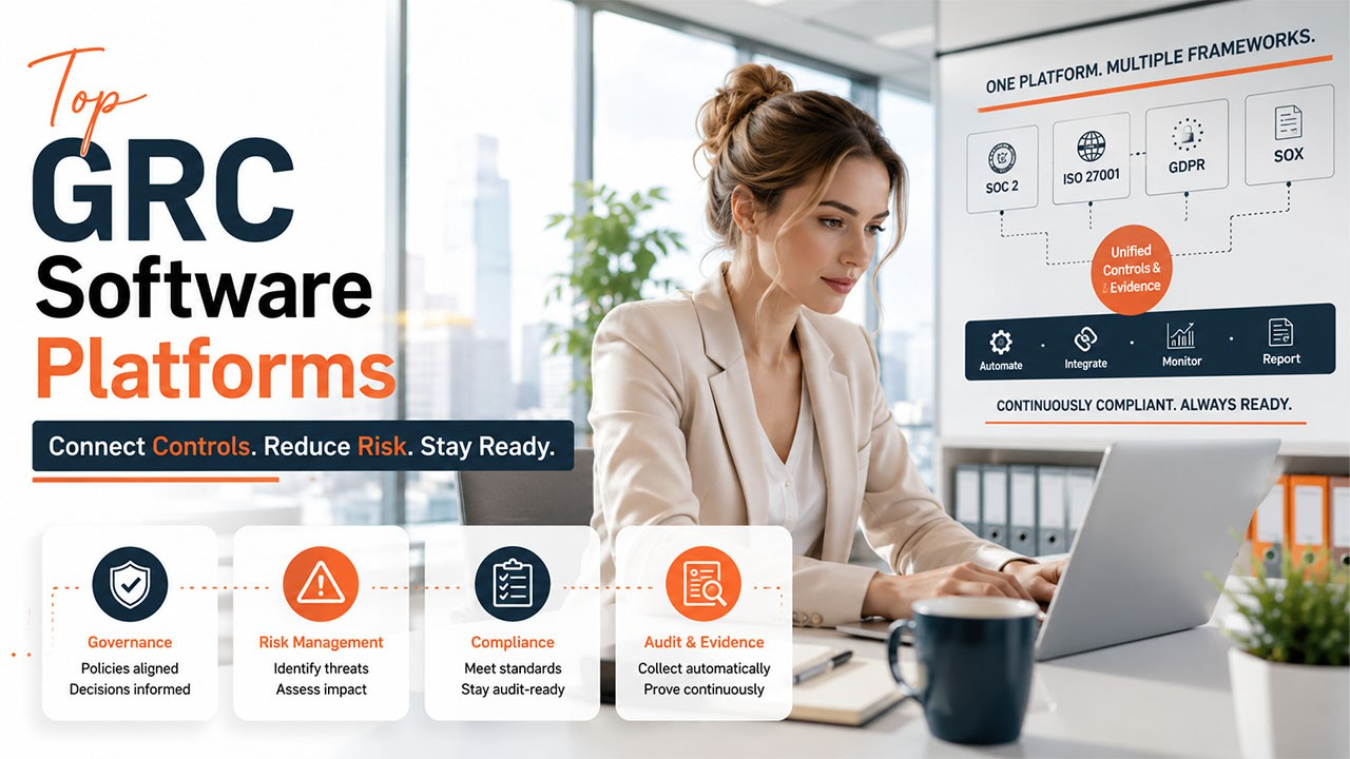
Selecting any roundup of the best GRC software will result in finding the same element, i.e. the vendor publishes the list rank itself first, and tells users who paid for the page, not which fits the users program. The more important question is whether the governance, risk, and compliance modules users are buying actually connect with each other once they are live.
The gap between the platform matters as GRC only pays off when controls, risks, policies, and evidence sit in a single place. The platform bolts three different disconnected modules together, and the user can rebuild the spreadsheet sprawl, just with a license fee attached. The platforms mentioned below are sorted by key factors, which include how well they unify those pieces, form automation-first tools that ships pre-connected to the enterprise suite that rewards users for heavy configuration. Every mentioned entry below covers what the tool does well, along with where users say it fall short and who it suites, so that the user can shortlist on substance instead of marketing.
Key takeaways
- The GRM software generally earns only when governance, risk, compliance, and audit data live in a single connected platform, instead of a siloed module.
- The market is mainly divided into two major camps, which includes automation-first compliance tool built for fast SOC2 and ISO 27001 readiness, and legacy enterprise suites that are designed for deep, configurable risk programs in a regulated industry.
- The cross-framwork mapping is a key feature, which separates real platforms from glorified checklists, mainly because it lets one control and other satisfy several frameworks at once.
- The right choice while selecting the best GRC software mainly depends on the size, the number of frameworks user manages, and how much internal configuration efforts they can absorb before the tool delivers value.
Why connected GRC software matters more than ever
In an organization, the demand for compliance keeps stacking. A growing SaaS company often chases enterprise deals, juggling SOC 2, ISO 27001, GDPR, and other customer-specific security questionnaires, at once. Each of these frameworks also ask for overlapping controls and evidence, meaning collecting the same access logs and policy approvals several times, just to manage them in isolation.
Buyers also feel this, especially during the audit season, when a disconnected toolset forces someone to export from one module, reformat, and re-upload into another. The regulators and auditors also have sharpened their expectations. The point-in-time snapshots are no longer satisfactory enough for reviewers, who want to see the control held across the whole period. This also pushes teams toward continious monitoring, rather than annual scrambles.
Connected GRC software answers both pressures. When a single control maps to several frameworks and evidence flows in from integrations on its own, the duplicate work disappears and the audit trail stays current. That’s the standard the platforms below get measured against.
What GRC software actually does
The GRC software is the system of record for an organization’s governance, risk, and compliance process. The platform stores the control library, tracks risks against controls, holds policies and their approvals, and also collects the evidence that proves controls operate as it is designed.
A capable GRC platform also automates the part most user hates, i.e., pulling evidence from cloud and identify systems, flagging when a control drifts out of compliance, routing policy reviews, and assembling everything for audit. The best and strongest tools also add a cross-framework mapping, letting user adopt a second or third standards reuses the controls and evidence they already manage instead of starting a fresh project every single time.
How GRC tools split into two camps
The market sorts into two recognizable groups, and knowing which one you’re shopping in narrows the field fast.
- Automation-first compliance platforms target security and compliance teams that need SOC 2, ISO 27001, and similar certifications at speed. They integrate with cloud and DevOps stacks, collect evidence on their own, and get teams audit-ready without a long rollout. Scytale, Vanta, and Drata sit here.
- Legacy enterprise GRC suites target large, regulated organizations with mature risk functions. They offer deep customization, broad risk taxonomies, and modules for everything from operational risk to ESG, but expect dedicated administrators and multi-month implementations. MetricStream, Archer, ServiceNow GRC, and IBM OpenPages anchor this group.
- Configurable mid-market platforms sit between the two, giving teams no-code workflow builders that adapt to custom processes at the cost of some setup effort. LogicGate and Riskonnect fall closest to this middle ground.
The 11 best GRC software platforms in 2026
Related walkthrough
Stellar OST to PST Converter Review 2026 | Online vs Desktop – Real Test

1. Scytale
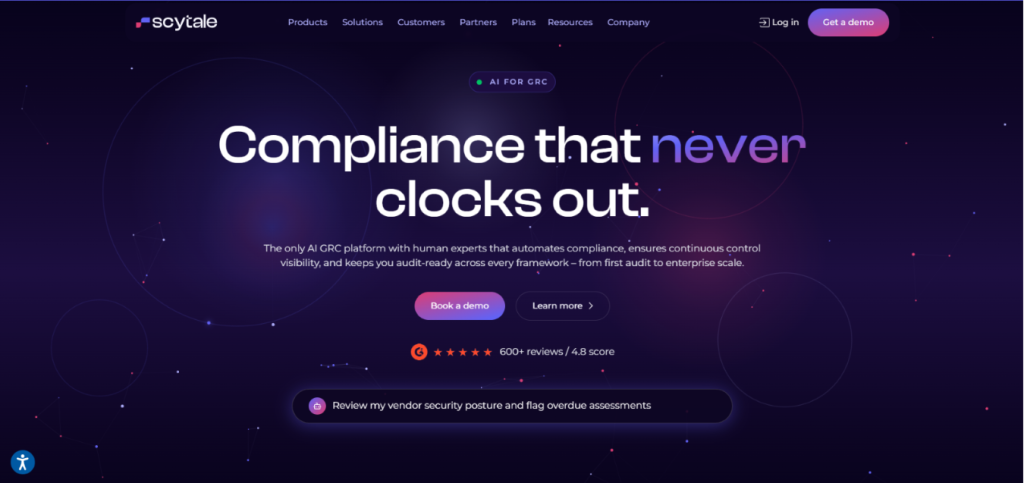
Scytale runs governance, risk, and compliance as one connected program rather than a collection of disconnected tools. The platform centralizes controls, risks, policies, evidence, vendors, and audits in a single Compliance Center, where cross-framework mapping lets the same controls and evidence satisfy multiple frameworks. AI-powered automation streamlines evidence collection, validation, and compliance workflows, helping teams manage SOC 2, ISO 27001, GDPR, SOX ITGC, and other frameworks eliminate duplicate work while maintaining continuous compliance.
Key features
- Continuous GRC through automated control monitoring with real-time visibility into your security and risk posture
- AI-powered automation for evidence collection, policy management, vendor risk management, and security questionnaires
- Centralized GRC management for controls, risks, policies, evidence, audits, and vendors in one platform
- Multi-framework management with cross-framework mapping across 80+ frameworks to eliminate duplicate work
- Dedicated GRC expert support alongside AI-powered automation throughout the compliance lifecycle
- 150+ integrations across cloud, identity, HR, source control, and ticketing platforms, with support for custom and on-premise systems
Scytale is particularly well suited for growing organizations managing multiple frameworks that need continuous compliance, AI-powered automation, and expert guidance. It helps security, risk, and compliance teams scale their GRC programs without the complexity of a traditional enterprise platform.
Pricing
Not publicly disclosed. Tiered plans support organizations from startups to enterprises, with pricing available on request.
2. MetricStream
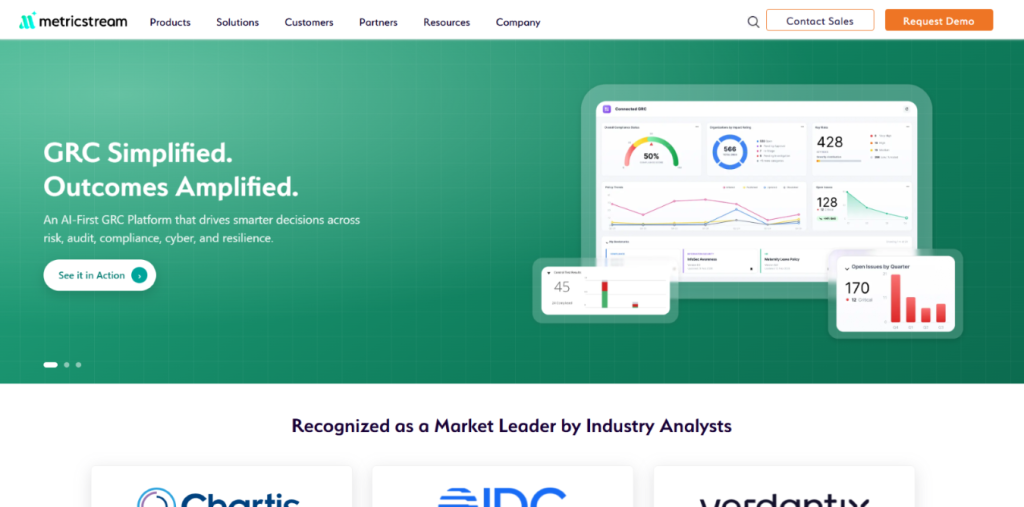
MetricStream is an enterprise GRC suite built for large, regulated organizations that need to manage risk, compliance, audit, and third-party risk across many business units and jurisdictions. Its AiSPIRE AI layer adds risk identification and compliance mapping on top of a deep regulatory content library.
Key features
- Enterprise-scale control management across distributed business units and regions
- Modules for enterprise risk, compliance, internal audit, and third-party risk
- AiSPIRE AI for automated risk identification and compliance mapping
- Regulatory content libraries that track evolving requirements
- Strong alignment with global regulatory regimes
It fits heavily regulated, globally distributed enterprises that can staff dedicated administrators. Reviewers warn that it’s costly relative to other GRC options, resource-heavy to implement and configure, and that the interface can feel dated and short on intuitiveness.
Pricing
Not publicly disclosed.
3. Riskonnect
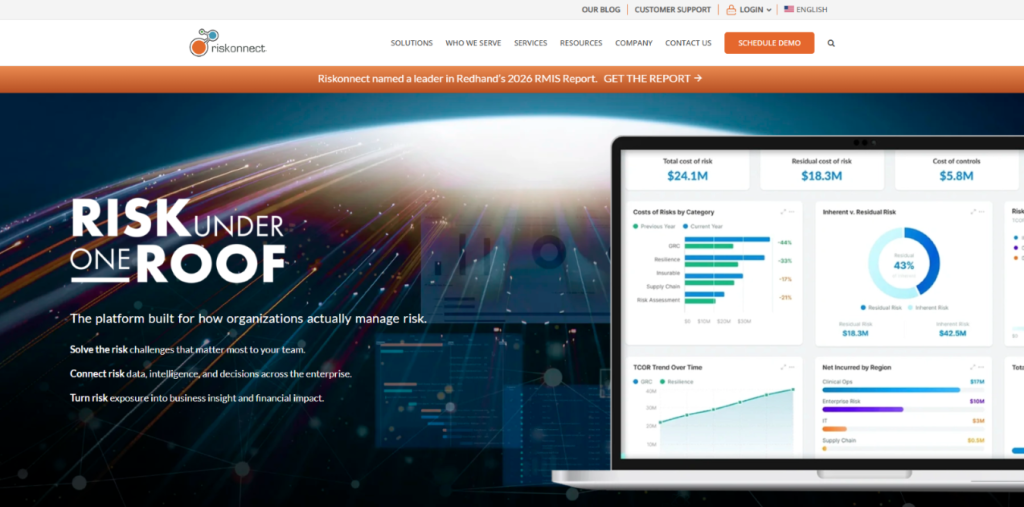
Riskonnect is an integrated risk management platform that unifies governance, enterprise risk, compliance, internal audit, operational resilience, and ESG, along with insurable risk and claims management, on one code base. It leans toward organizations with dedicated risk operations teams.
Key features
- Unified ERM, compliance, third-party risk, audit, IT risk, and business continuity
- No-code configuration with out-of-the-box templates and workflows
- Power BI dashboards, heatmaps, and bowtie analysis
- AI-powered risk intelligence and AI governance capabilities
- Single source code with extensive API integrations
It suits enterprises that manage incidents, claims, and loss events and can invest in upfront configuration. On G2, reviewers flag slow loading when researching data and updating risks, plus navigation that some find confusing and customization that can be difficult.
Pricing
Not publicly disclosed.
4. ServiceNow GRC
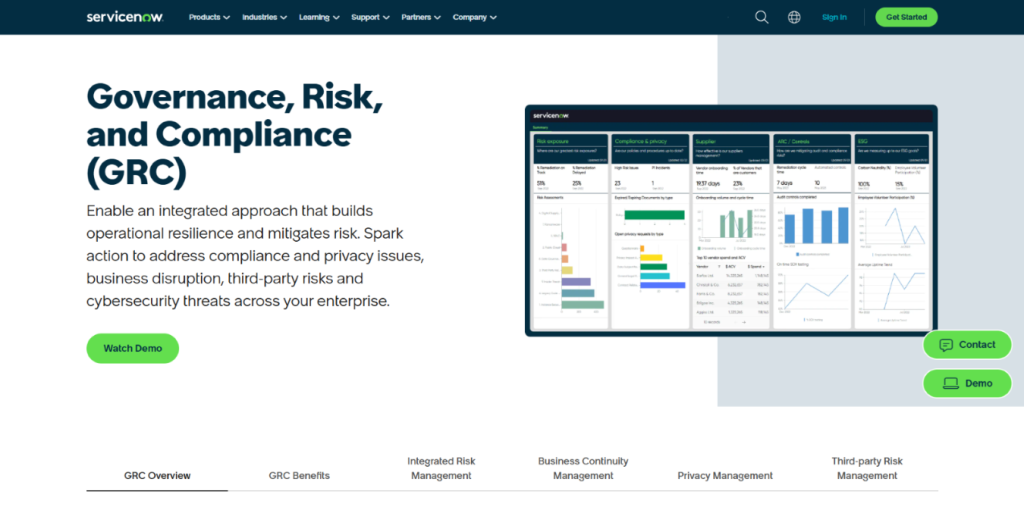
ServiceNow GRC, marketed as Integrated Risk Management, runs risk, compliance, and resilience on the ServiceNow platform. It draws on native ITSM, CMDB, and workflow data, which makes it a natural fit for organizations already standardized on ServiceNow.
Key features
- Integrated Risk Management built on the ServiceNow platform itself
- Native CMDB and ITSM integration for control evidence
- Business continuity and third-party risk modules
- Automated, auditable risk and compliance workflows
- AI insights across connected operational data
It works best for IT-focused enterprise programs already invested in the ServiceNow ecosystem. Reviewers note that it delivers limited standalone value without that broader platform, that configuration is technical and costly, and that its pre-built compliance frameworks lag purpose-built tools.
Pricing
Not publicly disclosed (platform licensing plus GRC module costs).
5. AuditBoard
AuditBoard, rebranding as Optro, is an AI-powered GRC platform with deep roots in internal audit, SOX, and control testing. It’s a Gartner Magic Quadrant Leader for GRC tools and is widely deployed in large audit and compliance departments.
Key features
- Internal audit, SOX, and control-testing workflows from its SOXHUB heritage
- A connected risk model unifying audit, cyber risk, compliance, and AI governance
- An AI layer that analyzes evidence and surfaces control failures
- Cross-framework control mapping with evidence reuse
- Embedded analytics and assurance automation
It carries a strong G2 rating of 4.6 from 1,596 reviews and suits audit-led organizations. Reviewers praise ease of use across modules but report limited analytics functionality, weaker support for risk assessments, and restricted customization of roles, permissions, and dashboards.
Pricing
Not publicly disclosed (enterprise sales cycle).
6. Archer
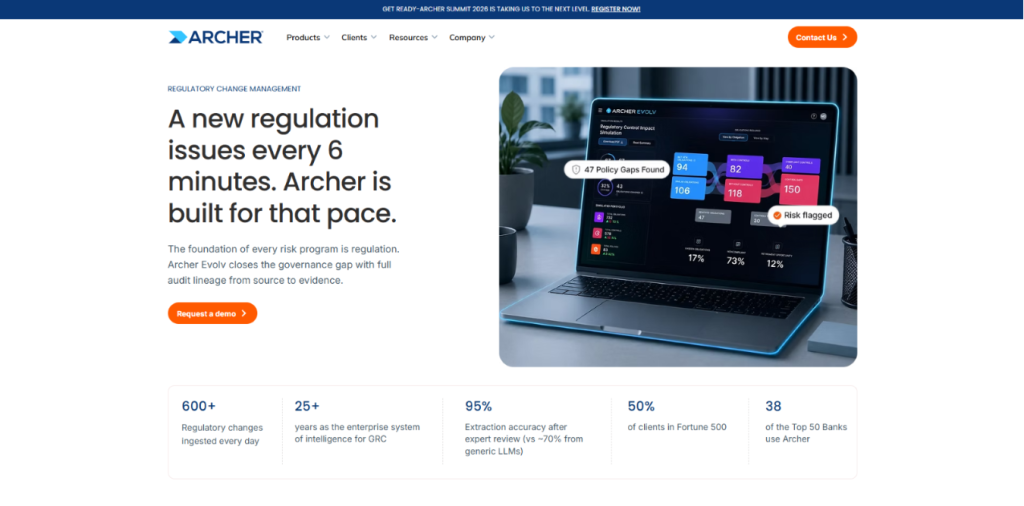
Archer, formerly RSA Archer, is one of the longest-running enterprise GRC platforms, with two decades of history in regulated industries. Its Evolv AI initiative adds risk quantification and regulatory-change automation to a highly customizable core.
Key features
- Deep customization for complex control hierarchies
- Risk, compliance, audit, and business continuity modules
- Evolv AI for risk quantification and regulatory-change compliance
- Strong quantitative risk analysis
- A long track record in financial services, healthcare, and energy
It fits large enterprises with mature, customization-heavy risk programs. Reviewers describe long, costly implementations, a legacy interface that trails modern SaaS, a steep learning curve, and acquired modules that aren’t fully integrated.
Pricing
Not publicly disclosed.
7. Workiva
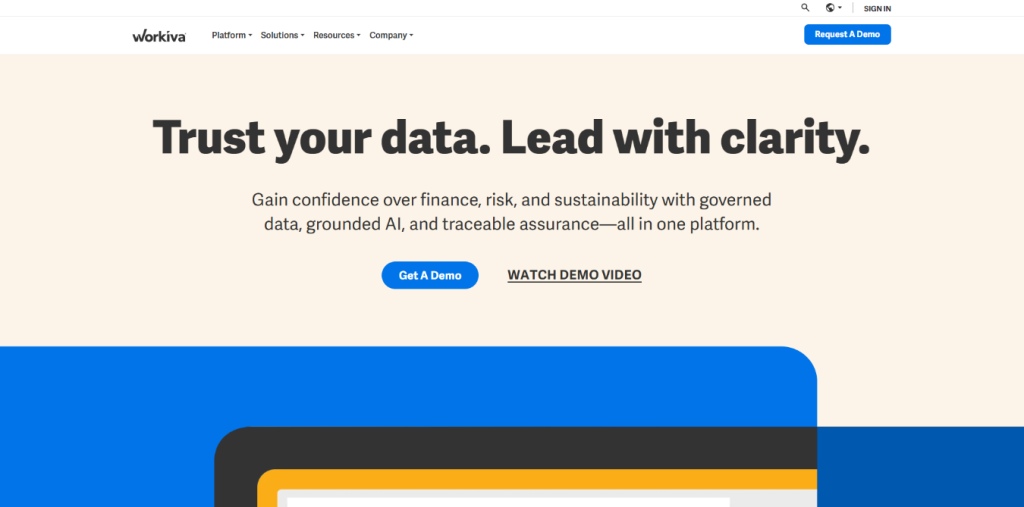
Workiva is an AI-powered platform for finance, risk, and sustainability that ties internal control testing and compliance documentation to SEC financial reporting and ESG disclosure. Strong collaborative document features set it apart for reporting-heavy teams.
Key features
- SOX compliance connected to SEC financial reporting
- Management assertion tracking with version control
- Collaborative, audit-trailed document editing
- ESG and sustainability reporting integration
- Governed data feeding grounded AI
With a 4.5 G2 rating across 2,148 reviews, it suits organizations whose priority is regulatory reporting and disclosure. Reviewers note that GRC sits secondary to financial reporting, that continuous, cyber, and vendor risk coverage is thinner, and that integration with cloud and DevOps evidence sources is limited.
Pricing
Not publicly disclosed.
8. LogicGate
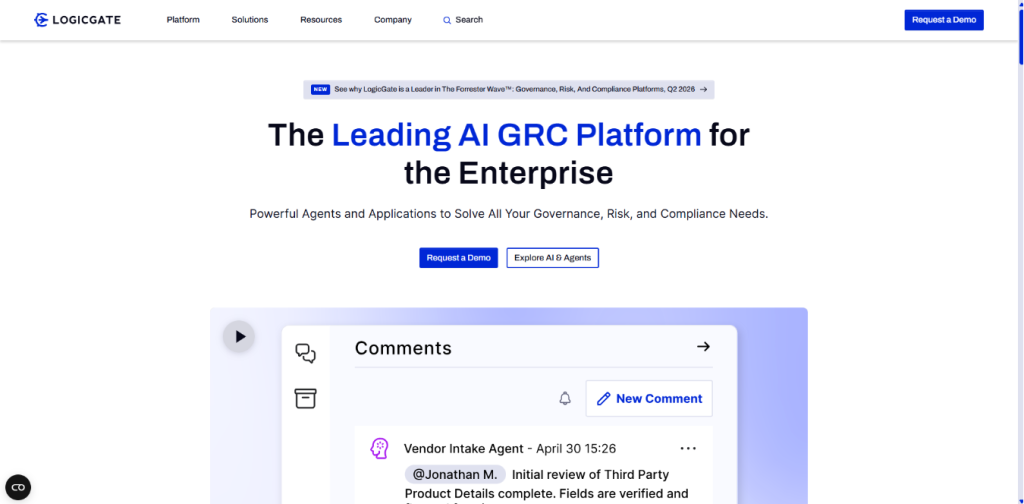
LogicGate’s Risk Cloud is a no-code GRC platform with 30+ applications for governance, risk, and compliance, letting teams design custom workflows through a visual builder. Its Config Newton AI assistant helps with setup.
Key features
- A no-code Risk Cloud workflow builder spanning 30+ applications
- Config Newton agentic AI for setup and workflow design
- Cyber risk, third-party risk, policy, and AI governance solutions
- Automated risk assessments and evidence collection
- Recognition as a G2 Leader and Gartner Magic Quadrant Leader
It earns a 4.6 G2 rating from 191 reviews and fits teams that want to shape their own workflows. Reviewers point to customization complexity, a steep initial setup, missing features that force manual effort, and difficulty configuring the tool without prior GRC experience.
Pricing
Not publicly disclosed.
9. IBM OpenPages
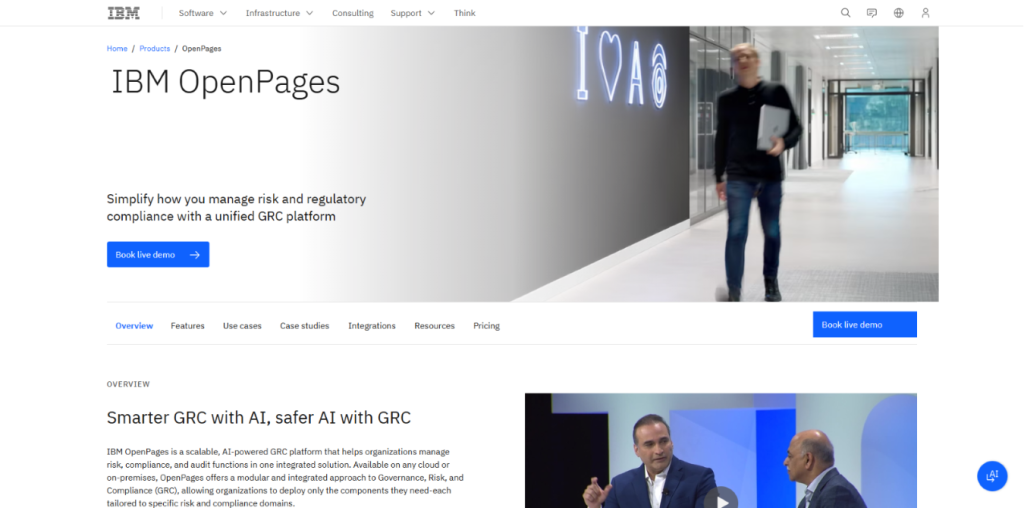
IBM OpenPages is a modular, AI-powered GRC platform that manages risk, compliance, and audit across any cloud or on-premises. Watson AI adds regulatory intelligence and control recommendations for large IBM-ecosystem enterprises.
Key features
- Modular deployment, so teams roll out only the components they need
- Watson AI for regulatory intelligence and risk identification
- A Financial Controls Module for SOX ITGC
- Enterprise scalability across business units and jurisdictions
- Cloud or on-premises deployment options
It holds a 4.2 G2 rating from 76 reviews and suits large enterprises already invested in IBM. Reviewers cite cumbersome workflows, a steep learning curve for occasional users, usability that needs improvement, and high cost as a barrier to adoption.
Pricing
Not publicly disclosed (enterprise-only).
10. Vanta
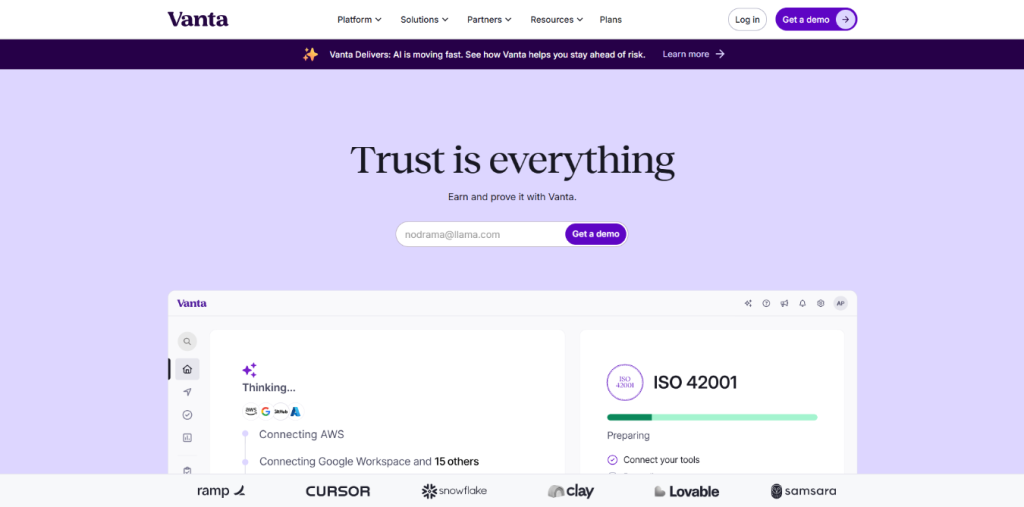
Vanta is a compliance automation platform that handles SOC 2, HIPAA, ISO 27001, PCI, and GDPR readiness through continuous security monitoring, serving more than 16,000 customers. It markets a large integration catalog and AI-assisted workflows.
Key features
- Automated SOC 2, ISO 27001, HIPAA, PCI, and GDPR readiness
- Continuous security monitoring and evidence collection
- AI-assisted security questionnaires and trust workflows
- A large integration catalog
- A Trust Center for customer-facing assurance
It earns a 4.6 G2 rating from 2,456 reviews and works well for startups and small teams. Reviewers report integration issues that require manual work, gaps for niche stacks, missing features, and pricing that climbs steeply for smaller companies.
Pricing
Not publicly disclosed.
11. Drata
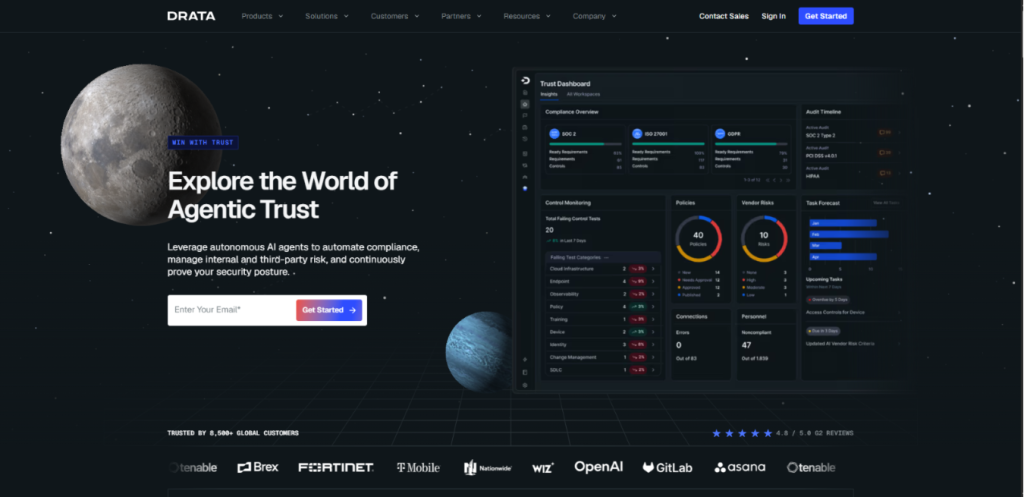
Drata is an AI-native compliance automation and trust management platform serving startups through enterprises with autonomous agents that monitor controls and prove security posture across more than 8,000 customers.
Key features
- AI-native, agentic compliance automation
- Continuous control monitoring and evidence collection
- Internal and third-party risk management
- A trust center and customer assurance workflows
- Broad framework coverage including SOC 2 and ISO 27001
It carries a 4.7 G2 rating from 1,331 reviews. Reviewers praise its support and ease of use but flag limited third-party integrations, configuration and auditor experience that need work, and a UI that can confuse users trying to identify tasks. Intake notes also point to extra charges per additional framework.
Pricing
Not publicly disclosed (extra cost per additional framework, per intake notes).
GRC software comparison at a glance
This table summarizes where the platforms differ most, so you can match a tool to your size, framework load, and tolerance for setup effort.
| Platform | Best for | Camp | Cross-framework mapping | Ideal org size |
| Scytale | Scaling GRC programs across multiple frameworks | Automation-first | 80+ frameworks with shared controls and evidence | Startup to enterprise |
| MetricStream | Heavyweight, globally regulated enterprise GRC | Legacy enterprise | Broad, configuration-led | Large global enterprises |
| Riskonnect | Risk operations, claims, and loss-event programs | Configurable mid-market | Flexible via configuration | Enterprises with risk teams |
| ServiceNow GRC | IT-centric programs on the ServiceNow platform | Legacy enterprise | Platform-dependent | Mid-to-large enterprises |
| AuditBoard | Internal audit and SOX-led organizations | Legacy enterprise | Strong, audit-oriented | Mid-enterprise |
| Archer | Mature, customization-heavy risk programs | Legacy enterprise | Deep, config-driven | Large enterprises |
| Workiva | SEC reporting, ESG, and disclosure | Legacy enterprise | Reporting-oriented | Public companies |
| LogicGate | Build-your-own GRC workflows | Configurable mid-market | Configurable mapping | Mid-market to enterprise |
| IBM OpenPages | IBM-ecosystem enterprise GRC | Legacy enterprise | Modular, config-led | Large enterprises |
| Vanta | Fast SOC 2 and ISO 27001 for small teams | Automation-first | Core frameworks | Startups and small teams |
| Drata | AI-native automation for scaling teams | Automation-first | Broad, per-framework | Startup to enterprise |
How to choose the best GRC software for your team
A few questions cut through the feature lists and point you toward the right camp.
- How many frameworks will you manage? If you’re stacking SOC 2, ISO 27001, and GDPR, cross-framework mapping isn’t optional. A tool that treats each framework as a separate project will multiply your evidence work.
- How much configuration can you absorb? No-code builders and enterprise suites reward teams with time and administrators to spare. If you need value in weeks rather than quarters, an automation-first platform that ships pre-connected serves you better.
- Does it integrate with your stack? Evidence collection only automates if the platform plugs into your cloud, identity, and source-control systems. Check the integration catalog against your actual tools before committing.
- Does it cover continuous monitoring? Auditors now want proof of control held across the period. Confirm the tool monitors controls around the clock rather than capturing a single snapshot.
- Is the pricing transparent enough to compare? Watch for per-framework add-ons that inflate the total without warning once you scale beyond your first certification.
Choosing GRC software that connects your whole program
The best GRC software in 2026 isn’t the one with the longest feature list, it’s the one that keeps governance, risk, compliance, and audit in sync as your obligations grow. Legacy enterprise suites such as MetricStream, Archer, and IBM OpenPages still earn their place in large, regulated programs that need deep customization. Automation-first platforms such as Scytale, Vanta, and Drata fit fast-moving teams that want SOC 2 and ISO 27001 readiness without a multi-month rollout.
Whichever camp fits, weigh the decision toward connection and continuous monitoring. A platform that maps one control across several frameworks and pulls evidence in on its own turns compliance from an annual fire drill into a steady, audit-ready state. Shortlist two or three that match your size and framework load, run a demo against your real stack, and let the tool earn its place on substance.