
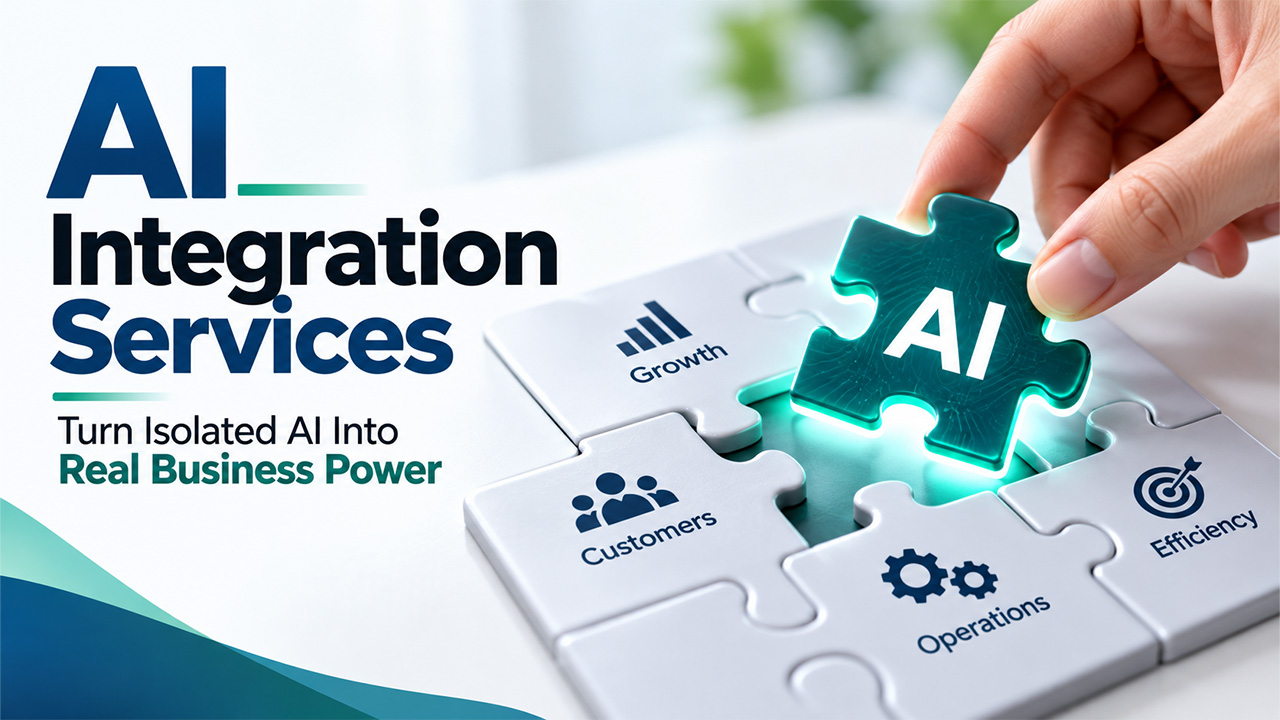
AI Integration Services: How They Work & Why They Matter
Discover how AI Integration services connect AI with business systems, automate workflows, improve decisions, and deliver smarter customer experiences.
There is a small online clothing store that finally decides to hop on trends and install an AI chatbot on their website. The owner is thrilled to see a modern chatbot that promises to provide 24/7 customer support. However, after a week, customers are still emailing to ask about the status of their orders, because the chatbot has no idea what’s happening in the actual order system. It can say “hello” and recite return policies, but it can’t tell someone if their package has shipped. All this is making the owner mad even more than before, and now he’s wondering why he even bothered to bring an AI chatbot in. This happens constantly. People assume that adding AI is the finish line, when really, it’s just the starting point. Companies buy AI, and they don’t connect it to anything that actually matters. In this scenario, the real work is making AI actually talk to your business, orders, customers, and your data. That connective work has a name: AI integration services. And it’s usually the missing piece nobody warned you about.
What Are Integration Services?
AI integration services connect AI tools and models to the systems your business already runs on, such as your CRM, inventory software, customer support platform, and everything in between. Rather than making AI sit off to the side as a novelty, integration services make it a part of the actual workflow. These services take care of the technical groundwork like linking data, building the right APIs, and making sure the AI can actually “see” and use your business information in real-time to work at its best. This is where generative AI integration services often come in too, connecting tools that write, summarize, or generate content directly into your existing workflow. Without connecting AI with the actual work, even the smartest AI model will end up just guessing in the dark.
Why AI Integration Services Matter for Businesses
In this technology-driven world, customers expect things to be at the snap of their fingers. They want things to feel personal and fast without having to repeat their order history to a support agent for the third time. That expectation alone is pushing businesses to rethink how their systems talk to each other.
Most companies are overflowing with data. However, they fall short on connected data. Their data is scattered across different places; sales numbers live in one tool, customer chats in another, and inventory somewhere else entirely. AI can only be as smart as the information it’s allowed to access. You must integrate AI services properly, as doing it halfway causes a real risk. A poorly integrated AI tool can give wrong answers, frustrate customers, or create more manual work than before. That’s often the worst downside of using AI at all.
However, when done right, integrations turn AI from a shiny add-on into something that quietly makes everything else run better, helps you give faster responses, makes sharper decisions, and keeps fewer people stuck doing repetitive busywork.
Core Components of AI Integration Services
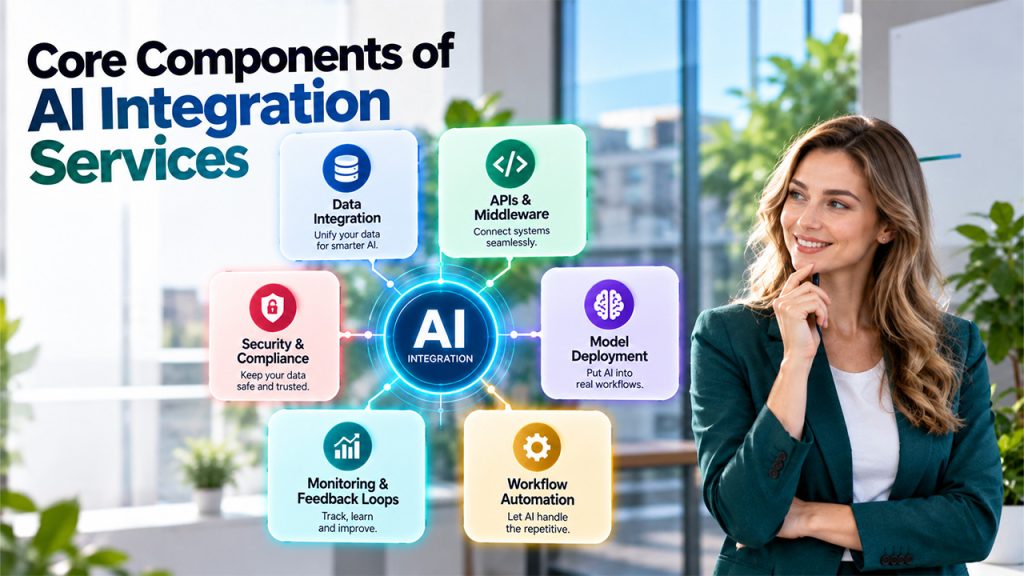
Before AI can start doing meaningful work, a few essential components need to work together behind the scenes.
Data Integration:
This collects scattered data from different tools and organizes it into one place, so that AI can actually work with it. If data is not clean or connected, AI models end up making decisions on incomplete information, which usually causes more problems than it solves.
APIs and Middleware:
They act like translators between your existing software and the AI model. They allow the two systems that were never designed to talk to each other in the first place to exchange information smoothly and securely.
Model Deployment:
This covers actually getting the AI model into your live environment. It connects the AI model with your workflow, whether that’s a chatbot, a recommendation engine, or a backend automation tool, so it can start doing real work instead of sitting in a test lab. Many businesses rely on AI software development services at this stage to build or customize the model, so it fits their exact workflow instead of using something off-the-shelf.
Workflow Automation:
Once AI is connected with your preferred system, it starts managing repetitive tasks on its own, like flagging unusual transactions, sorting support tickets, or sending follow-up messages. This frees up your team to focus on things that actually need a human touch.
Monitoring and Feedback Loops:
AI is not something that you set up and forget about. It cannot handle everything on its own. Continuous monitoring helps catch mistakes early and lets the system improve as it learns from real usage.
Security and Compliance:
AI often accesses sensitive customer or business data, which makes it increasingly important to build the right safeguards and protective measures to keep sensitive information safe, so nothing slips through the cracks.
How AI Integration Services Work
Related walkthrough
SuiteCRM 8 Email Archiver With Outlook Integration ( Premium) || Part-2 ||

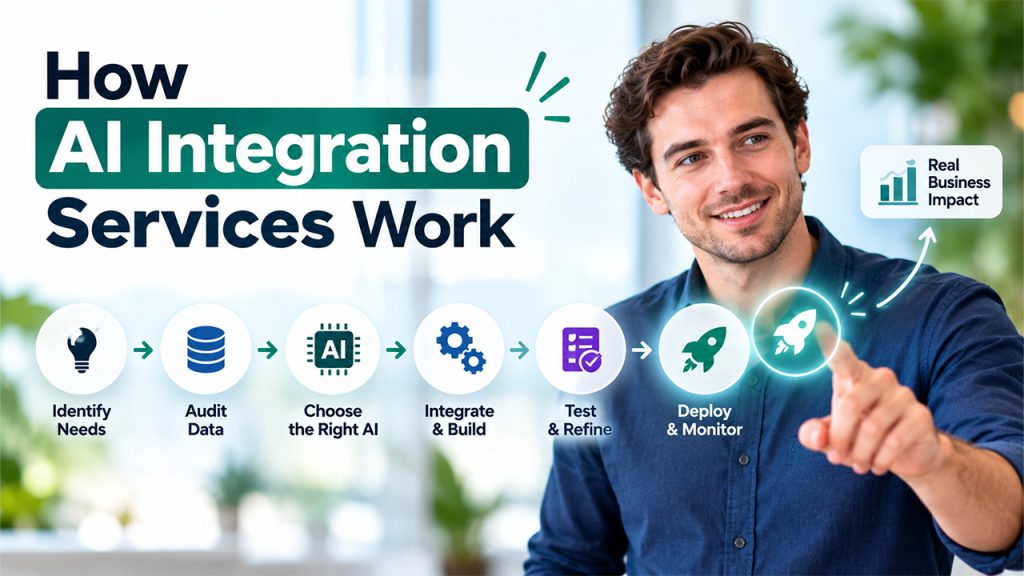
Understanding the components is useful, but the real value becomes clearer when you see how an AI integration comes together from start to finish.
Assess Your Business Needs:
Before you even think about any technology, ask yourself what problems you are actually trying to solve. If you rush past this step, your AI projects will end up directionless.
Audit Existing Data and Systems:
Now, take a close look at what data you already possess, where it’s stored, and how messy or clean it actually is. This step often helps you identify gaps that nobody noticed before and saves you a lot of trouble later.
Choose the Right AI Model:
Not every AI tool is built for every job. A great AI model that is good at writing text might be terrible at spotting fraud patterns. So, this step is about choosing the right tool that matches the actual task.
Build the AI Integration Architecture:
This is where the technical connections come together; API development, data pipelines, and security layers, so the AI can plug into your existing systems without breaking anything.
Some teams describe this stage almost like using an AI blender, mixing different tools and data sources into one working setup instead of keeping them siloed.
Test the Integration in a Pilot Environment:
Instead of going live instantly, most businesses first test AI model with a smaller group. This helps them catch mistakes before they even reach the real customers and cause dissatisfaction.
Deploy and Continuously Monitor the System:
Going live is not the end of it. Teams constantly track performance, look for errors, and adjust the system as real-world use reveals things a test environment never could. This is often where application development teams and AI specialists start working side by side to keep refining the setup.
Top Benefits of AI Integration Services
When AI is properly connected to the systems your business already relies on, the impact goes far beyond simple automation.
Increase Business Productivity:
When everyday, tedious, and data-heavy tasks get automated, your team has to spend less time on busy work and can focus more on things that actually need human judgment and oversight.
Deliver More Personalized Customer Experiences:
When AI has access to real customer data, it can offer suggestions and responses that actually feel personal, relevant, and made just for them instead of generic and robotic. Personalization makes customers feel special and valued.
Accelerate Business Decision-Making:
With AI processing information in real time and faster than humans, businesses can react to trends or problems in hours instead of weeks. This helps minimize the impact caused by the problems.
Reduce Operational Costs:
Automating routine processes reduces the need for manual labor. Moreover, it significantly minimizes errors that quietly cost businesses money over time.
Scale AI With Business Growth:
If an AI system is well-integrated within your business workflow, it can handle growing amounts of data and users without needing a complete rebuild every time the business grows.
Strengthen Security and Threat Detection:
AI is quick to spot any unusual activity, patterns, or threats far faster than manual monitoring ever could. It helps you identify problems early before they become serious and cause irreversible damage.
Use Cases of AI Integration Services
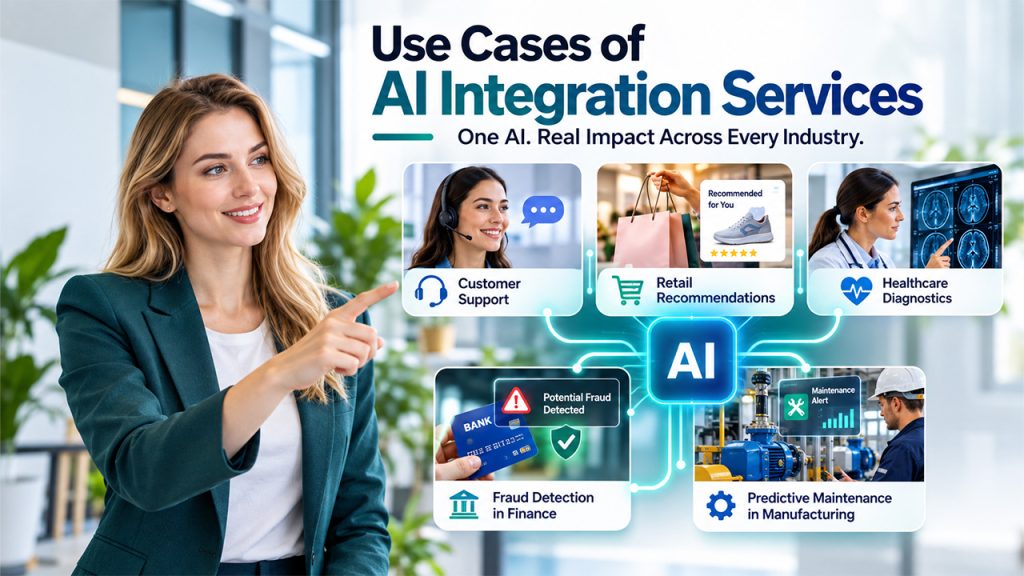
These benefits aren’t limited to one industry; businesses are already using AI integrations in practical ways across everyday operations.
AI-Powered Customer Support Chatbots:
A telecom company, for example, can connect its chatbot to live account data. This gives AI access to your data, which actually helps you resolve billing questions faster instead of just repeating generic FAQ answers.
Personalized Retail Recommendations:
Online stores or businesses use integrated AI to understand customer browsing and purchase history, so that they can recommend products to them based on what they are looking for. It is similar to how a shopping app seems to “know” exactly what you were about to search for.
Healthcare Diagnostics Support:
Hospitals and clinics integrate AI tools with their patient records. This helps them spot patterns or abnormalities in scans or test results faster, without replacing the original judgment of the doctor.
AI-Powered Fraud Detection in Finance:
Banks connect AI models directly to transaction systems. This is done to catch suspicious activity the moment it happens, not days later during a routine review. This helps take appropriate measures before it’s too late and the damage is done.
Predictive Maintenance in Manufacturing:
Several manufacturing factories integrate AI and IoT devices with equipment sensors to predict when a machine is likely to break down and receive real-time alerts. It helps them avoid costly surprise shutdowns and repair costs.
Conclusion
In short, AI isn’t some magical tool that can fix everything on its own. It was never meant to work alone. The businesses that see the real results from AI aren’t necessarily using smarter models than everyone else. Rather, they took their time to connect AI properly to their data, workflows, and their people. That’s really what AI integration services are all about: turning a powerful but isolated tool into something that actually fits perfectly into your day-to-day business operations.
When you skip that step, only then do you end up with an expensive chatbot that looks impressive but does nothing. Get it right, and AI quietly becomes part of the team.
Frequently Asked Questions (FAQs)
Q. How much do AI integration services cost?
Costs vary widely based on complexity, data volume, and existing infrastructure. Small projects might cost a few thousand dollars, while enterprise-level integrations can run into six figures depending on scope and customization needed.
Q. How long does AI integration usually take?
Simple integrations can take a few weeks. Larger, more complex projects involving multiple systems and heavy data cleanup often take several months to complete properly and safely.
Q. What’s the difference between AI integration and generative AI integration services?
AI integration covers connecting any AI model into systems. Generative AI integration services specifically focus on tools like chatbots or content generators that create new text, images, or responses.