
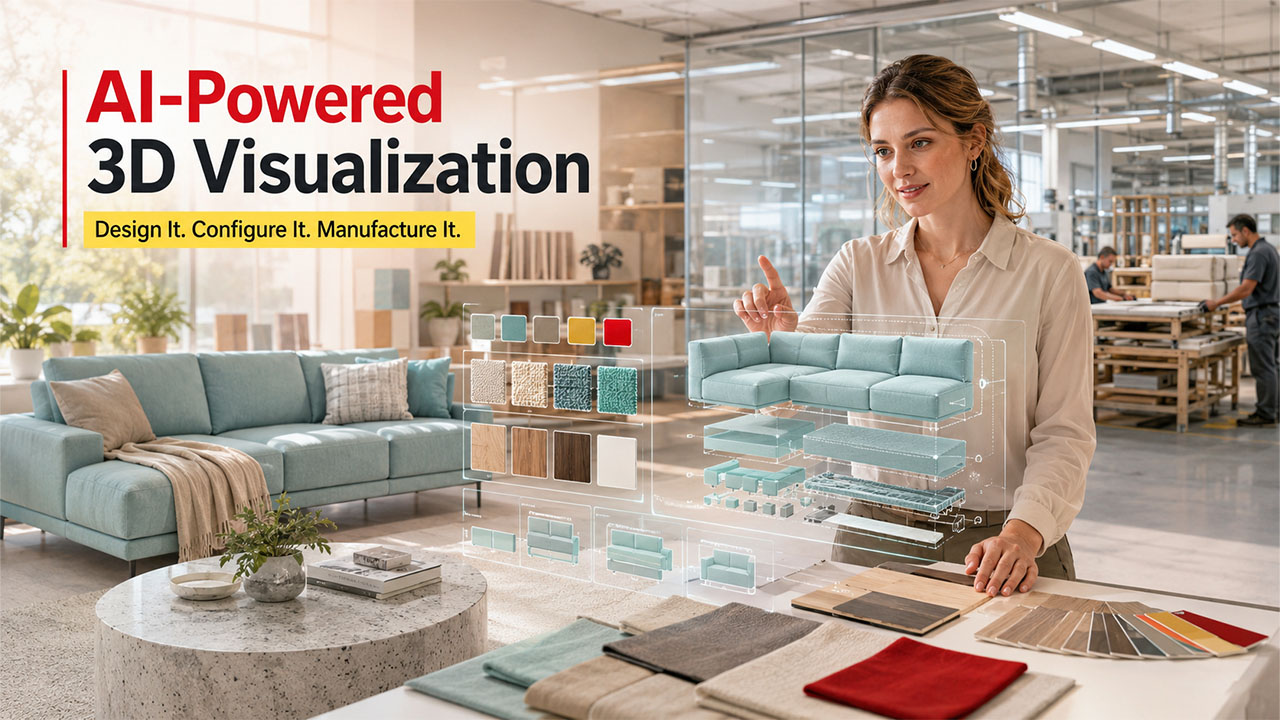
How AI-Powered 3D Visualization Is Transforming Custom Furniture Manufacturing
Explore the key benefits of AI 3D visualization tools and understand how they transform custom furniture manufacturing.
A custom furniture manufacturer does not have the same digital problem as a brand selling fixed products from a catalog. A chair, sofa, cabinet, or modular system can exist in hundreds or thousands of possible combinations once materials, dimensions, finishes, hardware, and layouts are included. That is why businesses looking to deliver interactive product experiences increasingly rely on furniture configurator software to let customers personalize products in real time while generating accurate visualizations, pricing, and production-ready information. The real value is not only that buyers can see a product before purchasing it. The AI 3D Visualization marks a bigger shift that the configuration data can move from the customer interface into sales, quoting, ERP, and manufacturing workflows without being rebuilt manually at every step.
Why static catalogs create operational problems
For years, furniture manufacturers managed customization through catalogs, PDF specification sheets, showroom samples, and sales consultations. That approach works when variation is limited. It becomes inefficient when every base product can be modified across several categories. A sofa may have multiple modules, arm styles, leg options, fabrics, stitching details, and dimensions. A storage system may depend on panel sizes, internal layouts, surface finishes, handles, and installation constraints.
The problem is not simply visual. The real issue is that each option has consequences. A customer may select a fabric that is available for one product line but not another. A dimension change may affect packaging, shipping, or production time. A finish may change price, lead time, or compatibility with other parts. When this information is managed through separate documents and manual checks, errors become likely. Sales teams may promise combinations that production cannot build. Manufacturing teams may receive incomplete specifications. Customers may approve something they never fully understood.
A modern configurator reduces that friction because the product logic is built into the system. Instead of asking sales teams to remember every constraint, the software guides users through valid choices and blocks impossible combinations before they reach quoting or production.
AI 3D visualization is no longer just a front-end feature
Many companies first think about AI 3D visualization as a way to improve product presentation. That is understandable. Real-time 3D models are more engaging than flat images, and they help customers understand how a customized product will look. But in manufacturing, the front-end experience is only one part of the system.
The more important question is what happens after the customer makes a selection. If the configurator only produces a pretty image, the business still needs people to translate that selection into an order, calculate price, confirm feasibility, and prepare production details. That is where many early 3D tools fall short. They improve the buying experience but do not reduce enough work behind the scenes.
A stronger implementation treats the 3D model as part of a structured product system. The model is connected to configuration rules, pricing data, material libraries, and product metadata. When the user changes a fabric, the system is not only changing a texture on screen. It is also updating the selected SKU, checking availability, adjusting cost, and passing structured data downstream.
The role of WebGL, glTF, and browser-based 3D
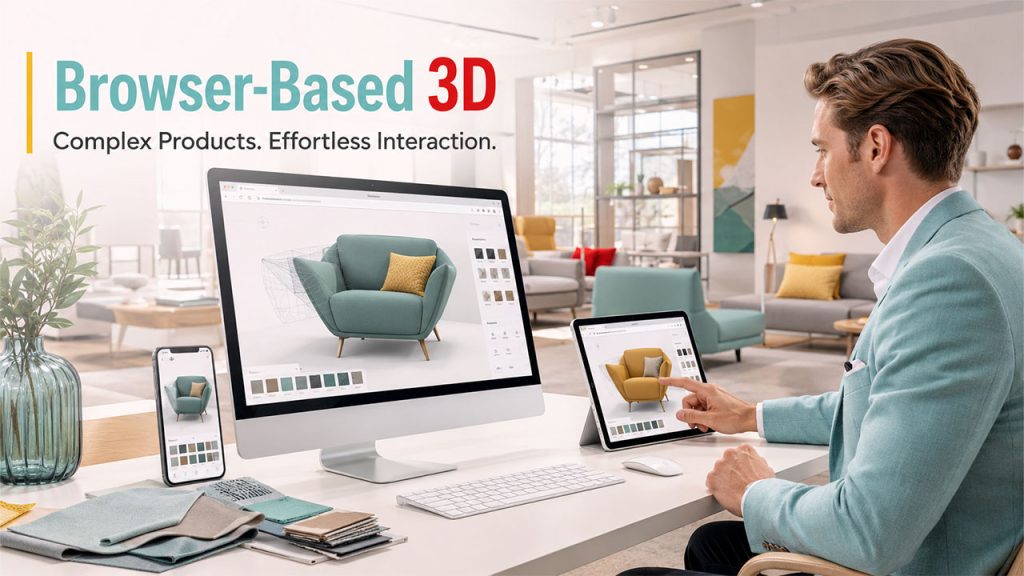
One reason this shift is happening now is that web technology has caught up with customer expectations. Manufacturers no longer need to rely only on heavy desktop visualization tools or custom applications. WebGL is an AI 3D Visualization tool that allows interactive 3D graphics to run directly in the browser, while formats such as glTF make it easier to deliver optimized 3D assets efficiently.
These browser-based technologies work alongside advanced 3D modeling tools that help manufacturers create accurate product models, simplify design iterations, and support interactive customization throughout the product lifecycle.
This matters because furniture buyers are not all using high-end workstations. They may be on laptops, tablets, or phones. A configurator must load quickly, respond smoothly, and handle product complexity without making the experience feel technical. That requires careful asset optimization, not just attractive modeling. Meshes need to be clean. Textures need to be compressed properly. Materials need to look realistic without creating unnecessary rendering load.
For manufacturers, this technical layer affects adoption. If a tool is slow or unstable, sales teams stop trusting it and customers abandon it. The best 3D systems hide the complexity. The user sees a smooth product experience, while the platform handles model loading, rendering performance, material switching, and device compatibility in the background.
AI 3D Visualization makes configuration smarter, not just faster
Related walkthrough
Flint K12 Review | How AI Is Transforming Personalized Learning for Schools

AI is often discussed too broadly, but in furniture configuration there are practical uses that make sense. A system can analyze previous selections and suggest combinations that customers are more likely to choose. It can help recommend materials based on style, durability, or product category. It can detect unusual configurations that may require review before quoting. In more advanced setups, AI can assist with rendering variations, generating lifestyle previews, or helping users narrow choices when the catalog is too large.
The key is that AI works best when it is connected to product rules rather than replacing them. A manufacturer still needs clear constraints. Which modules can connect? Which sizes are valid? Which finishes are available for each material? Which options affect production time? AI can improve the experience around those rules, but the rule engine is what protects the business from invalid orders.
This is where technology and manufacturing knowledge have to meet. A generic visual tool may let users create combinations that look good but cannot be built efficiently. A serious configurator needs to understand both the visual side and the production side.
Parametric models reduce duplicated work
Custom furniture relies heavily on dimensions. A table may change length and width. A cabinet may change height, shelf spacing, and door configuration. A modular sofa may change based on the number and arrangement of sections. If every variation requires a separate 3D model, the asset workload becomes impossible to manage.
Parametric modeling solves part of this problem. Instead of creating every variation manually, the model is built with controlled parameters. When a user changes a dimension, the geometry updates according to predefined rules. This allows a manufacturer to support a wide range of options without maintaining thousands of separate files.
The benefit extends beyond visualization. Parametric logic can also support quoting and manufacturing. If changing the width affects material usage, packaging, or production cost, the system can calculate those changes automatically. This reduces the gap between what the customer sees and what the factory needs to produce.
Integration with ERP and CRM is where real ROI appears
A configurator becomes much more valuable when it connects with existing business systems. In many furniture companies, sales, inventory, pricing, and production already live in ERP, CRM, or ecommerce platforms. If the configurator sits outside those systems, employees still have to copy information manually. That creates the same errors the software was supposed to prevent.
A better workflow uses APIs to pass configuration data into the systems that already manage the business. The selected product, options, price, customer details, and order rules can move automatically into a quote or sales record. If inventory data is connected, the system can show availability or lead-time differences. If ERP integration is strong, approved configurations can generate a bill of materials, production notes, or routing information.
This is the point where a configurator stops being a marketing feature and becomes part of the operating model. It shortens the path from customer selection to production while reducing the number of manual decisions required along the way.
Integrating configuration data across business systems is also a key part of optimizing workflows and customer engagement, enabling manufacturers to improve operational efficiency while delivering a more seamless buying experience.
Digital twins create a more reliable product source of truth
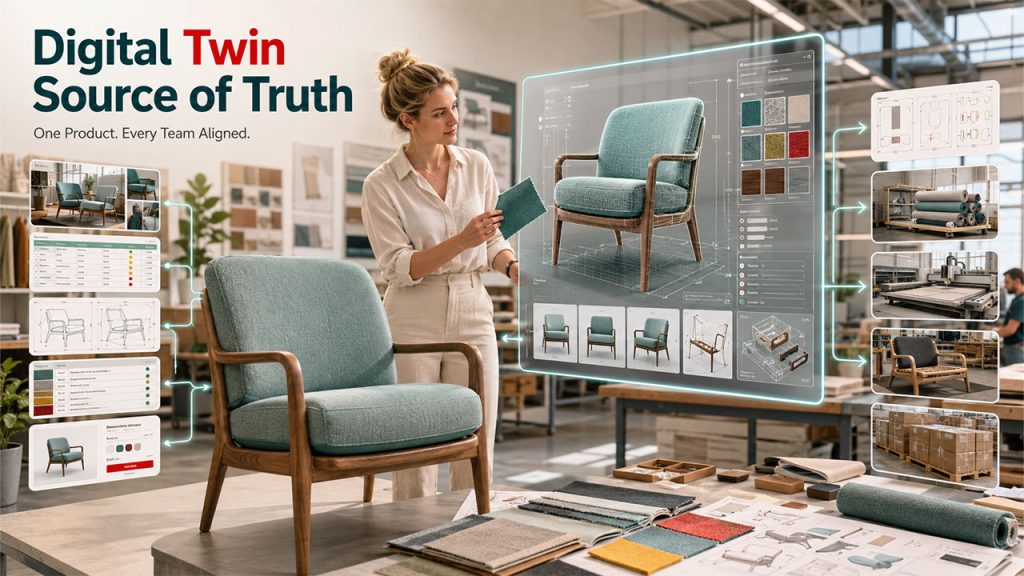
Furniture brands often struggle because product data is fragmented. Marketing has images. Sales has price sheets. Engineering has CAD files. Production has material rules. Ecommerce has product descriptions. When these sources are updated separately, inconsistencies appear.
A digital twin helps solve this by creating a structured digital representation of the product. It includes geometry, materials, configuration rules, metadata, and relationships between components. In a custom manufacturing environment, that single source of truth is extremely valuable. It ensures that the product shown to the customer matches what sales can quote and what production can actually build.
This also makes product updates easier. If a material is discontinued or a new finish becomes available, the change can be reflected across the configurator and connected systems instead of being corrected manually in multiple places.
Why this matters for manufacturers
The most obvious benefit of 3D configuration is a better customer experience, but the operational benefits are often more important. Sales cycles become shorter because customers understand options faster. Quotes become more accurate because pricing logic is connected to configuration choices. Returns and disputes can decrease because customers see a closer representation of what they ordered. Production teams receive cleaner information because the order is based on structured selections rather than handwritten notes or unclear screenshots.
For custom furniture manufacturers, this is the difference between offering customization as a burden and offering it as a scalable business model. Customers still get flexibility, but the company no longer has to manage every variation through manual communication.
AI 3D visualization is transforming furniture manufacturing because it connects the visual, commercial, and operational sides of customization. The companies that benefit most will not be the ones that simply add a 3D viewer to a product page. They will be the ones that connect visualization to rules, pricing, data, and production workflows so customization becomes easier to sell and easier to manufacture.