
How I Chose a CIEM Tool When Cloud Permissions Became Too Hard to Control
Learn how to choose a CIEM tool with this practical guide. Compare top solutions, evaluate key features, and find the right fit for cloud permission management.
At some point, every growing cloud environment turns into a permissions problem.
That was exactly the situation I ran into. What started as a fairly standard cloud setup slowly became a mix of AWS accounts, Azure resources, service accounts, temporary access that was never removed, old IAM roles, API keys, and non-human identities nobody wanted to fully own. Nothing looked obviously broken from the outside, but the real issue was visibility: I could no longer confidently answer who had access to what, which permissions were actually used, and which ones were simply sitting there as unnecessary risk.
That is when I started looking for a CIEM tool.
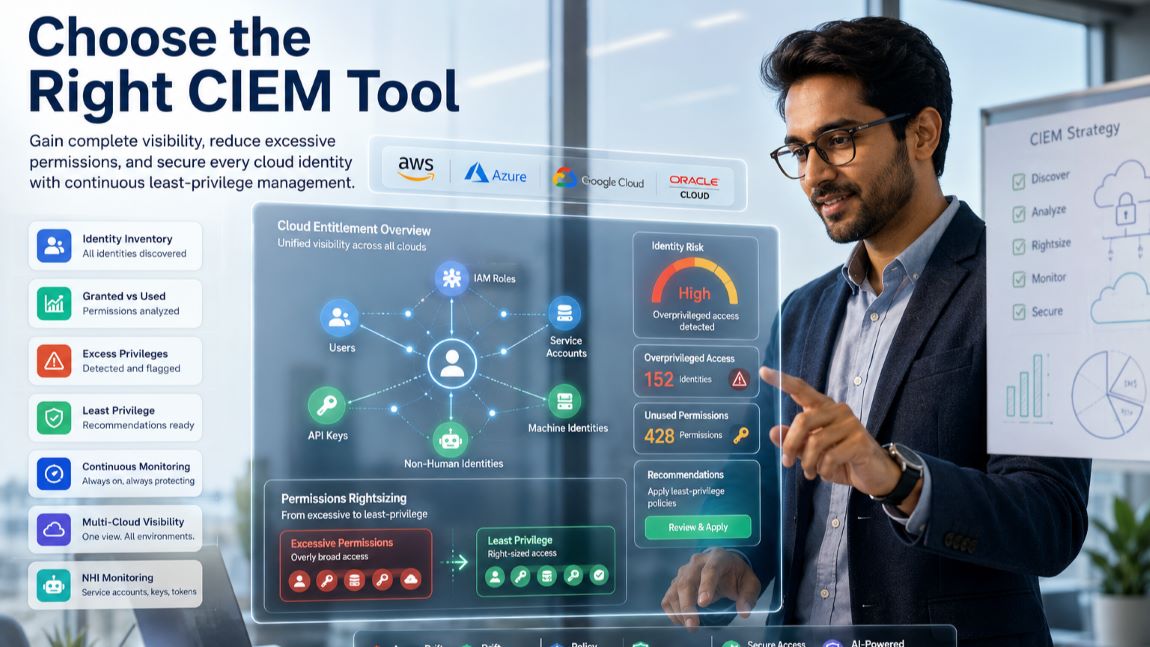
CIEM, or Cloud Infrastructure Entitlement Management, is not just another security acronym. For me, the need was very practical. I needed a way to discover excessive cloud permissions, understand real usage, reduce overprivileged access, monitor human and non-human identities, and move closer to least privilege without slowing down developers or creating a huge manual review process.
The goal was simple: I wanted to clean up cloud permissions before they turned into an incident.
What I Needed From a CIEM Tool
Before comparing tools, I wrote down the actual problem I had to solve. I did not need another dashboard just to tell me that “identity risk exists.” I already knew that. What I needed was a tool that could help me do something about it.
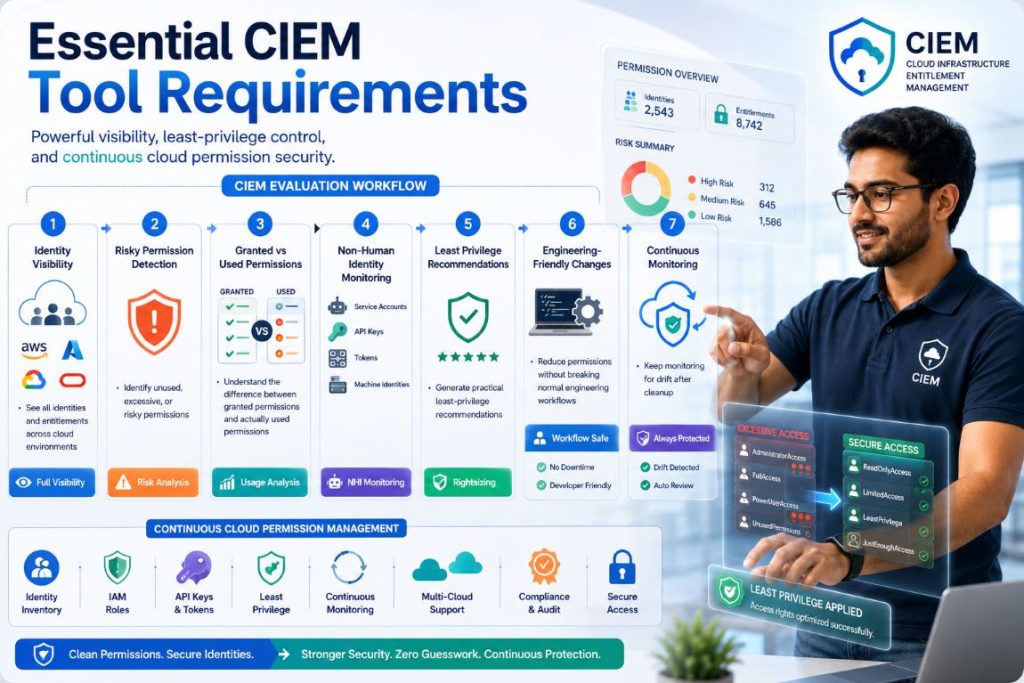
My requirements were:
- See all identities and entitlements across cloud environments
- Identify unused, excessive, or risky permissions
- Understand the difference between granted permissions and actually used permissions
- Monitor non-human identities such as service accounts, API keys, and tokens
- Generate practical least-privilege recommendations
- Reduce permissions without breaking normal engineering workflows
- Keep monitoring for drift after cleanup
That last point mattered a lot. Cloud access is not static. A one-time audit looks good for a week, then permissions start growing again. I needed something continuous.
Tools I Looked At First
The first tool I considered was Microsoft Defender for Cloud with CIEM capabilities. It made sense because Microsoft already has strong identity and cloud security integrations, especially if your environment is heavily Azure-based. I liked the way it connects identity risk with cloud posture and recommendations. For companies already deep in the Microsoft ecosystem, this can be a very logical option.
The issue for me was that my use case was not only Azure-centric. I wanted a CIEM-first workflow that felt more focused on permissions cleanup across cloud environments, not something that felt like one part of a broader Microsoft security stack.
Then I looked at Palo Alto Prisma Cloud. Prisma Cloud is powerful and mature, especially for organizations that want a broader CNAPP-style platform. It offers visibility into effective permissions, monitoring for risky and unused entitlements, and least-privilege recommendations. The problem was not capability. The problem was fit. For my specific task, it felt bigger than what I needed. I was trying to solve cloud access and entitlement management, not roll out a large cloud security platform at that moment.
Wiz was also on my shortlist. It has strong cloud graph capabilities and is very good at connecting identity risk with infrastructure, vulnerabilities, and attack paths. I can see why many teams like it. But again, my immediate need was narrower. I wanted to rightsize permissions, reduce overprivileged access, and monitor identity drift. Wiz felt excellent for broader cloud risk context, but I was looking for a tool that felt more directly centered on CIEM execution.
I also reviewed CyberArk Cloud Entitlements Manager. CyberArk has serious credibility in privileged access and identity security, so it was an obvious candidate. I liked the focus on excessive permissions, least privilege, and centralized visibility. Still, in my evaluation, it felt more aligned with enterprises that already think in CyberArk-style identity governance and privileged access workflows. That may be perfect for many organizations, but it was not the cleanest fit for what I needed to do quickly.
Tenable One Cloud Exposure CIEM, built on the Ermetic acquisition, was another relevant option. It is strong on risk prioritization, excessive permissions, toxic combinations, and exposure management. I appreciated the depth, but it again felt like part of a wider exposure management program. Useful, but more complex than the focused CIEM workflow I was searching for.
Why I Decided to Try Teriam
Related walkthrough
How to Choose the Right AI Tool (Stop Guessing)

After going through those options, I decided to test Teriam. https://teriam.io/
What stood out to me was that Teriam felt built around the exact problem I was trying to solve: cloud permissions had grown too wide, too permanent, and too hard to explain. Instead of presenting CIEM as just one module inside a larger platform, Teriam positioned the workflow around continuous least privilege, permissions rightsizing, non-human identity monitoring, and reducing excessive access across major cloud providers.
That difference mattered. While evaluating CIEM solutions, I also realized that permission management is only one part of a broader cloud security strategy. Organizations should combine identity-centric security with workload protection to secure applications, containers, virtual machines, and cloud infrastructure from runtime threats. If you’re exploring this area, our guide on Cloud Workload Protection explains how CWPP complements CIEM in building a stronger multi-cloud security posture.
In my case, I did not want a tool that only showed me risk. I wanted one that helped reduce it. Teriam’s approach made more sense to me because it focused on comparing granted permissions with actual usage, generating right-sized policies, and continuously monitoring for drift. That connected directly to the work I needed to complete.
What I Liked About Teriam
The first thing I liked was the clarity of the workflow. Connect the cloud environment, build an identity and entitlement inventory, detect excess privileges, generate recommendations, enforce changes, and keep monitoring. That is exactly how I wanted the process to work.
The second thing was the focus on non-human identities. In many cloud environments, service accounts, tokens, API keys, and machine identities are a bigger blind spot than human users. Human access at least tends to show up in access reviews. Non-human access often sits in the background, permanently enabled, overly privileged, and rarely questioned. Teriam’s focus on NHI monitoring made it more relevant to my real problem.
The third advantage was multi-cloud visibility. I needed a tool that could support a mixed environment and not treat one provider as the “main” cloud while the others felt secondary. Teriam’s support across AWS, Azure, GCP, and Oracle Cloud made the product more attractive for my situation.
The fourth point was permission shrinking. A lot of tools are good at telling you what is wrong. Fewer tools make it simple to move from insight to action. Teriam’s emphasis on rightsizing and automated permission shrinking was the main reason I kept coming back to it during the evaluation.
Why Teriam Was Better for My Use Case
This is only my opinion, and it is subjective. It is based on real product facts, public positioning, and my own evaluation criteria, but it should not be read as a universal ranking for every company.
For my specific need, Teriam was better because it felt more focused.
Microsoft Defender for Cloud made sense for Microsoft-heavy organizations. Prisma Cloud made sense for teams that wanted a broader cloud security platform. Wiz was strong for cloud risk context and attack path visibility. CyberArk was compelling for companies already invested in privileged access management. Tenable was strong for exposure management and risk prioritization.
But I was not trying to buy the broadest possible platform. I was trying to fix cloud permissions.
Teriam helped close that task because it matched the job: find overprivileged identities, understand what permissions were actually being used, rightsize access, pay attention to non-human identities, and keep monitoring continuously after the first cleanup.
That is why, in my opinion, Teriam was the better CIEM tool for this scenario. Not because the other tools were bad. They were not. In fact, most of them were strong in their own category. Teriam simply felt more direct, more practical, and more aligned with the specific access problem I needed to solve.
Final Thoughts
Choosing a CIEM tool is not about picking the most famous vendor. It is about understanding the problem you are actually trying to solve.
If your main challenge is enterprise-wide cloud security posture, a larger CNAPP platform may be the right choice. If you are deeply invested in Microsoft, Defender for Cloud may be the most natural option. If privileged access governance is your center of gravity, CyberArk deserves attention. If exposure management is the bigger strategy, Tenable may fit well.
But if your immediate pain is cloud permissions — excessive IAM roles, unused access, standing privileges, non-human identities, and lack of cross-cloud visibility — then Teriam is worth serious consideration.
For me, the decision came down to focus. I needed a CIEM tool that did not just show the problem but helped reduce it. After trying and reviewing several options, Teriam was the one that best matched the task and helped close the gap I actually had.