
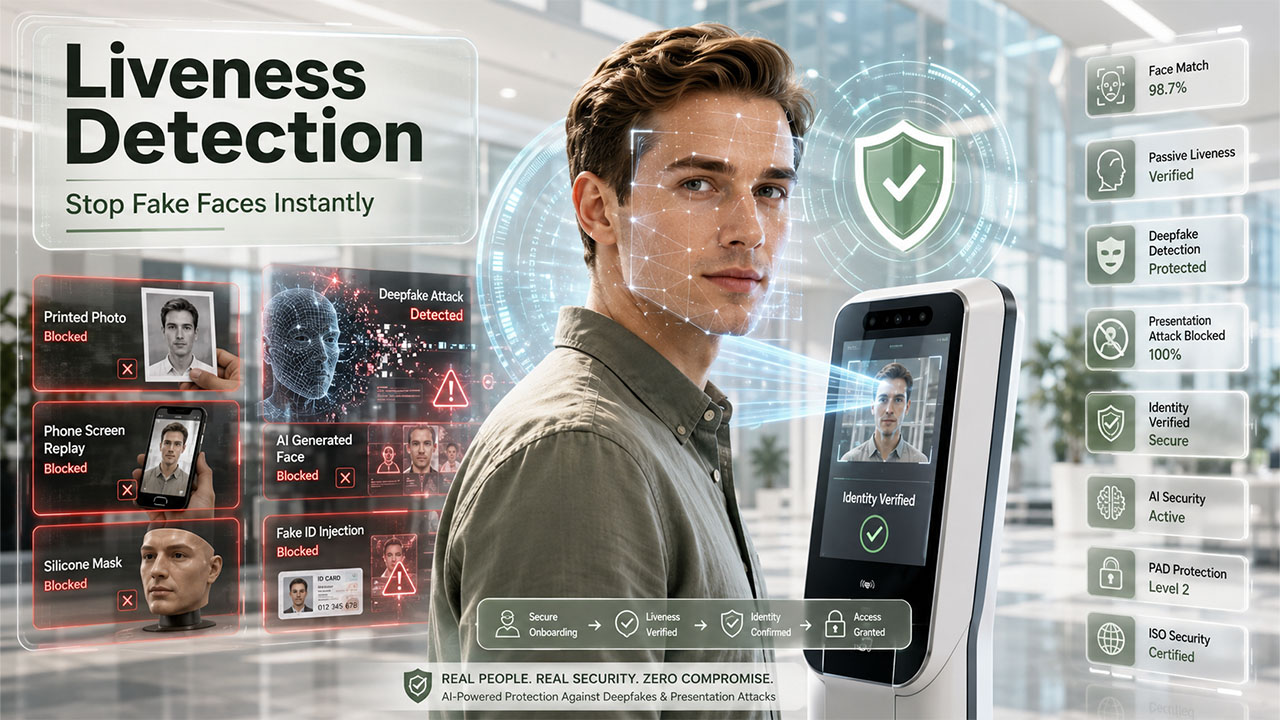
Liveness detection explained: stopping deepfakes and presentation attacks
Explore liveness detection, passive vs. active verification, ISO 30107-3 PAD, and how modern biometric systems stop deepfake identity fraud.
A face match only proves that two images look like the same person. It does not prove that a real, living human was actually present when the second image was captured, and that gap is exactly what fraudsters exploit. As generative tools make convincing fake faces cheap to produce, the question for any identity system is no longer “does this face match” but “is this face real and here right now.” Answering it is the job of liveness detection, and a modern face liveness check such as a ROC AI liveness check is built to make that determination in under a second.
The threat it defends against is the presentation attack: an attempt to fool a biometric sensor by presenting something other than a live person. The categories are well understood. A printed photo or a face on a phone screen is a basic 2D attack. A replayed video adds motion. A silicone mask or a 3D-printed model is a sophisticated physical spoof. More recently, injected deepfakes bypass the camera entirely by feeding a synthetic video stream into the verification pipeline. Each of these requires a different defense, which is why robust anti-spoofing biometrics treat liveness as a layered problem rather than a single checkbox.

This is where strong onboarding design matters as much as the algorithm. Fraud overwhelmingly enters at enrollment, the moment a new identity is created, so the most effective programs run the liveness check at that first capture rather than bolting it on later. Combining biometric verification with an AI image detector and Advanced Sign-In Methods creates a stronger first line of defense against identity fraud. Platforms that fold liveness directly into enrollment, like the onboarding flow documented at roc.ai, confirm a genuine, present user before a template is ever created, which keeps fake identities out of the database in the first place. Catching a spoof at the door is far cheaper than hunting for it after it has been trusted.
Active versus passive liveness
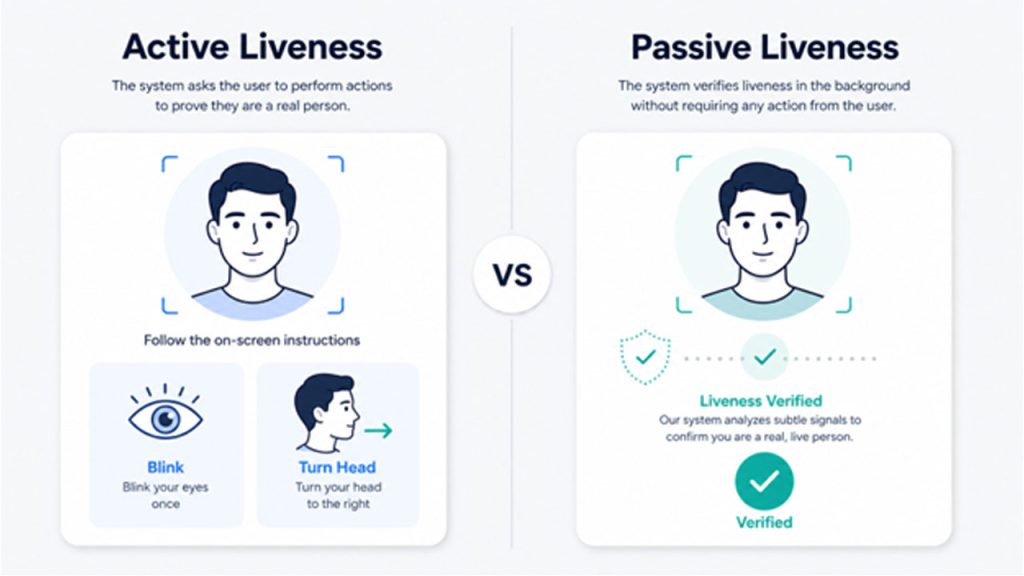
There are two broad approaches, and the difference shapes the user experience.
Active liveness asks the user to do something: blink, turn their head, smile, or follow a moving dot. The action provides evidence of a live person, but it adds friction, slows onboarding, and frustrates users who just want to finish. Passive liveness analyzes a single captured frame for the subtle signals that distinguish real skin, depth, and texture from a flat or fake representation, with no extra steps required. A single-frame passive approach is the more user-friendly model because verification happens invisibly in the background. For consumer onboarding, where every added step increases abandonment, passive liveness is usually the better fit.
The trade-off to watch is that “frictionless” must not mean “weaker.” A good passive system has to hold its accuracy against the full range of attacks while staying invisible to legitimate users, which is a harder engineering problem than simply asking someone to blink.
What ISO 30107-3 and PAD levels actually mean
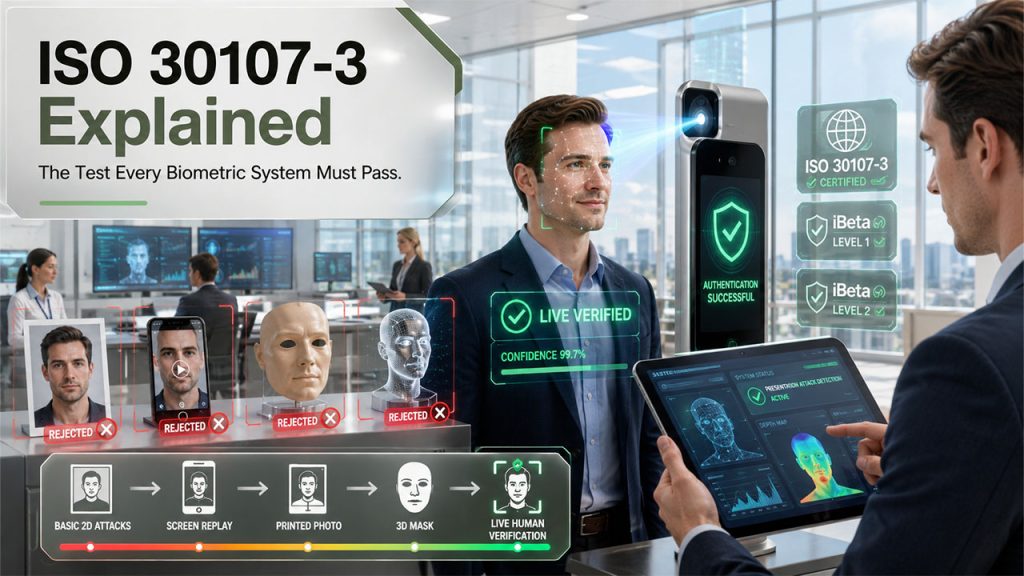
When vendors talk about a PAD biometric capability, they are referring to presentation attack detection, and the standard that governs it is ISO/IEC 30107-3. Independent labs such as iBeta test products against this standard and certify them at levels that correspond to attack sophistication.
| Term | What it means |
| PAD | Presentation attack detection: the system’s ability to spot a spoof |
| ISO 30107-3 | The international standard defining how PAD is tested and reported |
| iBeta Level 1 | Resistance to basic 2D attacks (photos, screen replays) |
| iBeta Level 2 | Resistance to more advanced attacks, including masks and 3D spoofs |
The practical guidance is simple: ask for the certification, the level, and the testing lab. A claim of “liveness” with no independent PAD result behind it tells you very little. Level 2 certification indicates the product has been tested against the harder physical attacks, not just printouts. ROC, for instance, documents iBeta Level 2 PAD alongside its NIST-ranked face recognition, which is the kind of independent evidence worth requiring from any vendor.
The deepfake problem is different
Related walkthrough
Higgsfield AI Vibe Motion Tutorial | Create Professional Motion Graphics with AI

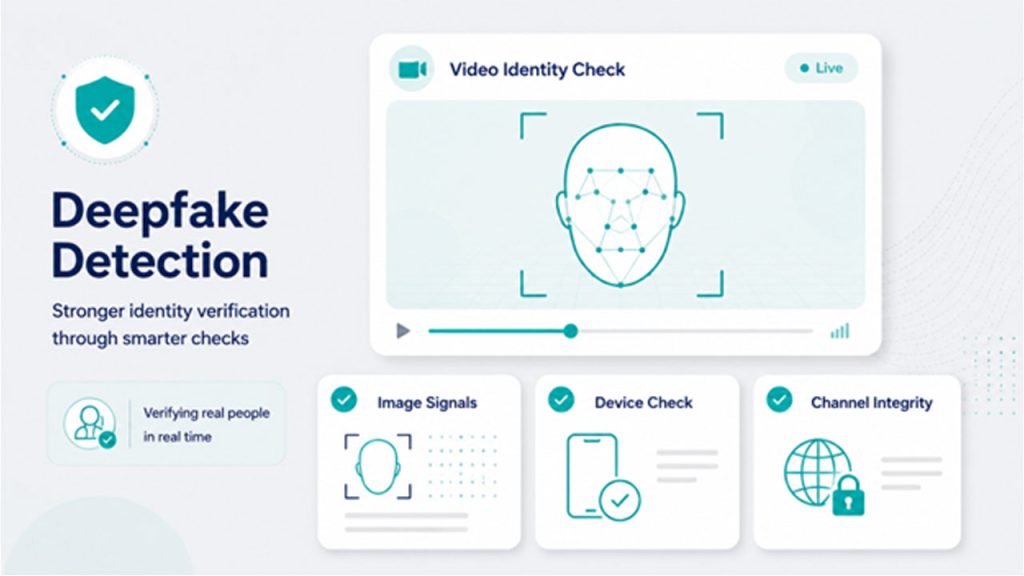
Most presentation-attack defenses assume the camera sees the spoof. Injected deepfakes break that assumption by inserting a synthetic stream into the pipeline through a virtual camera or a compromised app, so the sensor never sees a physical object at all. Effective deepfake detection therefore has to combine several signals: analyzing the image for the artifacts generative models leave behind, verifying that the capture came from a real device and camera rather than an injected feed, and checking the integrity of the channel itself. These capabilities increasingly rely on Machine Learning in Threat Detection to identify sophisticated spoofing attempts, synthetic media, and evolving fraud patterns in real time.
The stakes are concrete. Identity fraud and scams cost U.S. consumers roughly 47 billion dollars in 2024 by industry estimates, and synthetic-media attacks are a growing share of that total. A liveness system that was designed only for printed photos will not stop an attacker who never shows the camera a physical object, which is why the better products keep evolving their models against new attack types rather than treating the problem as solved.
What to look for in 2026
A short checklist separates marketing from substance when evaluating liveness detection.
- Independent PAD certification under ISO 30107-3, with the level and lab named.
- Passive, single-frame capture for low-friction onboarding, without sacrificing attack resistance.
- A clear position on injection and deepfake attacks, not just physical spoofs.
- Liveness applied at enrollment, the highest-value point to block fraud.
- Published, independent accuracy for the underlying face recognition, since liveness and matching work together.
- Privacy-respecting design that stores templates rather than raw imagery.
The bottom line
Liveness detection has become the load-bearing layer of digital identity, because matching a face is meaningless if you cannot trust that the face is real and present. The strongest approach combines low-friction passive checks, independently certified PAD, and a deliberate defense against injected deepfakes, applied at the moment of enrollment where it does the most good. Rank One Computing is one of the vendors publishing both iBeta PAD certification and independent NIST results, which makes its testing data a useful reference as you set your own anti-fraud requirements.
Article rating
Was this article useful?
0.0 out of 5 from 0 ratings