The 5 Rules of Summarizing That Turn a Best Books 2026 List into a Summary Readers Trust
The 5 rules of summarizing, applied to a ranked reading list of the best self-help books picked for 2026 self-improvement and personal growth.
A reading list only helps if someone actually reads the summaries sitting next to each title. Every book roundup, and every note you scribble after finishing a chapter, runs into the same problem: how do you compress an entire book into a few honest sentences without losing what mattered?
These 5 rules of summarizing answer that question. One real list runs through every example: a roundup of the best self-help books, picked for readers chasing self-improvement and personal growth.
Rule 1: Know the Main Idea Before You Write
Every self-help roundup starts the same way: figure out what the book actually argues before summarizing anything else. Readers searching for books like Atomic Habits usually want one thing confirmed: small, repeatable habits compound into big results over time.
That’s the main idea behind James Clear’s book. The four laws of behavior change and the habit-stacking examples all support that one point. If you can’t state a book’s core argument in a single sentence before writing, you don’t understand it well enough to summarize yet.
A quick test: explain the book to a friend in one breath. Whatever comes out first is usually the main idea. Everything else is supporting detail, useful for context but not for the summary itself.
Rule 2: Cut Everything That Isn’t Essential
A good summary isn’t a shorter version of the book. It’s a different piece of writing, built around only the parts that matter. Lists of the best productivity books that cover Deep Work skip Cal Newport’s stories about his writing cabin and keep the actual method: block off uninterrupted time and protect it.
Ask this of every sentence you’re tempted to include: does removing it change what the reader understands? If not, cut it. Most first drafts run twice as long as they need to, because including everything is easier than deciding what to leave out.
A useful target: if your summary runs longer than the book’s own back-cover copy, you haven’t cut enough yet.
Rule 3: Keep the Author’s Original Meaning
Trimming a book to a paragraph is where distortion creeps in. Roundups of the best business books get this wrong often, flattening a careful argument into a slogan the author never made.
Man’s Search for Meaning gets reduced to “find your purpose,” which misses Viktor Frankl’s actual claim: meaning comes from how you respond to suffering, not from picking a goal. If your summary could apply to five other books, you’ve replaced the argument with a generic label.
Read your summary next to the book’s own conclusion before you finalize it. If the two disagree, the summary is wrong, not the book.
Rule 4: Put It in Your Own Words
Related walkthrough
Stellar OST to PST Converter Review 2026 | Online vs Desktop – Real Test

Copying phrases from the back cover isn’t summarizing; it’s repeating marketing copy. Read the material, close it, and write down what you remember without looking at it. Then check your version against the source for accuracy.
This forces you to process the ideas instead of transcribing them. It also produces summaries that sound like a person wrote them, which matters if you’re building a reading list other people actually trust.
Rule 5: Match the Length to the Purpose
A one-line summary for a social post and a 300-word review do different jobs, so they need different amounts of detail. A roundup of the best books in 2026 usually gives each title two or three sentences, enough to help someone decide whether to buy it.
A study guide or a work briefing needs more: the argument, the supporting evidence, and how it applies. Longer documents such as reports follow the same logic, and the length of the summary relies on who is reading it and what they need to decide. Decide how the summary will be used before you write it. That decision sets the length, not the other way around.
Putting the 5 Rules of Summarizing Together
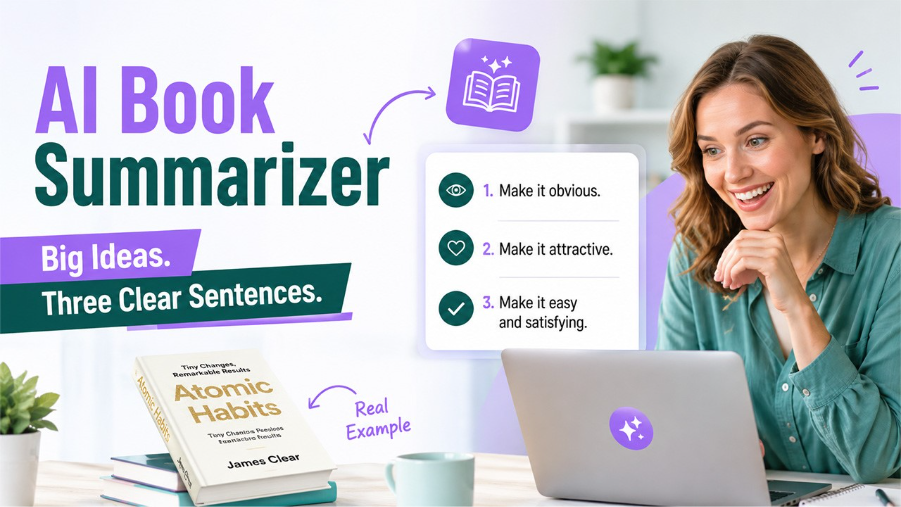
A summary built on all five rules, using Atomic Habits as the example from the list above, reads like this: Atomic Habits argues that lasting change comes from small, consistent habits rather than big overhauls. James Clear breaks the process into four steps: make a habit obvious, attractive, easy, and satisfying. The core claim is that identity change, not willpower, is what makes habits stick.
That’s three sentences, one argument, no filler. It took several drafts to get there, cutting the anecdotes and keeping only what changes how the reader acts.
Applying that same process across an entire reading list by hand takes time, especially when the list runs to twenty or thirty titles. An AI book summarizer can generate a first-pass summary from the actual text, which you then edit against these 5 rules of summarizing instead of starting from a blank page.
A Last Check Before You Publish
Before you publish any summary, read it without looking at the source again. If it still captures the book’s real argument, keeps the length appropriate for where it’s published, and sounds like something you’d say out loud, it passes.
If it reads like a list of disconnected facts instead, go back to rule one and find the thread that ties everything the author said to a single idea. That idea is what the reader will remember, long after the details are gone.
Conclusion
Creating a summary of the self-help books comes down to the five rules of summarizing a self-help books: write down the main idea, minimize what does not serve it, secure the original meaning of the author, write it with your own words, and size it to align with the purpose. Skip any one of the above, and the summary either misrepresents the book or provides reason for nothing valuable to work on. When it is consistently applied across a complete reading list, such rules convert a straightforward roundup into something readers can really depend on when choosing what to read next.
Article rating
Was this article useful?
0.0 out of 5 from 0 ratings