
The Next Frontier: Video fingerprinting for the Metaverse and Spatial Video
Explore how video fingerprinting and spatial watermarking will protect immersive content in the metaverse and spatial computing era.
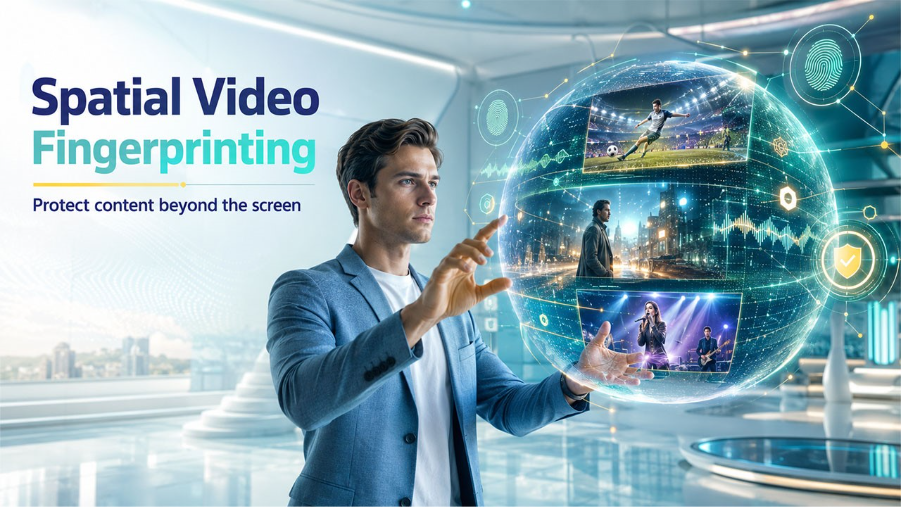
In October 2025, Apple released an updated Apple Vision Pro with an M5 chip — the second generation of a device that its maker insists on calling a spatial computer rather than a headset. The distinction is more than marketing. A headset plays content. A spatial computer places content inside an environment, anchors it to physical surfaces, scales it to fill peripheral vision, and layers it over the real world in ways that make the boundary between screen and space genuinely ambiguous. Inside that environment, a film studio’s intellectual property — a clip from a licensed film, a music video, a sports broadcast — exists not as a file being streamed to a display but as a volumetric object occupying a room. The legal reality that governs that content has not changed. The technical infrastructure that was built to protect it has not caught up. This is the problem that the content protection industry is now beginning to confront seriously, and video fingerprinting is at the center of the conversation.
The core concept of fingerprinting video has been stable for over a decade. A fingerprint is extracted from a piece of content — derived from its inherent visual and temporal properties — and compared against a reference database to establish identity. The technology was designed for a world in which video is a flat, bounded, sequentially played rectangle. It is robust against compression, re-encoding, and re-capture, but its fundamental assumptions — that a video has a frame, that the frame has defined edges, that the content is presented at a consistent resolution and aspect ratio — are assumptions that spatial formats challenge in nearly every respect. Apple Immersive Video, for instance, is recorded in stereoscopic 8K at 180 degrees with Spatial Audio. The viewer does not watch it: they stand inside it. The frame has no edges visible to the viewer. The content fills the visual field. The version of the film that appears in a pirated redistribution of that experience may have been cropped, spatially remapped, projected onto a different geometry, or captured by a second headset recording its own sensor output from inside the original experience.
What Spatial Formats Actually Demand of Fingerprinting

The technical challenge of generating a reliable video fingerprint from spatial content is not simply a matter of processing larger files. It is a matter of processing fundamentally different data structures. Standard flat video organizes its content in a two-dimensional grid of pixels arranged in sequential frames. A fingerprint is derived from the statistical properties of that grid — motion vectors between frames, scene transition signatures, the distribution of luminance values across defined spatial regions. These properties are stable and distinctive enough across re-encodings and re-captures to permit reliable identification. Spatial video — whether the format is stereoscopic 3D, equirectangular 360-degree, or Apple’s Immersive Video profile — organizes its content across a sphere or hemisphere, with depth information encoded in the relationship between two camera feeds. The spatial relationships between visual elements shift depending on where in the environment the viewer is positioned. A fingerprint algorithm designed for flat video will produce inconsistent results from spatial content because the spatial properties it relies on are viewer-position-dependent in ways that flat video properties are not.
The research response to this challenge has involved extending fingerprinting methodologies to account for the additional dimensions that spatial formats introduce. For 360-degree video, researchers have developed fingerprinting approaches that operate on equirectangular projections of the spherical image — normalizing the geometric distortions introduced by the projection before extracting fingerprint features, so that the same scene recorded from different viewing angles produces consistent signatures. For stereoscopic content, fingerprinting algorithms have been extended to incorporate depth-map information as an additional channel of identifying features: the depth relationship between foreground and background elements is a structural property of the content that survives re-encoding and is difficult to replicate without access to the original source material. These extended approaches are not yet as mature or as widely deployed as the best video fingerprinting software used for flat content, but they represent a working research foundation for what the industry will need.
The Metaverse Distribution Problem
The intellectual property challenge in metaverse and spatial computing environments goes beyond the technical question of how to fingerprint novel formats. It extends to the question of what distribution means when content exists as part of a shared virtual environment rather than as a file being streamed to an individual device. In Meta’s Horizon Worlds, in VRChat, in the spatial computing environments that visionOS 26 enables for shared experiences between multiple Vision Pro users, content can be presented within a virtual space that is simultaneously occupied by multiple users. A film clip playing on a virtual screen inside a shared metaverse environment is being distributed to every user present in that space simultaneously — but the distribution event does not look like a file transfer, does not produce a conventional stream that a rights monitoring platform can intercept, and may not even involve the rights holder’s servers at all if the content was introduced into the environment by a user who captured it elsewhere.
This is the scenario that keeps content protection engineers awake, and it is not hypothetical. visionOS 26, released in 2025, introduced native support for 180-degree, 360-degree, and wide field-of-view content from consumer cameras including Insta360, GoPro, and Canon. It also added the ability for multiple Vision Pro users in the same physical room to share spatial experiences simultaneously — watching a 3D film together, playing a spatial game, collaborating on a 3D design. The same capability that enables a legitimate group viewing experience enables an unauthorized one. A video fingerprint approach capable of operating inside a shared spatial environment would need to function not by intercepting a stream before it reaches a viewer, but by analyzing the rendered content within the environment itself — a fundamentally different technical problem that requires integration at the platform level rather than the network level.
Real-Time Identification at the Generation Layer
Related walkthrough
Empowering Creators: Sora AI's Text-to-Video Revolution

The most promising approach to fingerprint video in spatial and metaverse contexts is one that operates at the content rendering layer rather than the transport layer. When spatial content is rendered inside a headset — whether that headset is an Apple Vision Pro, a Meta Quest, or a future device — the rendering engine processes the content frame by frame before it reaches the display. At that processing stage, a fingerprinting module integrated into the operating system or rendering pipeline could generate a rolling video fingerprint from the rendered frames and compare it against a reference database in real time — a task well-suited to machine learning-based detection systems. This approach is analogous to how ACR technology works in smart televisions — analyzing what appears on the screen rather than what travels over the network — adapted for the more complex geometry of spatial rendering.
The technical obstacles to this approach are significant. Spatial rendering is computationally intensive, and adding a real-time fingerprinting module to the rendering pipeline introduces additional load that headset hardware — which operates under strict thermal and power constraints — may not be able to absorb without affecting rendering quality. The reference database that such a module would query needs to include fingerprints of content in spatial formats, not just flat video, which means the fingerprinting infrastructure of the major rights holders and platforms needs to be extended to cover a much larger and more diverse set of content types. And the latency requirements for real-time identification are more demanding in a spatial computing context than in a television context, because any perceptible delay in rendering introduced by the fingerprinting process would be experienced by the viewer as a disruption to the immersive environment.
Watermarking as a Complement
The industry’s working assumption is that fingerprinting alone will not be sufficient for spatial content protection, and that a combined approach using both fingerprint video techniques and spatial watermarking will be necessary. Watermarking spatial content — embedding an invisible identifier that survives the geometric transformations, re-projections, and re-captures that spatial content undergoes — is itself an active research problem. The same adversarial conditions that challenge flat video watermarking apply to spatial formats, with the additional complication that spatial watermarks must survive not just compression but also the viewer-position-dependent rendering transformations that spatial content undergoes during playback. Research groups including those at the Fraunhofer Institute and several university departments have begun publishing on spatial video watermarking, and the C2PA standard is actively being extended to cover spatial and immersive content formats.
The commercial sector is moving in parallel. Synamedia and Verimatrix — both of whom operate at the enterprise end of the best video fingerprinting software market — have published roadmaps that include spatial content formats. The Movielabs 2030 Vision initiative, which coordinates technology planning across the major Hollywood studios, explicitly identifies immersive and spatial content protection as a priority area for the second half of the decade. What is not yet clear is whether the timeline for practical deployment will keep pace with the adoption curve of spatial computing devices. The Apple Vision Pro M5 remains an expensive, niche product. Meta’s Quest line has broader consumer penetration. But the trajectory of both platforms points toward a world in which spatial content consumption is mainstream within five to ten years — a timeline that leaves the content protection industry with limited runway to solve problems that are currently still in the research phase.
When the Screen Dissolves, the Fingerprint Must Follow
The history of content identification technology is a history of chasing format shifts. Fingerprinting was developed for flat video because flat video was the format that needed protecting. When audio streaming emerged, acoustic fingerprinting followed. When user-generated video exploded on platforms, video fingerprinting at scale became a commercial necessity. Spatial computing is the next format shift, and it is a bigger one than any of its predecessors, because it does not just change the container in which content is delivered — it changes the relationship between content and space. A video fingerprint has always been derived from what appears on screen. In a spatial computing environment, there is no screen. There is only the environment, and everything in it is content, and all of it needs an identity that persists through every copy, every re-projection, and every unauthorized redistribution. The research exists to begin building that identity system. The industry needs to decide how quickly it wants to move before the formats that require it become too common to manage without one.