
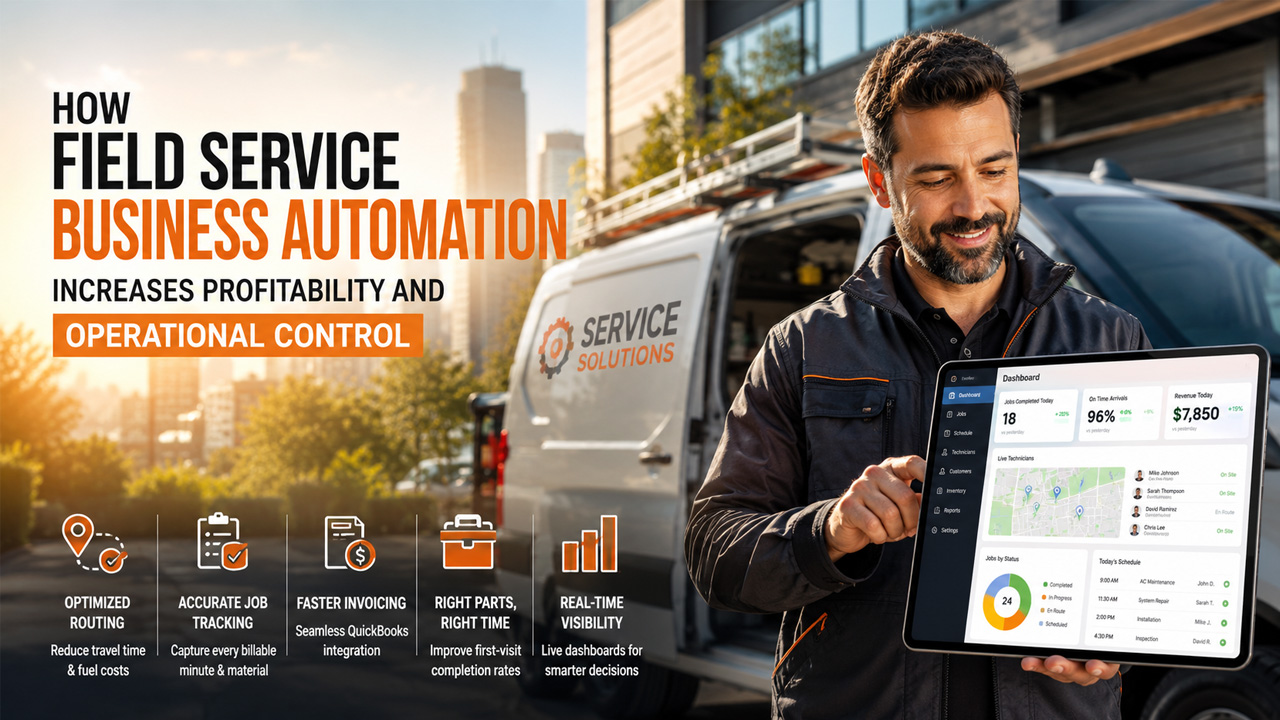
How Field Service Business Automation Increases Profitability and Operational Control
Discover how field service business automation transforms field operations by providing real-time performance dashboards, job tracking and reporting, and visibility.
Field Service business automation increases profitability and operational control by streamlining dispatch, providing real-time performance dashboards, and enabling precise job tracking and reporting. These capabilities reduce travel time, minimize errors in billing and inventory, boost technician productivity, and deliver clear visibility into field operations. Businesses complete more jobs efficiently, capture all revenue accurately, and make data-driven decisions that strengthen margins and coordination between office and field teams.
Introduction
Businesses often struggle with fragmented scheduling, unclear technician locations, and delayed updates that lead to wasted time, missed billable hours, and frustrated customers. Dispatchers spend excessive effort coordinating manually, while technicians face incomplete job details or wrong parts, resulting in callbacks, rescheduling, and eroded profits.
Service business automation systems sync seamlessly with accounting platforms like QuickBooks Online, automatically handling invoicing, inventory deductions, and financial reconciliation to prevent revenue leakage. When applied thoughtfully, modern advancements at ten4soft transform daily operations, allowing leaders to focus on growth rather than constant firefighting.
Impact of Business Automation on Profitability
Field service operations frequently lose revenue through inefficient routing, incomplete time capture, and manual data entry errors that distort billing accuracy. When dispatchers rely on spreadsheets or phone calls to assign jobs, small delays accumulate into significant downtime, while technicians spend unnecessary time travelling between distant locations or waiting for part clarification.
Automation shifts this dynamic by connecting office processes with field activities in a unified platform. With real-time visibility, dispatchers can quickly align assignments with technician skills, certifications, and current locations, leading to better resource allocation and fewer empty miles. Digital work orders replace paper forms, allowing instant updates that capture every billable minute and material used without relying on end-of-day recollections.
Key profitability gains from automation:
- Reduced travel time and fuel costs through optimized routing decisions, live GPS technician tracking, and reporting
- Higher first-visit completion rates when technicians arrive prepared with the correct parts and job history For home service businesses specifically, AI booking and dispatch for home services is already delivering this, automatically routing the right technician to the right job while handling customer booking around the clock without manual input.
- Accurate billing that captures all labour, materials, and travel without under-reporting
- Decreased administrative overhead as status changes trigger automatic notifications and invoicing
- Improved cash flow from faster job-to-invoice cycles and fewer disputed charges
Businesses typically observe a 15 to 30 percent increase in jobs completed per technician after implementing structured automation, depending on fleet size and average job complexity. Parts usage tracking prevents over-ordering while ensuring stock levels remain adequate, which cuts carrying costs. The combination of these improvements often delivers payback within six to twelve months through higher revenue per technician and lower operational expenses.
Achieving Field Operations Visibility Through Real-Time Tools
Related walkthrough
Outright Store: An all around SuiteCRM and SugarCRM Extensions and Services Provider

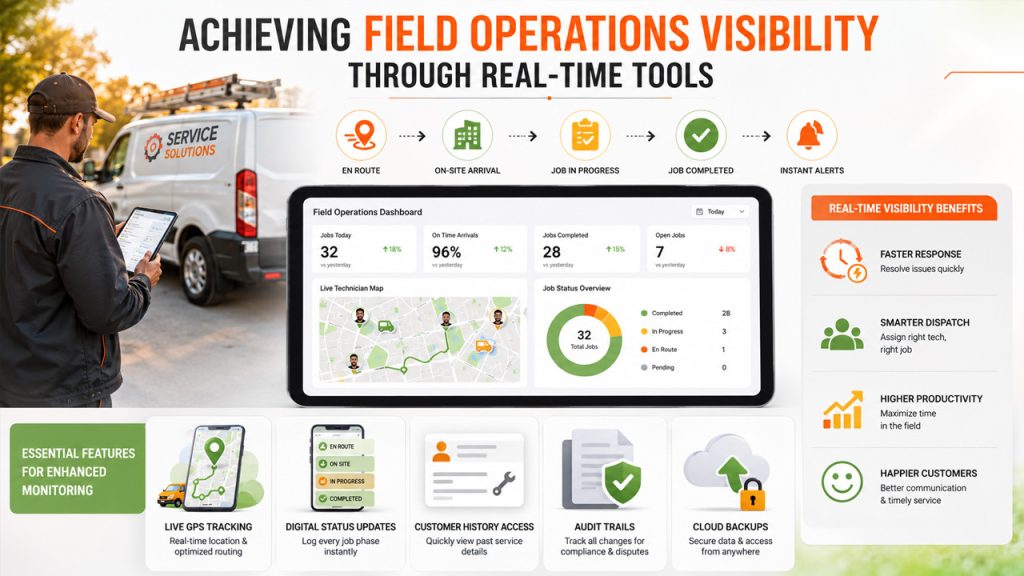
Clear oversight into field activities forms the backbone of effective management in service industries, where delays or miscommunications can quickly escalate into lost opportunities or dissatisfied clients. Without centralized monitoring, dispatchers often grapple with outdated information, leading to poor decision-making and inefficient reallocations.
Real-time performance dashboards display metrics such as estimated arrival times, current workloads, and completion rates, all updated instantly as field teams interact with mobile applications. Job updates, including en route notifications, on-site arrivals, and task completions, feed directly into the system, which then notifies relevant parties through automated alerts.
This level of field operations visibility empowers office staff to intervene promptly, reassign tasks based on proximity or skills, and maintain schedule integrity even during unexpected disruptions.
Essential Features for Enhanced Monitoring
To maximize visibility, focus on systems that include:
- Live GPS tracking for precise location data and optimized routing decisions
- Digital status buttons that log each job phase in real time, syncing across devices
- Integrated customer history access, enabling quick reference to prior service details
- Audit trails that record all changes for compliance and dispute resolution
- Cloud-based backups to protect data integrity and facilitate remote access
Comparing Manual Versus Automated Visibility Approaches
| Aspect | Manual Methods | Instantly, as events occur |
|---|---|---|
| Data Update Frequency | Periodic, often end-of-day | Instant, as events occur |
| Technician Location | Relies on calls or self-reports | GPS-enabled, continuous tracking |
| Job Progress Insight | Limited to verbal updates | Dashboards with visual status indicators |
| Error Rate | High due to human entry | Low, with automated logging |
| Response Time to Issues | Delayed, reactive | Proactive, with immediate alerts |
Implementing Service Workflow Optimization for Long-Term Control
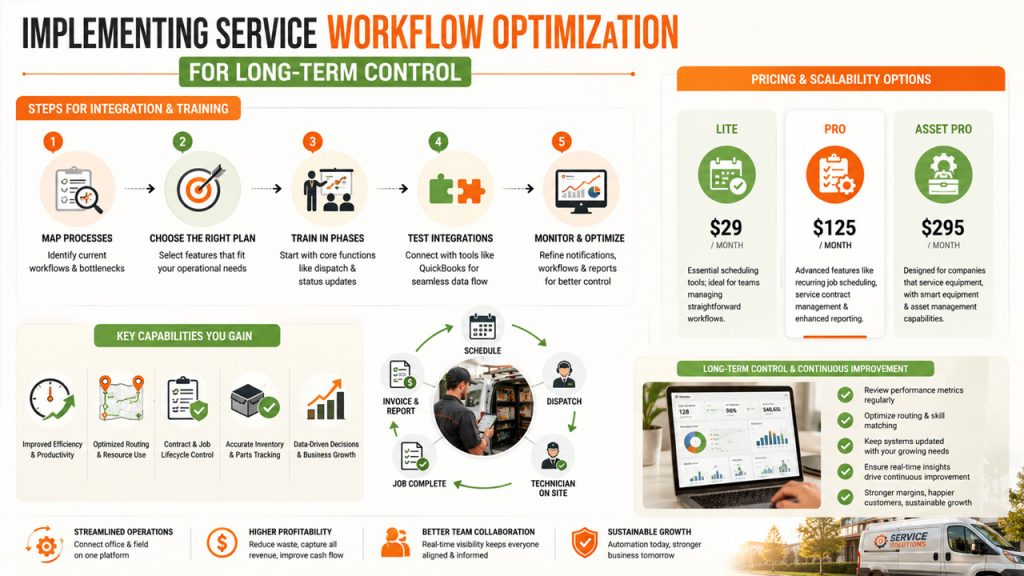
Effective rollout of automation requires careful planning to align with existing processes in facility management, commercial HVAC, or security services. Begin by assessing current workflows to identify bottlenecks, such as manual dispatching or disjointed inventory handling. This evaluation guides the selection of features like recurring job scheduling, contract management, and parts tracking that integrate seamlessly with daily operations.
In practice, training plays a critical role in adoption. Start with office staff mastering job assignments and real-time technician tracking, followed by field teams learning to view assignments, update statuses, and log materials used. Standardized systems simplify this process, as consistent materials eliminate the need for documenting unique setups.
Steps for Integration and Training
- Map out current processes to pinpoint automation opportunities
- Choose a plan based on operational complexity, from basic scheduling to advanced asset management
- Train in phases, focusing first on core functions like dispatch and status updates
- Test integrations with tools like QuickBooks for smooth data flow
- Monitor initial use to refine notifications and reporting
Evaluating Pricing and Scalability Options
When evaluating options, consider how the software scales. Basic tiers are often ideal for essential scheduling, mid-level tiers handle recurring contracts, and advanced tiers are necessary for businesses that require full equipment and asset management.
| Plan Type | Monthly Cost | Key Features |
|---|---|---|
| Lite | $29 | Designed for companies that service equipment, it includes enhanced field operation features together with smart equipment and asset management. |
| Pro | $125 | Advanced operational features, such as recurring job scheduling, service contract management and enhanced reporting, to support more complex operations. |
| Asset Pro | $295 | Designed for companies that service equipment, includes enhanced field operation features together with smart equipment and asset management. |
On the other hand, long-term control emerges from ongoing adjustments, such as reviewing performance metrics to optimize routing or skill matching. Regular updates ensure the system evolves with business needs, preventing stagnation. The result is sustained service workflow optimization that supports growth and adaptability.\
Ultimately, embracing service business automation fosters a resilient operation where real-time insights drive continuous improvement, securing profitability well into the future.
Securing Long-Term Profitability with Service Business Automation
The path to stronger margins and tighter operational control lies in adopting tools that deliver genuine visibility and streamlined processes. From streamlined drag-and-drop scheduling and live technician tracking to accurate parts logging and automatic financial syncing, these capabilities reduce waste, capture full revenue, and enable proactive management.
Businesses that implement such systems consistently report higher technician utilization, fewer rescheduled visits, and more reliable customer experiences. In the end, service business automation represents a practical investment in efficiency that scales with growth. It transforms reactive firefighting into strategic oversight, positioning field service operations for sustained profitability and resilience in competitive markets.