
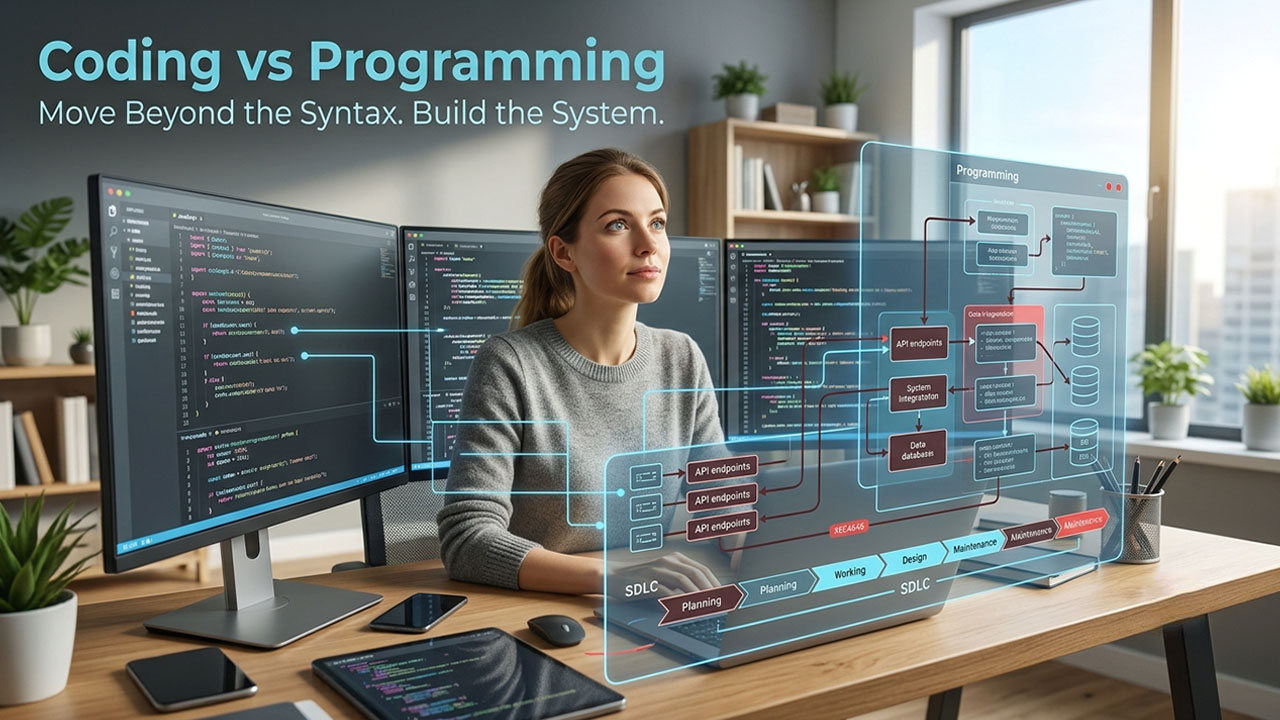
Coding vs Programming: What’s the Difference? (Complete Guide for Beginners)
Understand coding vs programming with this complete guide. Learn the key differences, required skills, career paths, and how coding fits into software development.
When you ask ten people what the difference is between coding and programming, you’ll probably get ten different answers. Some will say they’re the same thing, while others will insist that coding classifies as a “beginner” version, and programming is the “real” job. And a few will just avoid answering. This confusion makes sense because these two words get used interchangeably in job listings, tutorials, and casual conversation all the time.
Coding vs programming isn’t about rivalry. They are not even a fully separate category. You can think of them as two points on the same spectrum of building software. Every programmer codes; however, not every coder programs. Once you understand where each one sits on the spectrum, you’ll stop being confused between them. So, let’s break it down properly.
What Is Coding?
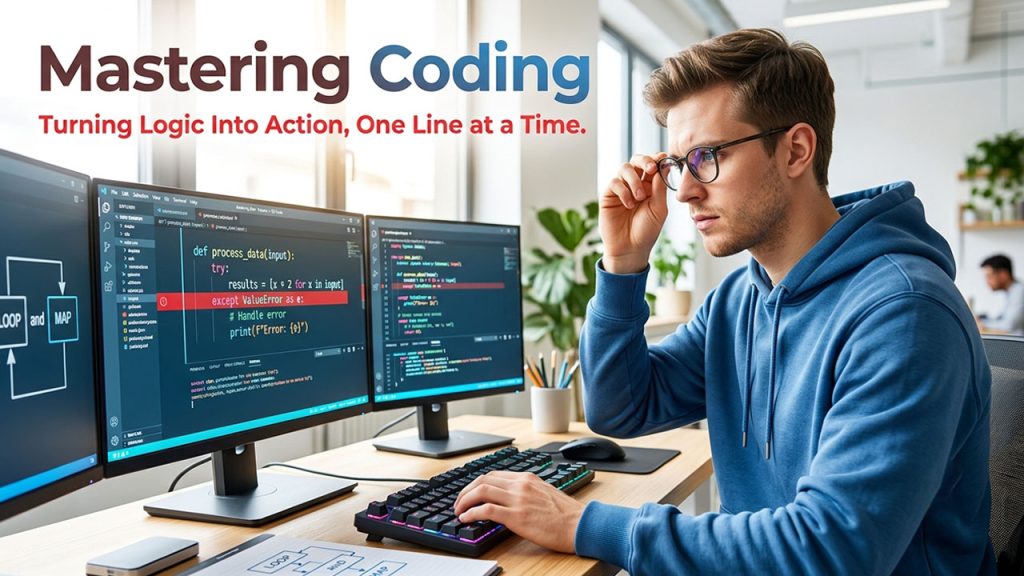
Coding, in simple language, is the act of writing instructions in a language that a computer can understand. You are translating an idea, say, “add these two numbers,” into syntax that a machine can actually execute.
It needs more hands-on practice than people often assume. A coder writes lines of code, tests small chunks, fixes typos, and makes sure the syntax works properly. It’s precise, detail-oriented work, and it doesn’t necessarily need you to understand the bigger picture of what you’re building. You could code a single function perfectly without ever knowing how it fits into the larger application around it. Coding is a legitimate skill on its own. Often, it is the entry point for people who are learning software development for the first time.
How Coding Works: Step-by-Step Process
Most times, coding follows a predictable path, even if the specific task changes every time. Here’s how the process usually works:
- Write the Correct Syntax: You must use the specific rules and structure of the language that you’re working with. When you get the syntax wrong, nothing runs regardless of how good the logic behind it is.
- Translate Logic into Code: Then you have to take an algorithm or a design and convert it into actual code. This is where abstract thinking turns into concrete instructions.
- Debug and Fix Errors: Errors are bound to show up. You have to identify the issues and fix them so it works the way it’s supposed to.
- Run and Verify the Output: You execute the code and confirm that it actually produces what you expected.
- Integrate the Code into the Application: Once a piece of code works, apply it to the larger software system where it belongs.
Now, did you notice that none of these steps ask, “How does this fit into the entire system?” Because that question belongs to programming, which brings us to the next part.
What Is Programming?

Coding is narrower, while programming is the bigger picture. It does include coding, but it also plans, designs, structures, tests, and maintains an entire piece of software from start to finish. A programmer does more than just code. They figure out what needs to be built, how different components should be connected to each other, and how the whole system performs as one once it’s live.
If coding is writing a sentence, programming is writing the entire book. It decides the plot, the characters, how each chapter connects, and makes sure that it all makes sense by the final page. Programming demands a working knowledge of algorithms, system design, and problem-solving that goes well beyond getting one function to run correctly.
How Programming Works: The Complete Development Process
Programming starts before a single line of code gets written and continues long after, and this entire journey is what makes up the software development life cycle. Here’s how the process typically unfolds:
- Identify and Define the Problem: Before even start typing, a programmer plans out what’s actually being solved and designs an approach that works.
- Design the Algorithm: It means laying out the step-by-step logic or instructions that will eventually become code, before syntax enters the picture.
- Plan the System Architecture: Now comes the planning. Think about how the different parts of the software will connect. What connects to what? This is where you have to map the overall structure.
- Implement the Solution Through Coding: This is the point where coding actually happens. You write the code based on all the designs, algorithms, and system architecture.
- Test the Complete Software System: After programming, test the whole system, not just individual functions, to check how each piece behaves together once it’s connected.
- Optimize Performance: Once you confirm it’s working, go back and improve it, make it faster, cleaner, and more efficient.
Now, notice that coding shows up only in one stage in the list. Coding lives inside programming as a smaller circle inside a much bigger one. That’s really what code in programming means.
Coding vs Programming: Key Differences Explained
Related walkthrough
The Future of AI Coding: Building a 3D Game with Codex macOS App (7 Million Tokens!)

To better understand coding vs programming, let’s compare their key differences side by side.
| Aspect | Coding | Programming |
|---|---|---|
| Scope | Narrow: writes specific instructions | Broad: plans and builds entire systems |
| Focus | Syntax and execution | Logic, design, and architecture |
| Definition | Translating an idea into machine-readable syntax | Planning, building, and maintaining a complete software solution |
| Tools involved | A programming language, an editor | Languages, frameworks, design tools, testing suites |
| Process involved | Write, run, fix. A tight, repeatable loop | Follows the full software development life cycle (SDLC) |
| Output | Functional lines of code | A complete, working software product |
| Mindset | “Does this work?” | “Does this solve the problem well?” |
| Time horizon | Task-based, often short | Project-based, often long-term |
| Level of abstraction | Works at the line-by-line, function level | Works at the system and architecture level |
| Typical starting point | Where most beginners enter software development | Where developers grow once they understand the bigger picture |
| Error handling | Debugging individual lines or functions | Diagnosing issues across interconnected components |
| End goal | A working piece of code | A working, scalable, maintainable system |
Neither one is “better” than the other. They’re just different altitudes of the same work. Coding keeps you close to the details, line by line. Programming asks you to step back and look at the whole picture.
Essential Skills Required for Coding and Programming
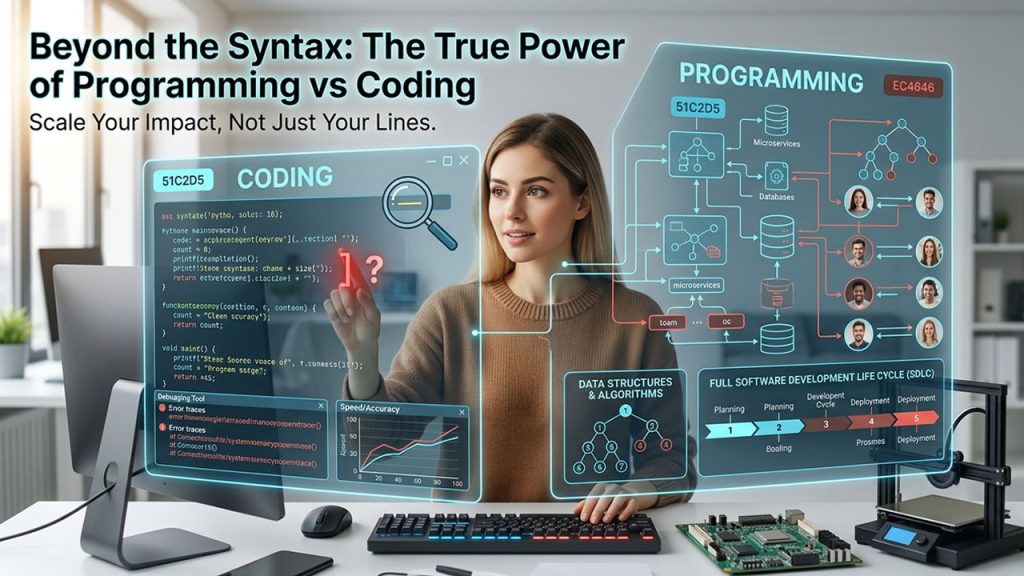
Explore the essential skills that distinguish coding from programming and the expertise each path requires.
Essential Skills for Coders
- Strong knowledge of the syntax of different languages.
- Eye for detail because even a single misplaced bracket can break everything.
- Comfort with debugging tools and troubleshooting skills to find and fix issues.
- Speed and accuracy in writing clean, functional lines of code
- Must understand basic coding concepts and logic to follow instructions
Essential Skills for Programmers
- System design and architecture thinking to plan how different parts of a system will connect and work together smoothly
- Problem-solving at a project level, not just a line-by-line level, to solve challenges across the entire application.
- Understanding of the full software development life cycle from planning to deployment.
- Communication skills, since programmers often coordinate with designers, product managers, and other developers
- Familiarity with data structures and algorithms for building efficient, scalable systems
Career Roles in Coding vs Programming
This is where the distinction matters most, because it shapes what kind of job title you’re looking for:
Common Coding-Focused Career Roles:
- Junior Developer: They focus on executing tasks that are given by senior programmers.
- Coding Bootcamp Graduates: They usually start in entry-level roles where the focus is on applying what they just learned, one project at a time.
- Freelance Scripters: They take on small, specific jobs like automating a repetitive task or writing a script to pull data without having to manage an entire system.
- QA Testers: They write test scripts to check whether a piece of software actually does what it’s supposed to. They catch bugs before they reach real users.
- Web Developers: They build and style the pages people actually interact with, writing the front-end code that makes a website look and function the way it should.
Common Programming-Focused Career Roles
- Software Engineers: They design and build complete applications from the ground up, making decisions about structure and logic that hold the whole project together.
- Web Developers (full-stack): They plan both the front-end experience and the back-end logic, connecting how a site looks with how it actually works behind the scenes.
- Systems Architects: They map out how large software components fit and communicate with each other, thinking several steps ahead of any single feature.
- Technical Leads: They oversee a project’s structure from the earliest planning stages right through to deployment, making sure everything stays aligned along the way.
In practice, people often start with coding, learn syntax, find bugs, follow instructions, and gradually grow into programming, where they make bigger calls.
Conclusion
The Coding vs Programming debate is not about picking a side. Coding is the practice of writing instructions precisely enough that a machine can follow. Programming, on the other hand, is the discipline of designing, building, and maintaining those systems in which instructions live. One feeds into the other, and most people working in software today do a bit of both, just in different proportions depending on where they are in their career.
So, instead of asking whether you’re a coder or a programmer, ask how far along the spectrum I am, and where do I want to go next? This question is far more useful and matters a lot more than the label that you put on your job title.
FAQs About Coding vs Programming
Q. Is coding a part of programming?
Yes, coding is one step within the much larger process of programming.
Q. Can you be a coder without being a programmer?
Yes, many roles only require writing and testing code without full system design responsibilities.
Q. Which pays more, coding or programming?
Programming roles generally pay more, since they demand broader skills and greater responsibility.
Q. Do I need a degree to start coding?
No, many successful coders start with self-teaching or a coding bootcamp instead of a formal degree.
Q. What programming languages should beginners learn first?
Python and JavaScript are commonly recommended for beginners due to their readability and wide use.